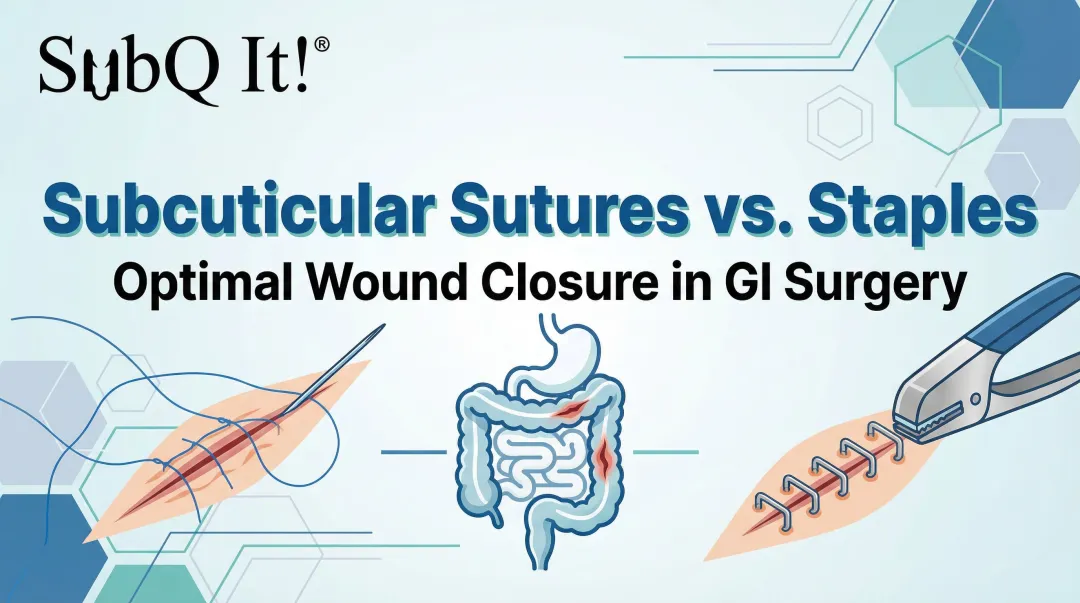

Skin closure in anterior hip surgery, though often considered routine, directly affects operative time, wound consistency, follow-up, and cosmetic outcomes.
As arthroplasty volumes rise and hip fractures are projected to exceed 4.5 million annually by 2050, the choice of closure method increasingly influences operating room efficiency and postoperative workflow.
In high-volume anterior hip programs, this decision also affects turnover and recovery pathways, particularly with early mobilization protocols.
While metal staples provide speed and consistency, they require removal and may result in different cosmetic outcomes compared with subcuticular sutures.
In this blog, you’ll explore how sutures and staples are used in anterior hip surgery incisions and examine their impact on efficiency, wound outcomes, and postoperative management.
Key Takeaways:
- Sutures provide precise dermal approximation and are typically preferred when cosmetic outcomes and avoidance of removal are priorities.
- Staples enable faster, more standardized closure, supporting Operating Room efficiency in high-volume anterior hip procedures.
- Staples require a follow-up removal visit, adding to postoperative workload and patient management.
- In anterior hip surgery, closure decisions are influenced by incision location, early mobilization protocols, and workflow demands.
- Closure method selection depends on balancing efficiency, cosmetic outcomes, and postoperative management requirements within specific surgical settings.
Sutures Or Staples in Anterior Hip Surgery Incisions: Quick Comparison in 2026
When selecting a closure method for anterior hip surgery incisions, surgeons evaluate trade-offs between efficiency, cosmetic outcomes, and postoperative management.
The comparison below outlines clinically supported differences between sutures and staples.
| Feature | Sutures | Staples (Metal) |
|---|---|---|
| Closure Speed | Slower, technique-dependent | Faster, standardized deployment |
| Cosmetic Outcome | Typically, better cosmetic outcomes are achieved with subcuticular techniques | Associated with visible puncture marks (“train-track” appearance) |
| Removal Requirement | Absorbable sutures do not require removal; non-absorbable sutures may require follow-up removal | Always require removal within 7 to 14 days after surgery |
| Infection Risk (Hip Arthroplasty) | Lower risk of superficial surgical site infection | Higher risk of superficial surgical site infection |
After outlining the key differences, a closer look at the practical use of sutures in anterior hip procedures provides added clarity.
How Are Sutures Used in Anterior Hip Surgery Incisions?
Sutures are used to approximate wound edges during anterior hip surgery, enabling controlled healing through primary intention. They maintain precise tissue alignment while supporting natural biological healing processes.
Types of Sutures Used in Anterior Hip Surgery Incisions
1. Absorbable vs. Non-Absorbable:
- Absorbable sutures (e.g., Monocryl, Vicryl) degrade naturally and do not require removal
- Non-absorbable sutures require removal in a follow-up visit, depending on healing
2. Material Composition:
- Monofilament sutures reduce tissue drag and bacterial adherence
- Braided sutures offer improved knot security but may increase bacterial adherence
- Synthetic materials such as poliglecaprone 25 provide predictable absorption profiles
Advantages & Limitations of Sutures
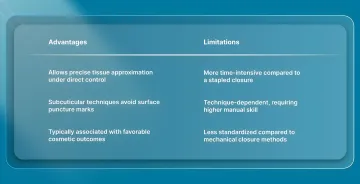
Sutures in anterior hip surgery provide precise control over tissue approximation but require more time and technical skill during closure.
While sutures remain a common choice, staples are also widely used in anterior hip procedures.
How Are Staples Used in Anterior Hip Surgery Incisions?
Staples are used for rapid skin closure in anterior hip surgery, allowing consistent approximation of wound edges with reduced technique variability compared to suturing.
In high-volume hip arthroplasty settings, faster closure supports operating room efficiency and early postoperative mobilization.
Types of Staples Used in Anterior Hip Surgery Incisions
Staplers used in anterior hip procedures are typically disposable, handheld devices designed for rapid skin closure. Selection is based on incision length and procedural requirements.
1. Device Configuration:
- Single-use skin staplers are commonly used in hip arthroplasty
- Designed for rapid deployment during final closure
- Available in multiple staple counts to match incision length
2. Staple Characteristics:
- Made from medical-grade stainless steel
- Designed to penetrate the epidermis and secure wound edges externally
- Applied across the incision to provide uniform skin approximation
In addition to traditional metal staplers, subcutaneous bioabsorbable systems such as SubQ It! SU-25 is designed for longer incisions, delivering dermal fasteners beneath the skin surface while eliminating the need for removal.
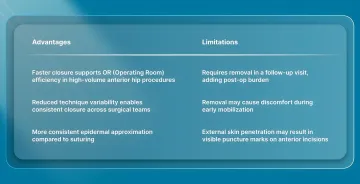
Advantages & Limitations of Staples
Staples provide rapid and standardized closure in anterior hip surgery, but their impact must be evaluated in the context of incision location, early mobilization, and postoperative management.
Looking at how each is applied in surgery helps frame the discussion around which option may be preferable.
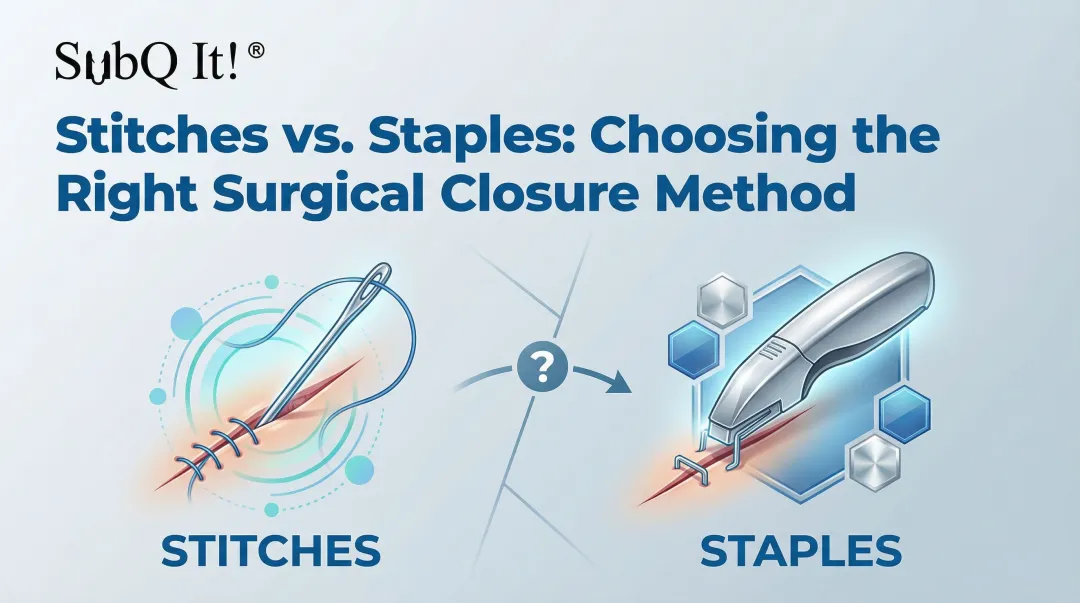
Sutures vs. Staples: Which is Better for Anterior Hip Surgery Incisions?

The optimal closure method for anterior hip surgery incisions depends on multiple clinical and operational factors. Current evidence suggests that outcomes vary based on surgical approach, patient characteristics, and procedural priorities.
1. Key Decision Factors
Surgeons must consider:
- Surgical time constraints and OR efficiency goals
- Cosmetic expectations of patients
- Patient skin quality and healing characteristics
- Surgeon training and technical proficiency
- Institutional protocols and standardized practices
- Approach-specific considerations in Direct Anterior Approach (DAA) procedures
2. Cosmetic Outcomes
Subcuticular sutures are typically associated with more favorable cosmetic outcomes, as they avoid surface puncture marks and support linear scar formation.
However, meta-analyses show no significant difference in standardized cosmetic scoring systems between sutures and staples, indicating that perceived outcomes may vary across patients.
Bioabsorbable subcutaneous closure systems place fasteners beneath the skin, avoiding surface penetration while maintaining rapid deployment.
3. Closure Speed and Efficiency
Staples are consistently faster than sutures for skin closure, reducing procedural time and variability.
While exact time differences vary by surgeon and incision characteristics, faster closure can improve operating room efficiency in high-volume hip arthroplasty settings.
Emerging bioabsorbable closure systems may reduce traditional trade-offs by combining rapid deployment with subcutaneous placement, avoiding removal and minimizing surface scarring.
Final Thoughts
Skin closure in anterior hip surgery extends beyond incision approximation. It continues to influence postoperative workflow, follow-up requirements, and consistency of outcomes across high-volume arthroplasty programs.
As procedural demands increase, the need for closure methods that reduce variability while maintaining efficiency becomes more critical.
In this context, systems like SubQ It! SU-25 is designed for longer incisions in procedures such as anterior hip replacement, delivering up to 25 bioabsorbable fasteners to close wounds up to 25 cm.
By placing fasteners beneath the skin surface without external penetration, the device eliminates the need for removal while maintaining consistent closure.
Contact us today to explore how SubQ It! SU-25 fits into your surgical workflow.
FAQs
1. Are sutures or staples better for anterior hip replacement incisions?
Both sutures and staples are effective, with trade-offs in speed, cosmesis, and follow-up. Evidence remains mixed, and selection depends on surgical priorities and institutional protocols.
2. How to care for an anterior hip replacement incision?
Postoperative care focuses on keeping the incision clean and dry, avoiding immersion, and monitoring for early signs of complications.
3. How long are staples left in after anterior hip replacement surgery?
Staples are typically removed 7–14 days after surgery, depending on the progression of healing and the condition of the incision.
4. What signs of infection should be watched after hip surgery?
After hip surgery, signs include increasing pain, redness, swelling, drainage, or systemic symptoms such as fever. Early identification is critical for preventing complications.
5. Is a shower allowed after anterior hip replacement surgery?
Showering is usually permitted once the incision is sealed, but immersion in baths or pools should be avoided until the wound is fully healed and cleared by the surgical team.
6. Why is a total hip replacement needed with the anterior approach?
It is performed to treat severe arthritis or joint damage causing pain and limited mobility. The anterior approach uses a front-entry approach between muscles, which helps preserve tissue and supports faster recovery.
7. What are the risks of total hip replacement with the anterior approach?
Risks include infection, blood clots, dislocation, fracture, implant issues, and nerve irritation or numbness near the surgical area.
8. What happens during and after a total hip replacement with the anterior approach?
During surgery, the damaged joint is replaced with an artificial implant through a front incision without cutting major muscles. After surgery, patients usually begin walking early, follow rehabilitation, and gradually regain mobility over several weeks.