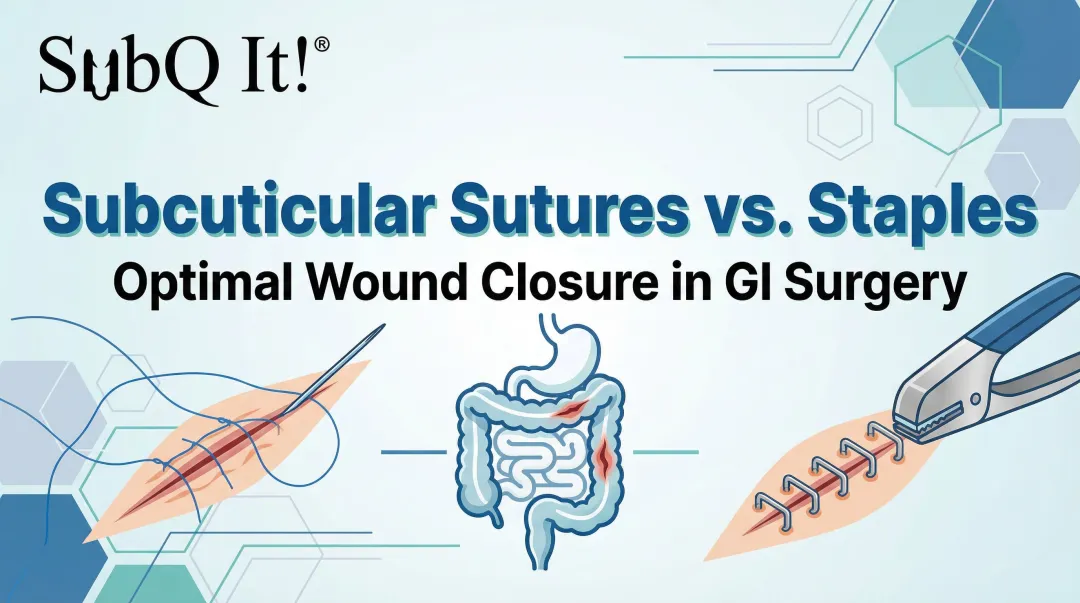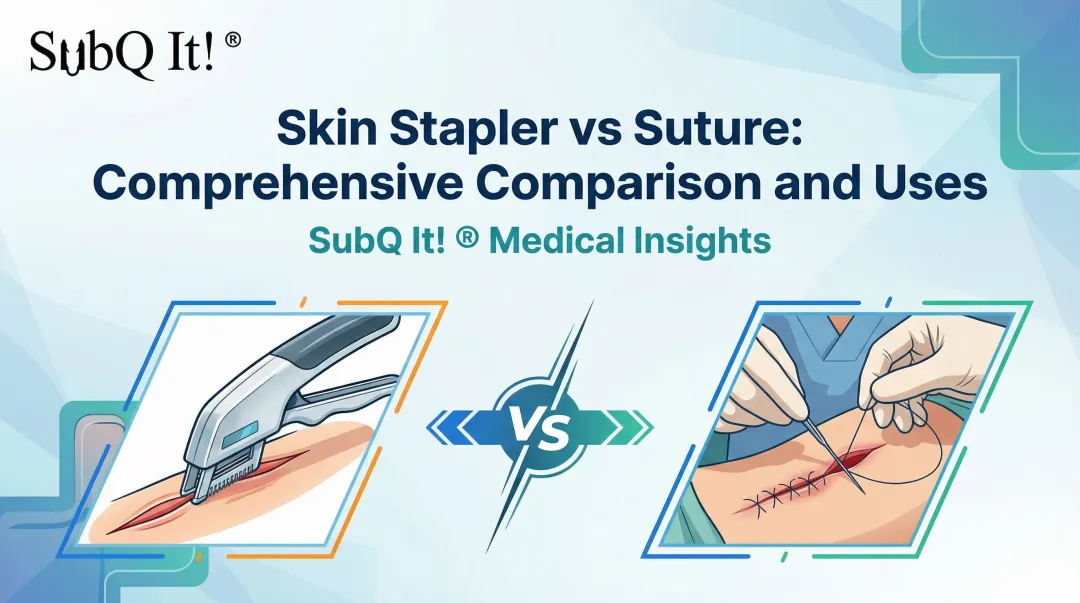
The method used for skin closure directly influences operative efficiency, tissue approximation, and follow-up requirements. Accordingly, the choice between sutures and skin staples affects both workflow and post-operative outcomes.
Comparative studies report closure times of roughly 7.17 minutes for staples versus about 13.93 minutes for sutures, showing the time advantage of mechanical closure.
This contrast reflects their different roles in practice. Sutures offer precise tissue approximation, while staples prioritize speed and consistency. The decision, therefore, depends on wound characteristics and surgical priorities.
In this blog, you’ll explore sutures versus skin staples and how surgeons determine the most appropriate method in clinical settings.
Key Takeaways:
- Sutures and skin staples show similar overall complication rates in many procedures, but differences can appear depending on the surgical context, such as cesarean delivery or orthopedic cases.
- Staples consistently reduce skin closure time, making them useful in emergency, trauma, and high-volume surgical settings.
- Sutures allow precise control over tension and edge approximation, which is important for cosmetic outcomes and layered closure.
- Closure method selection depends on wound location, tension, depth, and post-operative considerations rather than a single superior technique.
- Post-operative workflow, including the need for removal visits and access to follow-up care, plays a practical role in choosing between sutures and staples.
Sutures Versus Skin Staples for Skin Closure: Quick Comparison
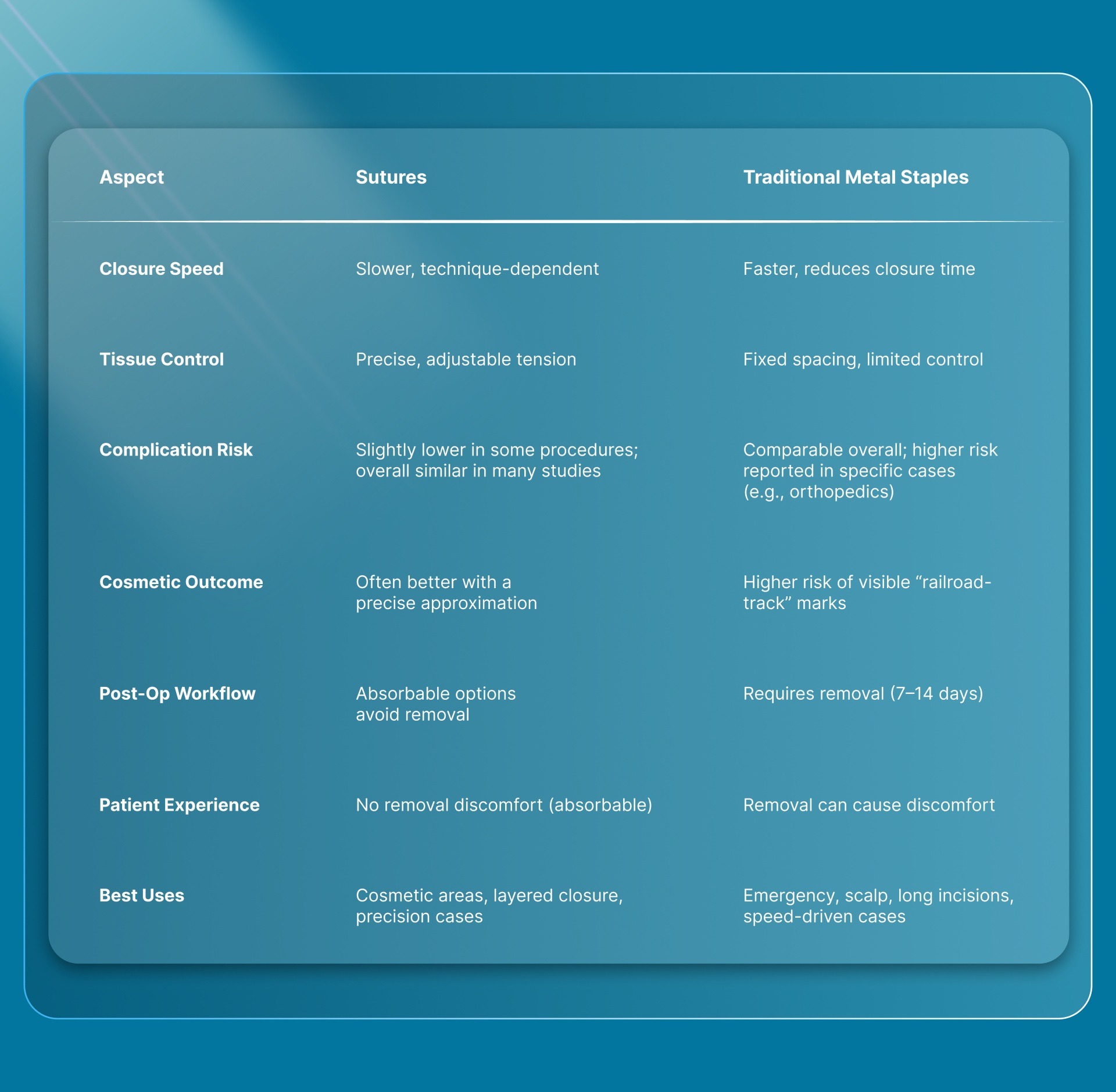
When evaluating sutures versus skin staples for skin closure, surgeons balance closure time, tissue control, cosmetic outcome, and postoperative workflow.
The choice is not about preference. It is about how each method performs under specific intraoperative conditions and patient requirements.
The table below summarizes the key differences that directly influence surgical decision-making.
How Sutures Perform in Skin Closure?
When comparing sutures versus skin staples for skin closure, sutures are selected when precise tissue approximation and tension control are required.
Their effectiveness depends on the surgeon's technique, which allows flexibility in closure but can introduce variability across cases.
The following sections outline how sutures function in practice and where they provide the most clinical value.
1. Categories and Materials
Sutures are classified based on their degradation profile, which directly influences post-operative management and the need for removal.
- Absorbable sutures: Gradually lose tensile strength and are degraded through hydrolysis (synthetic) or enzymatic processes (natural), eliminating the need for removal
- Non-absorbable sutures: Retain tensile strength over time and require removal when used for skin closure
Common materials used in surgical skin closure include:
- Polyglactin 910 (Vicryl): Braided absorbable, commonly used in subcutaneous layers
- Polydioxanone (PDS): Monofilament absorbable, suitable for higher-tension closures
- Nylon and Polypropylene: Monofilament non-absorbable, widely used for external skin closure
- Silk: Natural braided material with good handling characteristics but higher tissue reactivity
2. Clinical Performance in Skin Closure
Sutures enable controlled approximation of wound edges, which is important in procedures where alignment and tension influence healing and cosmetic outcome.
It has been observed that there is a lower infection or wound separation risk with sutures. This indicates that sutures are not universally superior but are often preferred when precise tissue handling is required.
In procedures involving longer incisions, this need for precision often comes at the cost of increased closure time.
This led to the adoption of device-assisted approaches such as SubQ It! SU-25 aims to maintain controlled approximation while reducing manual suturing time.
3. Advantages of Sutures
Here are the key advantages of sutures in skin closure:
- Controlled edge approximation: Supports improved cosmetic outcomes, particularly in subcuticular closure
- Versatility: Suitable for layered closure and a wide range of incision types
- Material flexibility: Enables selection based on depth, tension, and healing requirements
4. Where Are Sutures Preferred
Sutures are typically selected when surgical priorities extend beyond speed to include control, cosmesis, and layered closure requirements.
- Cosmetically sensitive areas: Facial procedures and plastic surgery
- Low-tension wounds: Where precise approximation supports healing
- Layered closures: Deep or complex wounds requiring fascial and dermal support
- Procedures with higher infection sensitivity, Such as cesarean sections and certain orthopedic cases
How Skin Staples Perform in Surgical Closure?
When speed and procedural efficiency are prioritized, skin staples are selected over sutures.
Their mechanical application reduces closure time but limits the degree of control over tissue approximation.
The following sections explain how staples function and where their advantages are most relevant.
1. Mechanism and Application
Skin staples are metal fasteners, typically made of stainless steel or titanium, applied using a stapling device that approximates wound edges through the skin surface.
- Staples are driven through the skin and formed into a closed shape
- This enables rapid approximation of wound edges with minimal manual handling
- Placement is external, requiring removal after initial healing
2. Clinical Performance in Skin Closure
The primary advantage of staples is reduced closure time. Staples can shorten skin closure compared to sutures, particularly in long linear incisions.
It has been observed that certain contexts, such as orthopedic surgery, carry a higher risk of infection. This makes staples more suitable for efficiency-driven cases rather than precision-driven closures.
3. Advantages of Staples
Here are the key advantages of staples in skin closure:
- Consistent application: Uniform spacing and closure pattern
- Reduced handling time: Minimizes time spent on manual suturing
- Ease of use: Shorter learning curve compared to suturing techniques
4. Where Are Staples Preferred
Staples are typically used when speed and efficiency outweigh the need for precise control or cosmetic optimization.
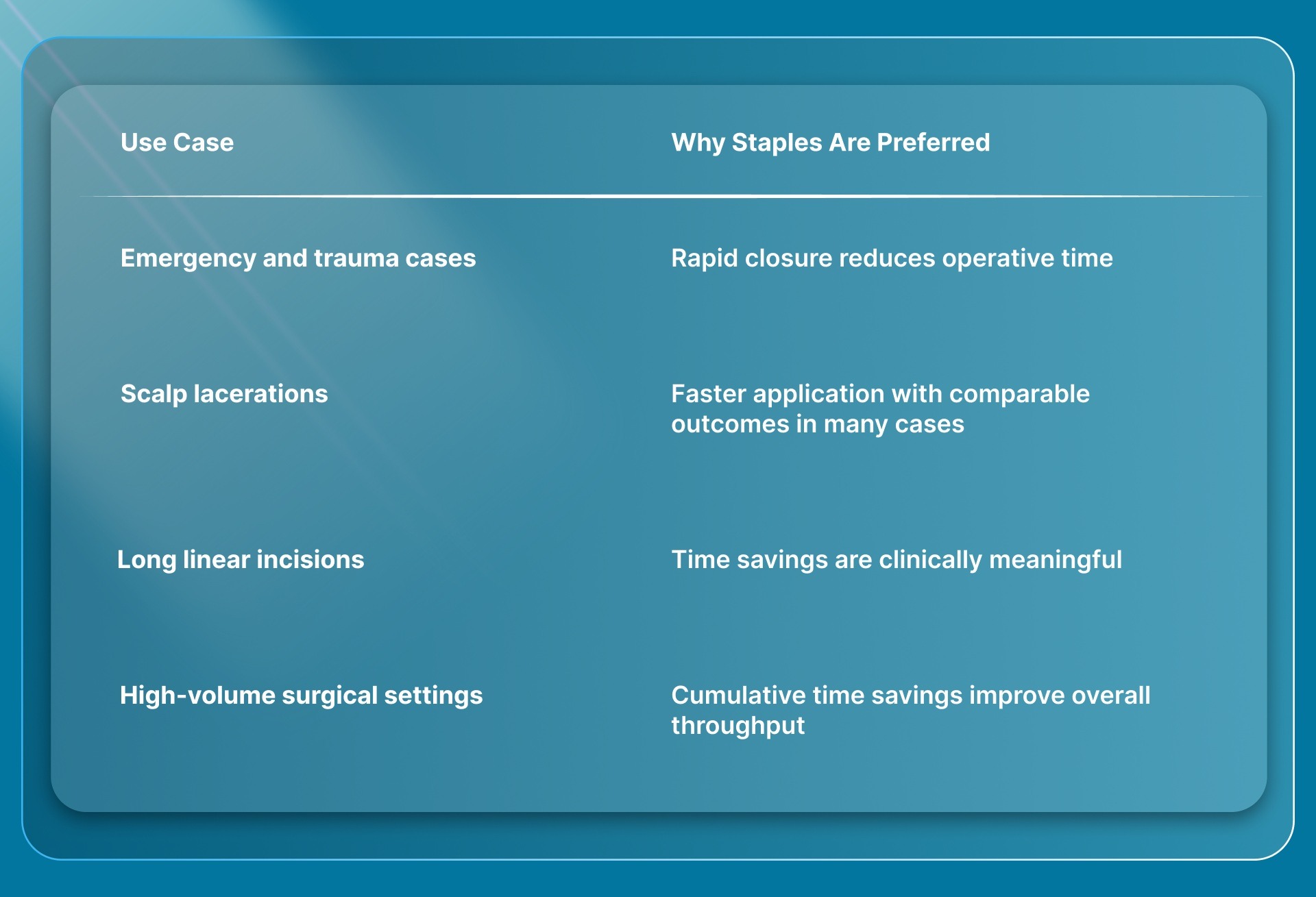
Evaluating how skin staples function in surgical closure provides context, but comparison with sutures ultimately shapes the choice.
Sutures Versus Skin Staples for Skin Closure: What Guides the Decision
When comparing sutures versus skin staples for skin closure, neither method is universally superior across all procedures.
The decision depends on wound location, tissue characteristics, closure depth, cosmetic priorities, operating room efficiency, and post-operative management requirements.
The factors below reflect how these choices are typically made in surgical practice.
1. Wound Location and Cosmetic Priority
Closure method selection often depends on the incision's visibility and the importance of scar quality to the overall outcome.
- Face, neck, and other visible areas: Sutures are commonly preferred because they allow more precise edge approximation and are often used when scar quality is a priority.
- Lower-visibility areas: Staples are often acceptable when cosmetic demands are lower and faster closure is useful.
- Cosmetically sensitive procedures: Subcuticular suturing is commonly used to optimize scar appearance while avoiding external staple marks.
2. Wound Tension and Depth
The mechanical characteristics of the wound, including tension and depth, directly influence whether sutures or staples can provide stable closure.
- High-tension wounds: Both sutures and staples can fail if tension is not appropriately managed, so layered closure or reinforcement may be necessary.
- Deep incisions: Sutures are required for the fascial and dermal layers because skin staples are used only for superficial skin approximation.
- Superficial, low-tension wounds: Either method may be appropriate, with the choice often driven by speed, cosmetic goals, and follow-up needs.
3. Tissue Quality and Patient Factors
Patient-specific factors such as skin integrity and healing capacity influence how well each closure method performs.
- Fragile or thin skin: Sutures allow more controlled adjustment of bite size and tension, which may be helpful when the surgeon wants to minimize skin edge tearing.
- Patients with heightened concern about wound complications: Sutures may be preferred where the risk of infection or wound separation is lower than with staples.
- Pediatric patients: Absorbable sutures are often used to avoid a return visit for removal.
4. Surgical Efficiency and OR (Operating Room) Priorities
In many cases, the choice between sutures and staples is influenced by operating room efficiency and time constraints.
- Emergency and trauma settings: Staples are often used when speed of closure is a priority because they generally reduce skin-closure time.
- Elective procedures: Sutures are often chosen when time permits, to prioritize precise tissue approximation and scar control.
- High-volume settings: Closure choice may also reflect cumulative time savings across multiple cases.
5. Post-Operative Workflow Considerations
Closure choice also affects post-operative care requirements and overall workflow for both the surgeon and the patient.
- Follow-up requirements: Skin staples usually require removal after initial healing, while absorbable sutures do not. Staples and other nonabsorbable closures are commonly left in place for about 7 days or longer.
- Access to care: When follow-up is uncertain, absorbable closure may reduce logistical burden.
- Practice workflow: Staple removal adds an additional post-operative step for the practice and the patient.
Based on published comparisons and standard surgical practice, the choice can be framed as follows:
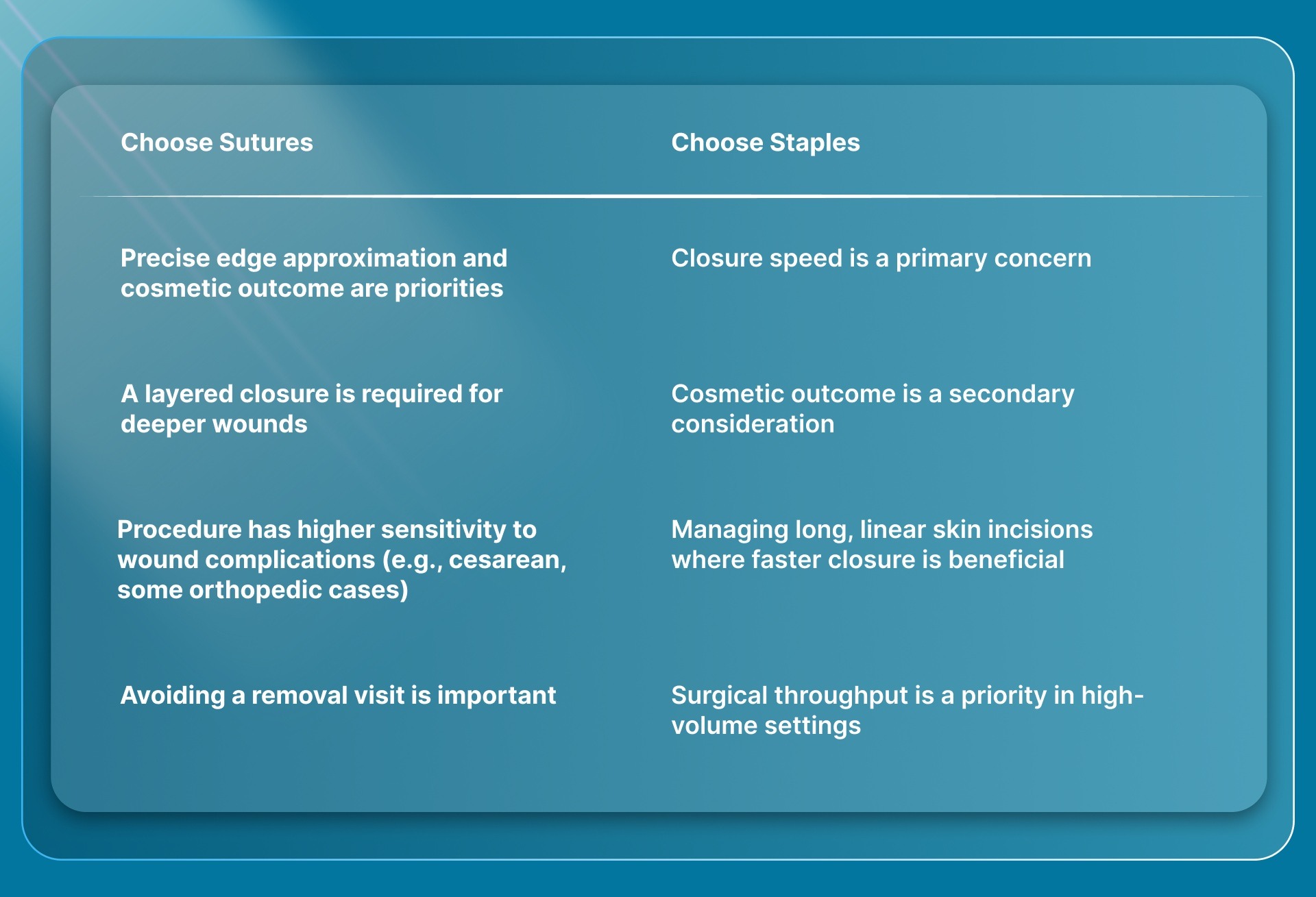
Final Thoughts
Skin closure in surgical procedures does not end with wound approximation. It continues to influence operating room efficiency, postoperative workflow, and the consistency of outcomes across cases.
As procedural demands increase, the need to reduce closure time without compromising control becomes more relevant in routine surgical practice. This is where approaches that go beyond the traditional sutures-versus-staples trade-off start to play a role.
In this context, systems like SubQ It! SU-25 provides a subcutaneous, device-assisted method for closing incisions up to 25 cm, using bioabsorbable dermal fasteners that are placed beneath the skin surface.
Contact us to learn how SubQ It! SU-25 can support more efficient closure while maintaining control over surgical outcomes in your practice.
FAQs
1. When is it more appropriate to use sutures instead of skin staples for closure?
Sutures are generally used when the surgeon needs more control over how the wound edges are aligned and how tension is distributed. This is particularly relevant in cosmetically sensitive areas or when a layered closure is required to support deeper structures.
2. Do sutures and skin staples differ significantly in infection risk?
In many procedures, overall complication rates are similar between the two methods. However, some studies have shown that sutures may be associated with lower infection or wound separation rates in specific contexts, such as cesarean sections or certain orthopedic procedures.
3. How much time difference does staple closure actually make during surgery?
The difference is typically a few minutes per incision, but that can become meaningful in longer procedures or high-volume settings. Staples allow faster mechanical closure, which can help reduce overall operative time in time-sensitive cases.
4. Are there limitations to where skin staples can be used?
Skin staples are primarily used for superficial skin closure and are not suitable for deeper tissue layers. In cases where fascial or dermal support is needed, sutures are still required as part of a layered closure approach.
5. How does the choice of closure method affect post-operative follow-up?
Closure choice can directly influence whether a patient needs to return for removal. Absorbable sutures do not require removal, whereas staples typically need to be taken out after initial healing, adding an extra follow-up step.
6. What factors do surgeons typically consider when choosing between sutures and staples?
The decision is usually based on a combination of wound characteristics, such as location, tension, and depth, along with procedural priorities like speed, cosmetic outcome, and follow-up requirements. It is rarely based on a single factor alone.