
Introduction
Skin closure in cesarean sections may seem routine, yet it directly affects operative time, surgical consistency, follow-up requirements, and visible outcomes. With skin wound complications occurring in 3–15% of cases, the choice of closure method has clear clinical and operational implications.
In high-volume settings, even small differences in speed and technique can affect workflow efficiency and introduce variability.
Metal staples are therefore widely used for their speed and consistency. However, they require removal, penetrate the skin surface, and may produce different cosmetic outcomes compared with subcuticular techniques.
In this blog, you’ll explore how surgeons compare dissolving staples for C-sections with traditional staples, with a focus on healing support and recovery outcomes.
TLDR:
- C-section staples are metal devices used for skin closure, applied at fixed intervals to support alignment and early healing.
- Staples are widely used because they enable rapid, standardized closure in high-volume surgical settings.
- Healing with staples involves early support, removal in the initial phase, and gradual tissue strengthening as scar formation progresses.
- Staples have limitations as they stay on the skin, require removal and follow-up, and may cause more visible scarring.
- Dissolving staples sit beneath the skin, avoiding removal, reducing follow-ups, and supporting cleaner healing with less scarring.
What Are C-Section Staples?
C-section staples are metal skin closure devices, typically made of stainless steel, used to approximate the outer layer of a cesarean incision.
They are applied after deeper layers, including the uterus and fascia, are closed with absorbable sutures, while muscle closure may vary by surgical technique.
After the internal layers are closed, the next step is to secure the skin with C-section staples, which promote precise closure and optimal healing.
Skin Staple Placement in Cesarean Section Closure
Staples are placed using a mechanical applicator to approximate skin edges at consistent intervals, ensuring uniform epidermal alignment and eversion. Their role is limited to cutaneous closure, while tensile support is maintained through sutured closure of deeper layers.
As clinical practice changes, comparative research is helping clarify how different skin closure approaches influence operative efficiency and post-operative recovery.
Real Case Study
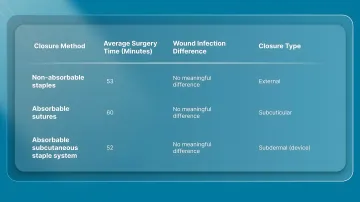
A 2025 retrospective cohort study reviewing 31,660 cesarean deliveries compared three skin closure methods: non-absorbable staples, absorbable sutures, and absorbable subcutaneous staple systems.
The study found that absorbable subcutaneous staples were associated with slightly shorter surgery times (52 minutes) than non-absorbable staples (53 minutes) and sutures (60 minutes). There were no meaningful differences in wound infection rates between the groups.
This suggests that while traditional staples remain a fast and practical option for skin closure, newer absorbable staple systems may offer similar safety outcomes while helping reduce recovery-related burdens such as extended hospitalization and follow-up care.
Once you understand what C-section staples are, it provides helpful context for why they are commonly used in skin closure.
Why are Staples Still Common for C-Sections?
Staples are used in C-section skin closure because they provide a fast and consistent method for approximating the outer layer of the incision.
Their mechanical application supports efficiency in operative settings, particularly where reducing closure time is important.
The following factors explain why staples are selected in cesarean procedures:
1. Speed and Operative Efficiency
Staples allow rapid skin closure through a mechanical application process that does not require continuous manual suturing.
- Reduces time spent on manual closure techniques
- Supports efficiency in time-sensitive or high-volume procedures
2. Consistency in Skin Closure
The use of a stapling device introduces a standardized method of closure, reducing placement variability compared to fully manual techniques.
- Mechanical deployment provides uniform spacing.
- Supports consistency across different surgical settings
3. Support for Early Surface Healing
Staples bring skin edges together at defined intervals, maintaining closure during the early phase of healing, while deeper sutured layers provide structural support.
- Supports early surface-level healing
- Functions alongside the internal closure of deeper tissues
4. Familiarity Within Surgical Workflows
Staples are widely used in surgical skin closure and fit within established workflows.
- Commonly used across surgical procedures such as total joint arthroplasty, laparotomy, trauma surgery, and cardiothoracic or vascular access incisions.
- Integrated into routine operative protocols
The reasons for choosing staples are closely linked to how recovery typically progresses.
C-Section Healing Timeline With Staples: What to Expect
Recovery after a C-section follows a predictable pattern, but when staples are used, the healing process includes distinct steps such as external support and removal.
The timeline below outlines what typically happens week by week, so you know what to expect at each stage.
Week 1: Early Healing and External Support
Early healing is characterized by inflammation, swelling, and initial tissue bonding. The incision is held together through external staples, while the underlying layers provide structural support.
Post-operative monitoring focuses on wound integrity, drainage, and early signs of separation.
Staples are typically removed during this phase, usually between 24 and 48 hours, depending on the type of incision and the rate of healing.
On the other hand, subcuticular systems such as SubQ It! SU-25 places absorbable fasteners beneath the skin, allowing the early healing phase to progress without removal.
Week 2: Surface Closure and Follow-Up Care
After staple removal, the incision transitions from mechanical support to biological healing.
- Adhesive strips may be applied to support skin edges
- Follow-up evaluation ensures proper surface closure
This introduces an additional clinical interaction not required with absorbable closure methods.
Weeks 3-6: Progressive Tissue Strengthening
As collagen deposition increases, tensile strength improves, and functional recovery progresses.
At this stage, recovery may be influenced by:
- Surface appearance of the incision
- Stability of skin edge alignment after staple removal
- Need for continued external support
Beyond 6 Weeks: Ongoing Scar Development
Primary healing is typically complete, while scar maturation continues over several months.
Final appearance depends on patient factors, healing response, and how well early skin alignment was maintained after staple removal.
While proper wound care supports recovery, it is also important to consider the potential limitations associated with C-section staples.
3 Clinical Limitations of C-Section Staples
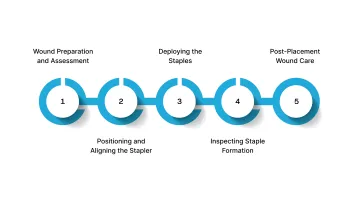
C-section staples provide a structured method for skin closure, but their external and point-based design introduces specific considerations during healing and follow-up.
These limitations reflect how staples interact with tissue, recovery, and post-operative management.
1. External Skin Surface Interaction
Staples remain on the skin surface during early healing, providing external support for skin edge approximation while deeper layers are closed with sutures.
- Interaction with clothing and external surfaces may affect comfort
- Surface conditions, such as moisture and friction, require management
2. Requirement for Staple Removal and Follow-Up
Staples are temporary and must be removed once initial healing is sufficient, introducing an additional step in recovery.
- Requires a scheduled visit for removal
- Additional support, such as adhesive strips, may be applied after removal
3. Post-Removal Transition in Wound Support
Once staples are removed, the incision transitions from external mechanical support to intrinsic tissue strength.
- Skin edges continue to stabilize after removal
- Temporary reinforcement may be used if needed
These limitations have contributed to the adoption of dissolving staples for C-sections.
Why Are Surgeons Choosing Dissolving Staples for C-Sections?
Surgeons are increasingly considering bioabsorbable (dissolving) staples as an alternative to traditional metal staples for C-sections. Understanding the differences between these options can help optimize patient care.
| Features | Traditional Staples | Dissolving Staples |
|---|---|---|
| Material | Stainless steel or titanium | Bioabsorbable polymers (e.g., PLGA) |
| Need for Removal | Must be removed after 5–7 days | Absorbed naturally; no removal needed |
| Wound Complications | Higher risk of infection and wound opening | Lower risk of infection and scarring |
| Healing Support | Mechanical support requires follow-up visits | Supports healing without extra visits |
| Cosmetic Outcome | May leave visible “train track” scars | Minimal scarring with subcutaneous closure |
The choice depends on the patient and surgical situation, with research still evaluating long-term outcomes.
How Does Dissolving Staples Improve Postoperative Healing?
Dissolving staples maintain skin approximation during early healing, similar to traditional staples, while eliminating the need for removal. Their impact on postoperative recovery is primarily related to workflow and wound management.
Key considerations include:
- No removal required: Eliminates the need for staple removal, reducing follow-up interventions and patient handling.
- Subcuticular placement: Positions fasteners beneath the skin surface, avoiding external puncture marks.
- Workflow efficiency: Removes the need for post-operative staple extraction, simplifying care pathways.
- Healing outcomes: Clinical outcomes such as infection rates and scarring are influenced more by technique and wound characteristics than by the closure device alone.
These advantages make dissolving staples a preferred choice in many surgical procedures, improving both patient comfort and clinical efficiency.
Final Thoughts
Skin closure in cesarean procedures does not end with incision approximation. It continues to influence how recovery is managed, follow-up is structured, and consistent outcomes are achieved across different surgical settings.
As expectations for efficiency and predictability increase, the role of dissolving staples in C-sections becomes more central to overall procedural performance.
In this setting, systems like SubQ It! SU-25 represents a subcutaneous, device-assisted approach for procedures such as cesarean sections. The device uses a handheld delivery system to place absorbable dermal fasteners beneath the skin surface without penetrating it.
Contact us today to explore how SubQ It! SU-25 fits into your surgical workflow, and learn more about this advanced system.
FAQs
1. Are there dissolvable staples or stitches used for C-sections?
Traditional metal staples are not dissolvable and require removal, while most internal stitches used in C-sections are absorbable and break down over time. Some newer closure systems use absorbable materials placed beneath the skin, but they are not the same as traditional metal staples.
2. Does it hurt to remove staples from a C-section?
Staple removal may cause brief discomfort or a pulling sensation, but it is generally quick and well-tolerated. The experience varies by individual, and the procedure usually takes a few minutes.
3. How to know if C-section staples are infected?
Signs of infection may include increasing redness, swelling, warmth, discharge, foul odor, or fever. If these symptoms appear, medical evaluation is recommended to assess the incision and guide treatment.
4. Can patients shower with C-section staples?
Showering is typically allowed after the initial dressing is removed, based on your provider’s guidance. The incision should be cleaned gently and kept dry afterwards, while soaking in water is usually avoided until healing progresses.
5. What should patients wear after a C-section with staples to avoid irritation?
Loose, comfortable clothing is generally recommended to reduce friction around the incision area. Avoiding tight or restrictive garments can help minimize irritation while the staples remain in place.
6. Can patients remove C-section staples at home?
No, C-section staples should not be removed at home. Only a healthcare provider should remove them to ensure proper healing and reduce the risk of infection.
7. How to care for c-section staples?
To care for C-section staples, patients should gently wash the area with mild soap and water after the initial dressing is removed, avoiding direct pressure on the staples.
8. What are surgical staples made of?
Surgical staples are typically made of stainless steel, providing durability and resistance to corrosion. Some modern staples are made from titanium or other biocompatible, corrosion-resistant materials.