Every procedure ends the same way. The incision needs to be closed. In a private practice setting, that final step directly affects how many cases fit into a surgical day. The faster and cleaner the closure, the more capacity the practice gets.
Closure time varies widely by method. Metal staples averaged about 5.2 minutes in a 2024 orthopedic RCT, while hand-sewn sutures in the same trial took nearly 12.6 minutes. Newer bioabsorbable systems further widen that difference.
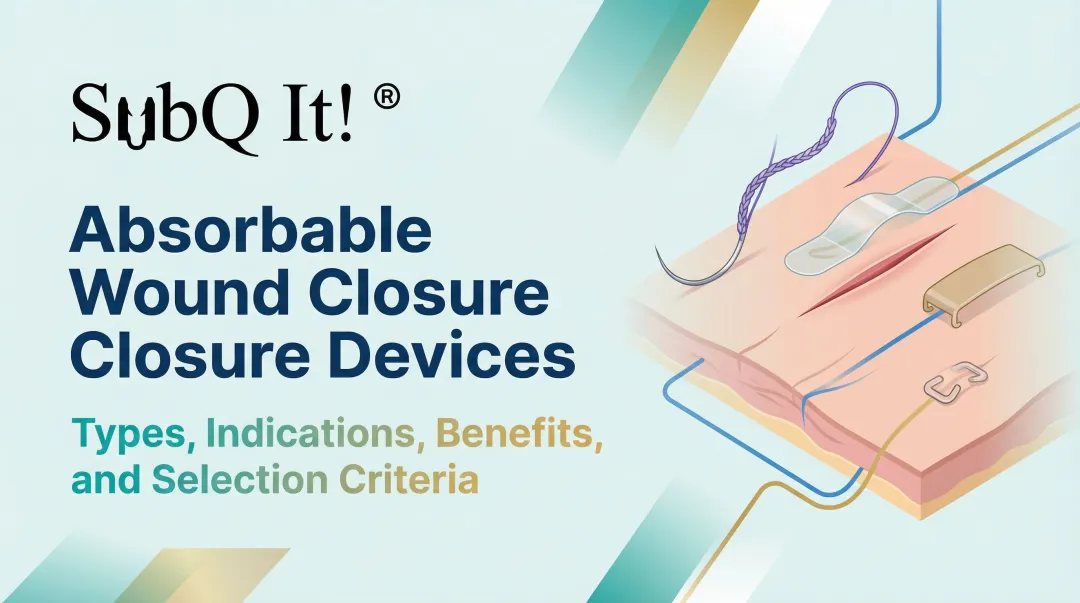
This post compares every major alternative suture skin closure option side by side, from adhesives and strips to staples and subcutaneous fasteners, so you can choose the right method for your needs.
Key Takeaways
- Hand-sewn subcuticular suture averaged 36.5 minutes for mastectomy closure in a study of 4,311 patients, while an absorbable subcuticular stapler averaged 16.2 minutes for the same procedure.
- Tissue adhesives close faster than sutures on low-tension wounds, but a systematic review of 33 RCTs found they carry a higher risk of wound separation.
- In a liver surgery study, raised or thickened scars developed in 9.4% of subcuticular closures vs. 25.9% of surface staple closures.
- Bioabsorbable subcutaneous fasteners are placed under the skin, dissolve in 90 to 120 days, and require no removal visit, covering incisions from a few millimeters up to 25 cm.
- A study of posterior lumbar spine cases found deep surgical site infections occurred in 1.4% of subcuticular closures vs. 5.9% of surface staple closures.
What Is Alternative Suture Skin Closure?
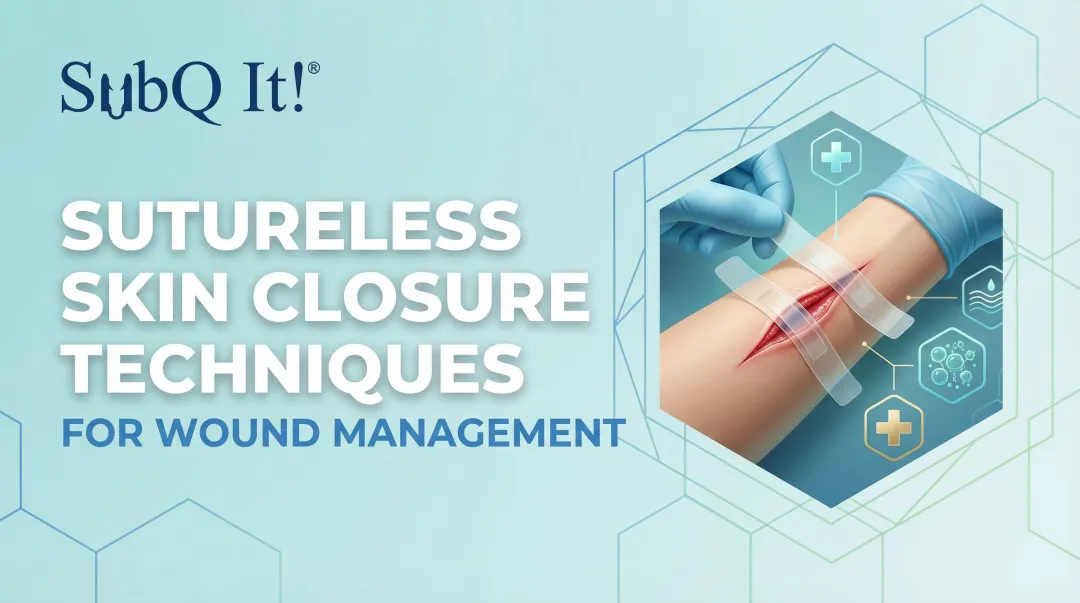
Alternative suture skin closure refers to any method used to close a surgical incision without traditional needle-and-thread suturing. These methods include tissue adhesives, adhesive closure strips, metal staples, subcuticular sutures, and bioabsorbable subcutaneous fasteners.
Each method was developed to address a specific limitation of hand-sewn closure. Tissue adhesives remove the need for needles on low-tension wounds. Metal staples speed up closure on longer incisions. Bioabsorbable subcutaneous fasteners combine speed with subcuticular placement and no removal requirement.
The choice between them depends on incision length, tissue tension, cosmetic expectations, and the value of OR time for the closure step in a given case.
Why Are Surgeons Looking for Alternatives to Traditional Sutures?
Traditional hand-sewn suturing remains the default for most surgical closures, but it carries well-documented limitations that affect OR efficiency, cosmetic outcomes, and postoperative workflow.
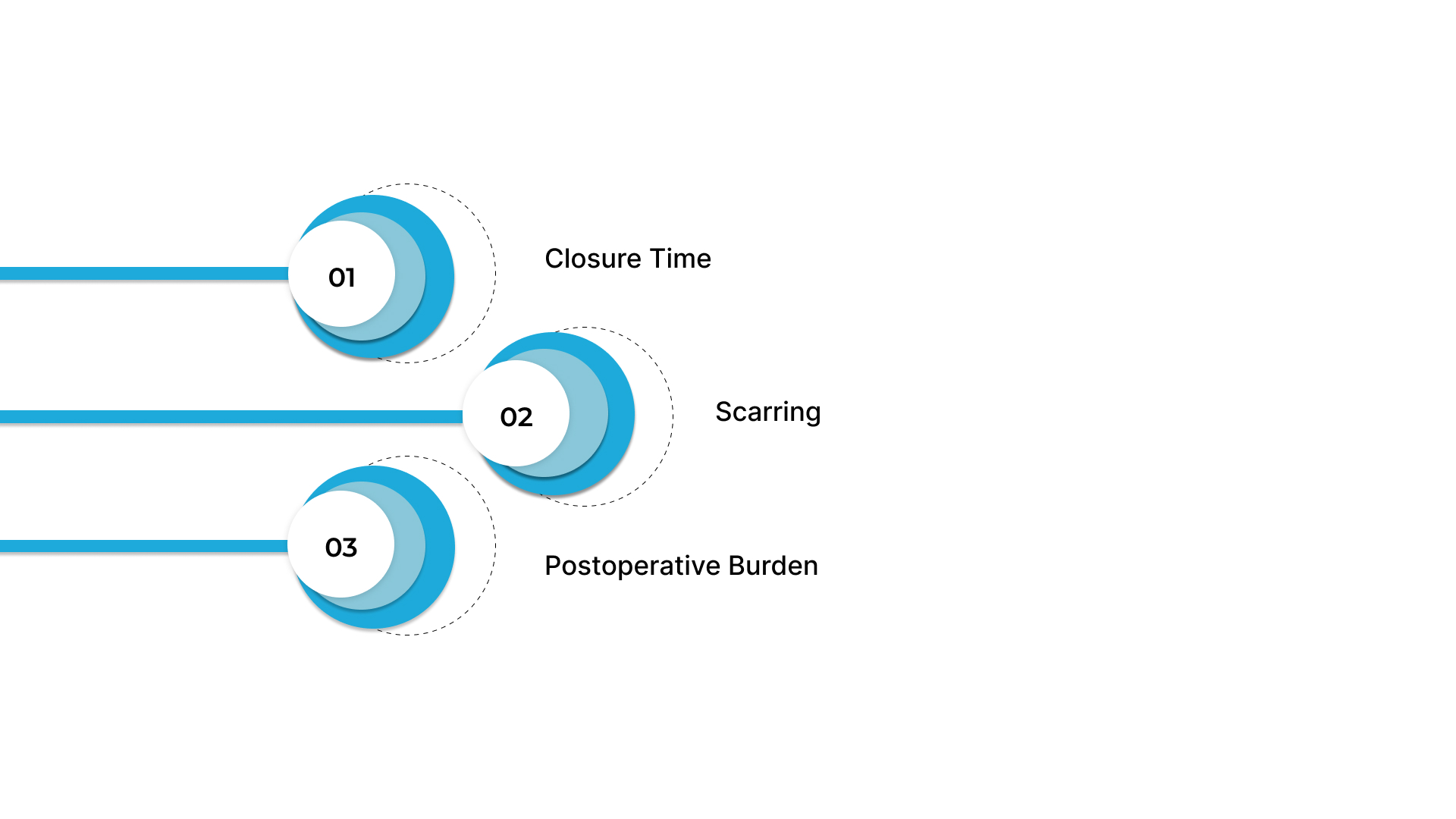
- Closure time: In a retrospective review of 4,311 mastectomy patients, hand-sewn subcuticular closure averaged 36.5 minutes per case. That's the time the surgical team, the anesthesiologist, and the OR itself are all committed to a single task.
- Scarring: Surface-placed closures like traditional metal staples puncture the epidermis on both sides of the incision, leaving the characteristic railroad-track marks that patients notice months after healing. In a study of liver resection patients, raised or thickened scars developed in 25.9% of patients closed with surface staples, compared with 9.4% of those closed subcutaneously.
- Postoperative burden: Metal staples require a return visit for removal, typically 7 to 10 days after surgery. For the patient, that's an additional appointment. For the practice, it's staff time, scheduling, and a procedure that adds no revenue.
These limitations are driving interest in alternative suture skin closure methods that can reduce time, improve cosmesis, or remove the need for a follow-up visit.
How Do Tissue Adhesives Compare to Sutures for Skin Closure?
Tissue adhesives (cyanoacrylate-based glues) close wounds faster than sutures and don't require needle handling. They work best on small, low-tension wounds where the skin edges can be held together easily.
A 2023 meta-analysis of 18 RCTs found that adhesives produced better cosmetic outcomes than sutures in the first month. By 3 to 12 months, sutures resulted in better physician-assessed scar quality.
Additionally, a systematic review of 33 RCTs (2,793 participants) found sutures were significantly better than tissue adhesives at preventing wound separation. Infection rates, patient satisfaction, and cost were comparable between the two.
These findings make adhesives a reasonable choice for short, superficial, low-tension wounds. For longer surgical incisions or areas under tension, the separation risk limits their reliability.
Are Metal Staples Faster Than Sutures?
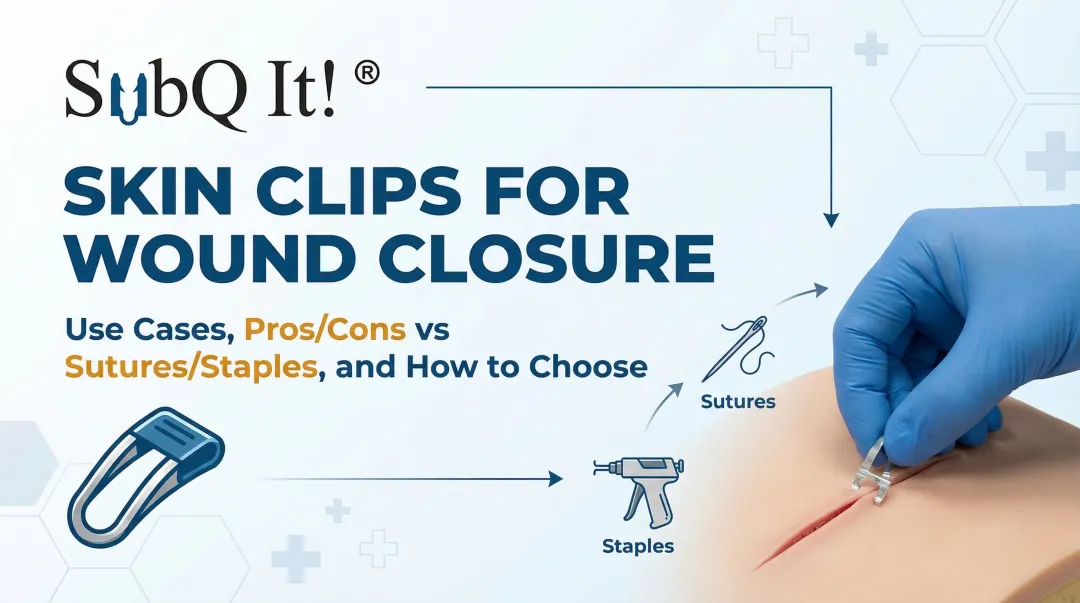
Metal staples consistently close skin faster than hand-sewn sutures. In a 2024 randomized controlled trial of 120 orthopedic patients, staple closure averaged 5.2 minutes compared with 12.6 minutes for sutures.
The speed advantage comes with tradeoffs. Metal staples are placed on the skin surface, creating the railroad-track scar pattern that's visible after the wound heals. A skin stapler also requires a return visit for removal, usually within 7 to 10 days.
Here's how metal staples and sutures compare across key metrics.
| Criteria | Metal Staples | Hand-Sewn Sutures |
|---|---|---|
| Average closure time (orthopedic, 2024 RCT) | 5.2 ± 0.9 minutes | 12.6 ± 1.5 minutes |
| Wound infection rate (42-RCT meta-analysis) | 6.75% | 4.90% |
| Placement | Surface (through epidermis) | Subcuticular or transdermal |
| Removal required | Yes, 7-10 days postop | Yes (non-absorbable) or no (absorbable) |
| Railroad-track scarring | Yes | No (subcuticular technique) |
The infection rate difference (6.75% vs. 4.90%) did not reach statistical significance in the meta-analysis, which covered 42 RCTs and 11,067 patients. However, a 2025 study of posterior lumbar spine cases found a more pronounced split, with deep surgical site infections in 5.9% of surface staple closures vs. 1.4% of subcuticular closures.
For surgeons who need speed, metal staples deliver it. For surgeons who also weigh scarring, removal burden, and infection trends, the tradeoffs are harder to accept.
What Are Bioabsorbable Subcutaneous Fasteners?
Bioabsorbable subcutaneous fasteners are dermal closure devices placed under the skin during surgery. They're made from a polylactide-polyglycolide copolymer that holds tissue together and then dissolves over a 90- to 120-day window, with no surface puncture and no removal visit.
This is the key difference between metal staples and adhesive skin closure methods. Because the fastener goes into the dermis rather than through the epidermis, there's no external entry point to leave a mark. The only visible line after healing is the original incision itself.
SubQ It! is a bioabsorbable skin closure system in this category. It's available in two variants: SubQ It! SU-10 (10 fasteners, closes incisions up to 10 cm) and SubQ It! SU-25 (25 fasteners, closes incisions up to 25 cm). The SU-10 works on incisions as small as a few millimeters, including laparoscopic trocar sites where surface-applied devices can't operate.
Closure Speed vs. Hand-Sewn Suture
Published data from independent studies show consistent time savings over hand-sewn suturing. In a study, closure with an absorbable subcuticular stapler averaged 16.2 minutes, compared with 36.8 minutes for hand-sewn subcuticular suture in the same cohort.
A study of 60 patients undergoing mammaplasty or abdominoplasty found absorbable subcuticular staple closure was approximately 7 times faster than absorbable monofilament sutures.
Complication Rates With Bioabsorbable Fasteners
Across published studies, bioabsorbable subcuticular staplers have complication rates comparable to those of hand-sewn sutures. In a study, infection rates were 0.38% for the stapler group and 0.36% for the suture group.
A study of 31,419 cesarean deliveries found the absorbable subcutaneous staple group had the shortest total procedure time at 52 minutes, compared with 60 minutes for subcutaneous sutures. Infection rates during the 45 days after delivery did not differ across closure groups.
Which Alternative Closure Method Works Best for Each Incision Type?
The right closure method depends on the incision. A 3 mm laparoscopic trocar site has different needs than a 20 cm mastectomy incision. Here's how each method maps to common clinical scenarios.
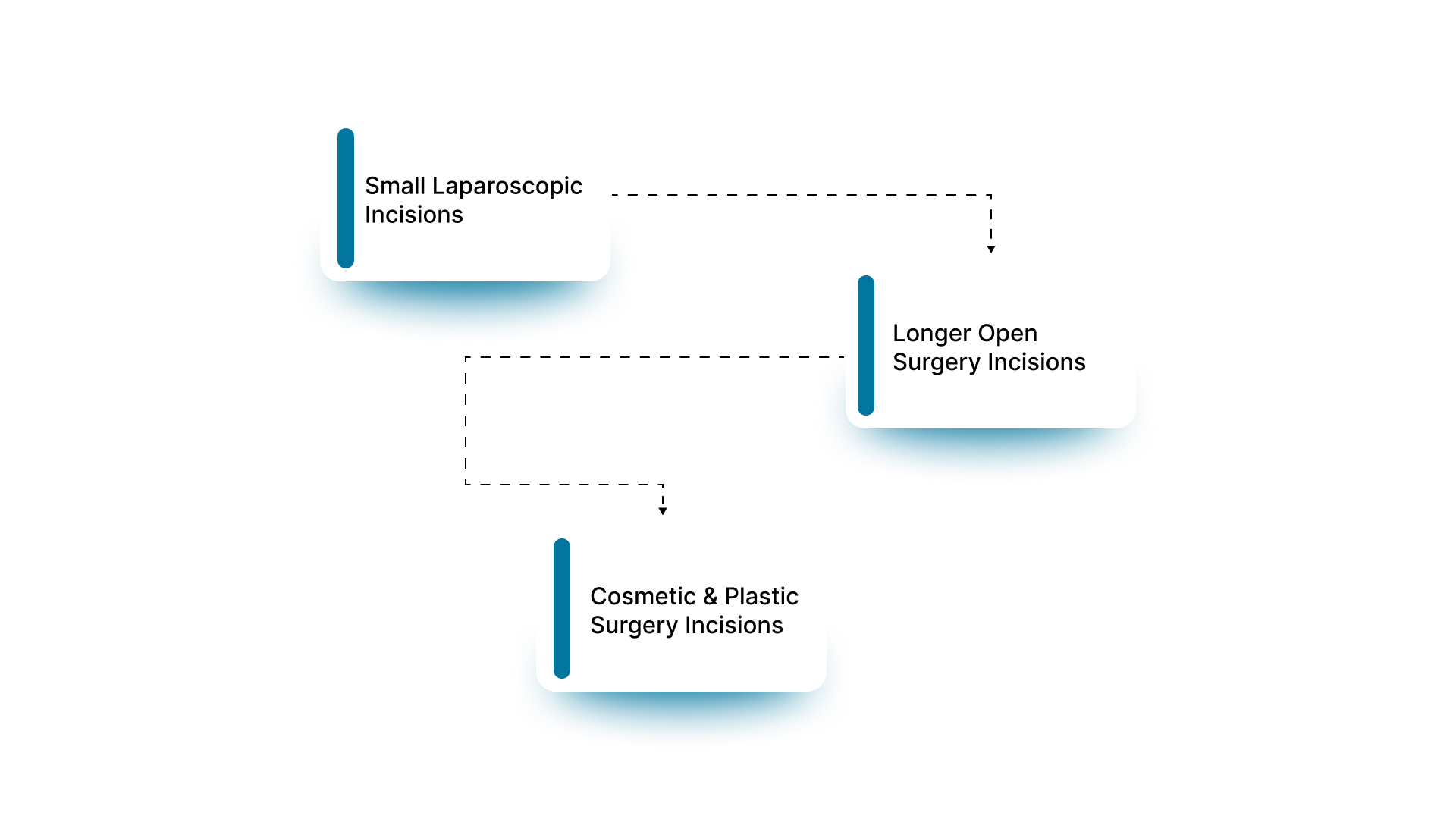
Small Laparoscopic Incisions (Under 10 cm)
Short, low-tension incisions made through laparoscopic ports pose a unique challenge. Many closure devices can't operate at this scale. Adhesive strips can be used for very small wounds, but they offer limited holding strength. Zipper-style external devices designed for longer incisions can't close incisions this small, leaving unclosed sections at the ends that require a hand stitch.
SubQ It! SU-10 was designed for this range. It's 10 bioabsorbable fasteners close incisions up to 10 cm, including very small trocar sites where surface-applied systems can't reach.
Longer Open Surgery Incisions (10-25 cm)
For incisions in the 10 to 25 cm range, surgeons typically choose between hand-sewn subcuticular suture and metal staples. Sutures offer precise approximation but take longer. Metal staples close faster, but add a removal visit and surface scarring.
SubQ It! SU-25 covers this range with 25 bioabsorbable fasteners. It offers the speed advantage of a mechanical closure system with the cosmetic benefit of subcutaneous placement. In reduction mammoplasty cases, an absorbable dermal stapler reduced total procedure time by approximately 20 minutes compared with suture-only closure.
Cosmetic and Plastic Surgery Incisions
Scar quality carries more weight in plastic surgery than in almost any other specialty. Surface-placed metal staples are rarely used in cosmetic procedures for this reason. Hand-sewn subcuticular suture has been the standard, but it's the slowest closure option.
Bioabsorbable subcutaneous fasteners offer an alternative that matches the scar quality of subcuticular suture without the time cost. In a 60-patient study comparing the two methods, scar scores showed no significant difference at any follow-up interval through 12 months.
How Does Closure Method Affect OR Costs?
OR time is a direct expense. Published estimates put the cost of one minute of operating room time anywhere from $36 to $46 per minute, depending on the facility and the study.
When an absorbable subcuticular stapler closes a mastectomy incision roughly 20 minutes faster than a hand-sewn suture, the savings are measurable. At the lower end of published OR cost estimates, that's over $700 in facility costs per case. Over a full surgical week, those minutes add up.
For private practice surgeons who control their own scheduling, the math extends further. Recouping 20 minutes per case could mean fitting one additional procedure into a surgical day. The per-case cost of a bioabsorbable closure device is a small fraction of the revenue that an additional case generates.
This is where the economic case for alternative sutureless closure systems becomes clear. The device saves time during closure and creates capacity that wouldn't exist if the surgeon spent those minutes with a needle holder.
Final Thoughts
Every alternative closure method has its own strengths. Adhesives work well on small, low-tension wounds. Metal staples close quickly but come with scarring and a removal visit. Subcuticular sutures produce clean results but take the longest. Bioabsorbable subcutaneous fasteners combine subcuticular placement, mechanical speed, and no removal requirement across incisions from a few millimeters to 25 cm.
The right choice depends on your caseload, your patients' cosmetic expectations, and how much value you place on the time your team spends closing. For surgeons handling a mix of incision sizes, a closure system that covers the full range without sacrificing scar quality or adding postoperative visits is worth evaluating.
SubQ It! is a bioabsorbable skin closure system available in two sizes (SU-10 for incisions up to 10 cm, SU-25 for incisions up to 25 cm) that places dissolving dermal fasteners under the skin. Surgeons who continue relying solely on hand-sewn closure are spending OR minutes they could recoup with every case. Contact us today to request a custom quote.
FAQs
1. How Long Do Bioabsorbable Fasteners Take to Dissolve?
The fasteners are made from a polylactide-polyglycolide copolymer that gradually breaks down over 90 to 120 days. During that window, they hold tissue together while the incision heals, then absorb without any intervention.
2. Can Tissue Adhesives Replace Sutures on Longer Surgical Incisions?
No, tissue adhesives are best suited for short, low-tension wounds where skin edges come together easily. On longer incisions or areas under higher tension, adhesives carry a higher risk of wound separation than sutures.
3. Do Adhesive Closure Strips Provide Enough Holding Strength for Surgical Wounds?
Adhesive strips can reinforce a closure or serve as the primary method for very small, superficial wounds. For deeper surgical incisions that require reliable tissue approximation, they don't provide the same holding strength as sutures, staples, or subcutaneous fasteners.
4. Is There a Learning Curve When Switching From Sutures to a Stapler System?
Yes, any new device takes a few cases to integrate into your workflow. Surgeons who've adopted bioabsorbable staplers typically report that the device is intuitive after a few procedures, with the time savings becoming apparent immediately.
5. Can Bioabsorbable Fasteners Be Used on Patients With Keloid-Prone Skin?
Keloid formation depends on patient biology, not the closure method alone. Bioabsorbable subcutaneous fasteners avoid surface punctures, which removes one source of epidermal disruption. Patients with a history of keloids should still be managed according to the same clinical protocols.
6. Do Metal Staples Cause More Pain Than Sutures During Removal?
Pain during removal varies by patient and anatomic site. Both staple and suture removal involve some discomfort, though the experience is generally brief. Bioabsorbable fasteners avoid this step entirely since they dissolve on their own.
About SubQ It!: SubQ It! manufactures the only bioabsorbable subcuticular skin closure system specifically designed for small and laparoscopic incisions. Our FDA-cleared devices combine the speed of metal staplers (7X faster than manual sutures) with superior cosmetic outcomes through subcuticular placement that eliminates train track scarring. For more information about how SubQ It! can optimize your surgical closures, contact our team at +1 339.933.8811 or sales@subq-it.com.