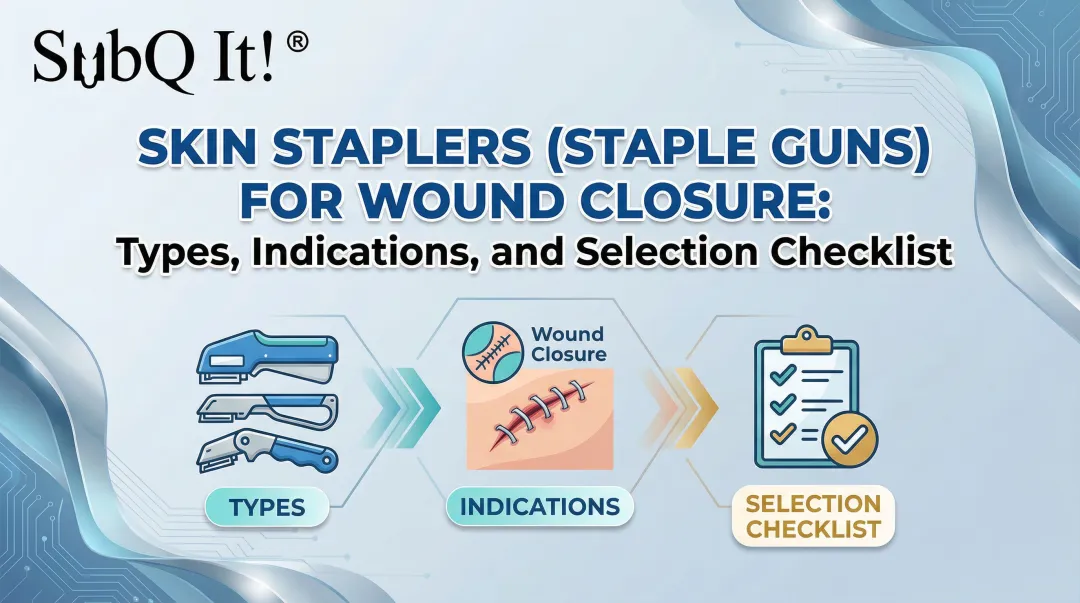
Skin closure is the final step of every procedure, and it's where speed and cosmetic outcomes collide. Traditional metal staplers close fast, but they leave surface punctures that require a removal visit and can produce railroad-track scars.
A 2026 randomized trial in calcaneal fracture surgery found that stapler closure averaged nearly 10.89 minutes, compared with about 20.44 minutes for sutures, with equivalent healing. Speed clearly favors staplers, but the question isn't whether staplers work. It's the type that works best for a given practice.
This post breaks down key criteria that separate one skin stapler from another. By the end, you'll have a practical framework for matching the right stapler category to your case mix, incision sizes, and scar expectations.
Key Takeaways
- Closure speed favors staplers over hand-sewn sutures. In a 2024 panniculectomy study, absorbable stapler closure cut total procedure time nearly in half, averaging 66.76 minutes compared to 125.33 minutes with sutures.
- Railroad-track scars are a known risk with surface-applied metal staples, as the fasteners pierce the epidermis and must be removed in 7 to 10 days.
- Bioabsorbable subcutaneous staplers place fasteners under the skin, avoid surface punctures, and dissolve with no removal visit required.
- A 2024 bilateral reduction mammaplasty study found absorbable dermal staples reduced operative time by an average of 21.8 minutes compared to suture-only closure, with comparable complication rates.
- Incision versatility matters. Some stapler categories are limited to long incisions, while subcutaneous bioabsorbable options cover incisions from a few millimeters up to 25 cm.
What Is a Skin Stapler?
A skin stapler is a handheld surgical device that deploys metal or bioabsorbable fasteners to close incisions. Traditional models use a spring-loaded or squeeze-handle mechanism to place stainless steel staples through the epidermis and dermis, holding wound edges together during healing.
The category has expanded over the past decade. Alongside traditional surface-applied metal staplers, surgeons can now choose bioabsorbable subcutaneous (under the skin) staplers that place dissolving fasteners in the dermal layer without piercing the outer skin.
Adhesive closure strips and tissue adhesives represent a third approach, though they serve a narrower range of incision types.
Each category has different implications for scar outcomes, closure time, follow-up requirements, and the range of incisions it can handle.
What Criteria Determine the Best Skin Stapler?
Five clinical and operational factors separate one skin stapler from another. Each one affects patient outcomes, surgeon workflow, or practice economics in a measurable way.
Here's how the three major stapler categories compare across those criteria.
| Criterion | Surface-Applied Metal Stapler | Bioabsorbable Subcutaneous Stapler | Adhesive Strips / Tissue Glue |
|---|---|---|---|
| Scar outcome | Risk of railroad-track marks from surface punctures | No surface puncture, only the incision line remains | Minimal scarring on low-tension wounds only |
| Closure speed | Fast (under 11 minutes per case in orthopedic RCT data) | Comparable to metal staples, significantly faster than hand-sewn suture | Fast on short, superficial wounds; not suited for deep or long incisions |
| Removal burden | Requires a removal visit at 7-10 days postoperatively | No removal needed; fasteners dissolve in 90-120 days | No removal needed; strips fall off or adhesive wears away |
| Incision size range | Mid-range; limited on very small laparoscopic ports | A few millimeters (trocar ports) up to 25 cm | Typically under 5-8 cm, low-tension sites only |
| Cost per case | Low device cost ($5-$30), but add removal visit overhead | Higher device cost, offset by no follow-up and OR time savings | Low device cost; limited clinical applicability |
The right stapler depends on which of these criteria matters most for a surgeon's case mix. A practice that handles mostly cosmetic procedures may prioritize scar outcomes above all else. A high-volume surgical stapler user in a private clinic may weigh closure speed and follow-up burden more heavily.
How Fast Do Skin Staplers Close Compared to Sutures?
Staplers consistently close faster than hand-sewn sutures, and the time savings grow with incision length.
In a 2024 study of 40 panniculectomy patients, absorbable dermal stapler closure reduced total procedure time by nearly half, averaging 66.76 minutes compared to 125.33 minutes with sutures. After controlling for other variables, the choice of sutures rather than the dermal stapler independently added more than 76 minutes to the procedure. Wound complications, aesthetic outcomes, and readmission rates were comparable between the two groups.
A separate 2024 study in bilateral reduction mammaplasty confirmed the pattern. Absorbable dermal staples reduced total operative time by an average of 21.8 minutes compared to suture-only closure. After adjusting for tissue mass and technique differences, the stapler predicted a 26.5-minute reduction.
These time savings carry a real dollar value. OR time is one of the most expensive resources in any surgical facility, so even a 20-minute reduction in closure time per case adds up across a full schedule.
For private practices, shorter closure times also free up scheduling capacity. That's especially relevant for skin closure in high-volume settings where back-to-back cases are the norm.
SubQ It! delivers this speed advantage through subcutaneous (under the skin) bioabsorbable fasteners that deploy quickly and require no post-operative removal, combining fast closure with zero follow-up burden.
Do Metal Skin Staplers Cause More Scarring Than Sutures?
Surface-applied metal staples pierce the epidermis on both sides of the incision, creating the characteristic railroad-track scar pattern familiar to both patients and surgeons. That pattern forms because each staple puncture site heals independently from the incision itself, leaving paired marks perpendicular to the wound line.
A 2024 randomized trial of 120 orthopedic patients found that the staple group scored higher on a cosmetic wound scale than the suture group. Complication rates, including infection and hypertrophic scar formation, were comparable.
This comparison measured surface-applied metal staples against traditional sutures in orthopedic wounds, where cosmetic expectations differ from plastic or cosmetic surgery.
In procedures where scar quality is a primary outcome, subcutaneous bioabsorbable staplers offer a different approach. The fasteners are placed in the dermal layer without penetrating the outer skin, so there are no surface puncture sites to heal. Only the original incision line remains visible.
Published comparisons in reduction mammoplasty have found that blinded raters detected no cosmetic difference between absorbable subcuticular closure and suture-only closure, with comparable complication rates.
For surgeons whose patients have strong cosmetic expectations, the difference between surface-applied and subcutaneous placement is a practical one. SubQ It! SU-10 and SU-25 place bioabsorbable fasteners subcutaneously, producing a closure that avoids railroad-track marks on incisions from a few millimeters up to 25 cm.
What About Infection Risk With Skin Staplers?
Infection data for skin staplers varies by surgical specialty, wound environment, and patient population. A single answer doesn't apply across all contexts.
A 2025 multi-institutional analysis of 18,268 lower extremity bypass procedures found that staple closure was associated with higher surgical site infection rates than suture closure (3.46% vs. 2.06%). Staples were also linked to higher rates of return to the OR and prolonged hospital stays beyond 7 days.
This finding applies specifically to a high-risk vascular surgery population with compromised lower-extremity perfusion and shouldn't be generalized across specialties.
In lower-risk settings, the picture looks different. Published data on absorbable dermal staplers in plastic surgery populations have shown complication rates comparable to those with suture-only closure, with no significant difference in major or minor wound events.
The mechanism of staple placement may be part of the explanation. Surface-applied metal staples create small puncture wounds that traverse the full thickness of the skin, providing a potential pathway for bacteria. Bioabsorbable subcutaneous staplers avoid this by placing fasteners within the dermal layer, leaving the outer skin intact. This distinction is worth considering when comparing staples vs. sutures across wound types and patient risk profiles.
Which Skin Stapler Works Best for Each Surgical Specialty?
The best stapler type depends on the incision characteristics each specialty typically produces.
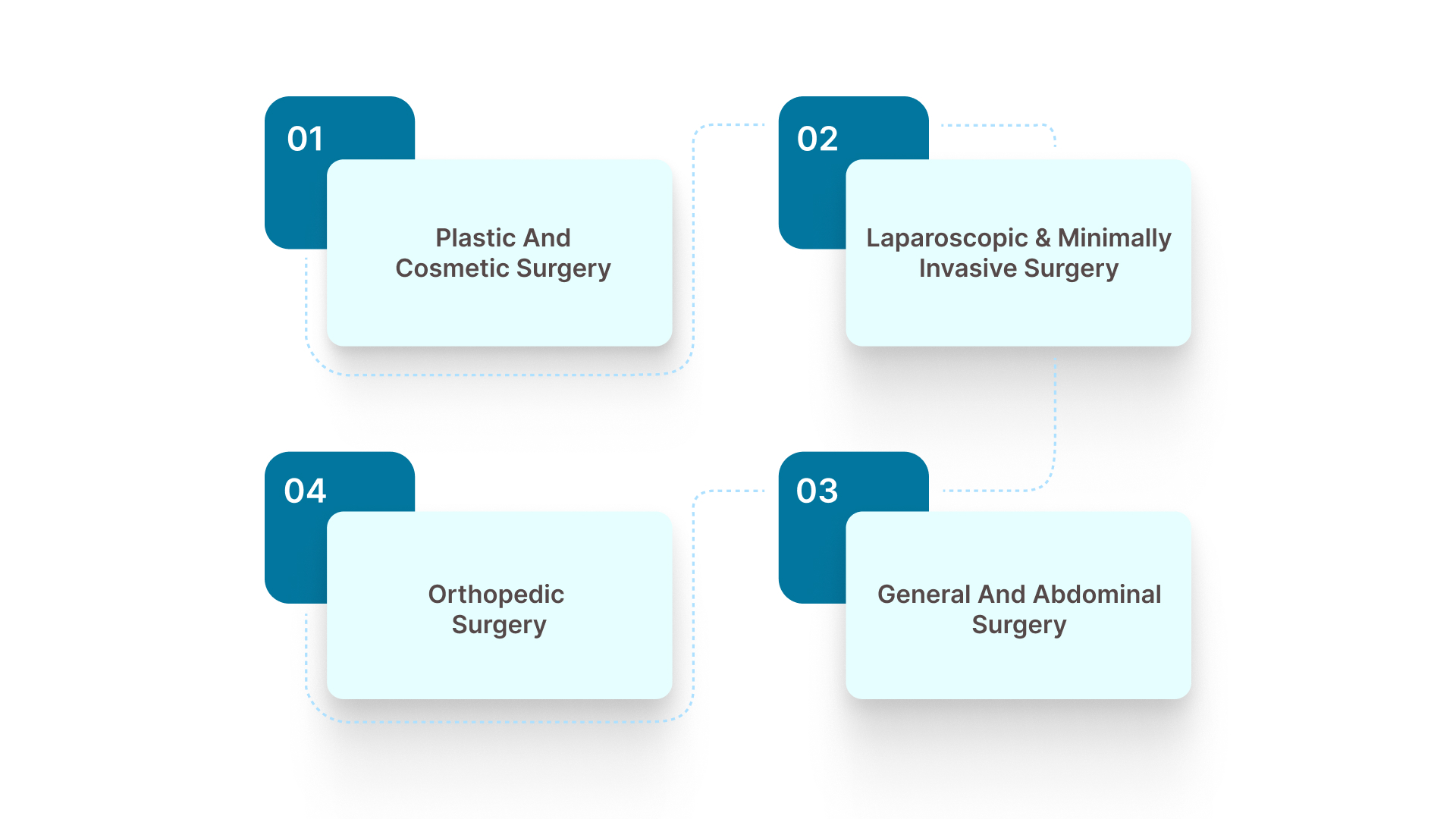
Plastic and Cosmetic Surgery
Scar quality is often the highest priority in this specialty. Bioabsorbable subcutaneous staplers avoid surface punctures and railroad-track marks entirely.
Published data from panniculectomy and reduction mammaplasty series confirm comparable aesthetic outcomes to hand-sewn suture, with significantly faster closure.
Laparoscopic and Minimally Invasive Surgery
Trocar port incisions can be as short as a few millimeters. Surface-applied metal staplers and external zipper-style devices often can't operate on sites that small.
Bioabsorbable subcutaneous staplers are the only category that reliably closes very small laparoscopic incisions, making the SU-10 (10 fasteners, up to 10 cm) a practical fit for minimally invasive cases.
General and Abdominal Surgery
Incision sizes vary widely in general surgery, from small drain sites to long midline incisions. A stapler that covers a broad range reduces the need to stock multiple closure devices.
Subcutaneous bioabsorbable options spanning a few millimeters to 25 cm address that variability. Abdominal closure in particular benefits from faster closure times in high-volume settings.
Orthopedic Surgery
Speed is a documented advantage in orthopedic wound closure. The 2026 calcaneal fracture RCT found that disposable staplers were roughly half the time of sutures, with equivalent healing outcomes.
In orthopedic settings where cosmetic scar quality is secondary to speed and wound integrity, metal staplers remain a standard choice. The removal visit is still required, though.
Final Thoughts
The best skin stapler isn't a single product. It's the category that aligns with a practice's priorities across scar outcome, closure speed, removal burden, incision range, and cost. The evaluation framework here provides surgeons with a way to make that decision using published data rather than product catalogs.
For practices where cosmetic outcomes, follow-up efficiency, and incision versatility all matter, bioabsorbable subcutaneous stapling consistently scores well across the five criteria. The time savings documented in recent plastic surgery studies are significant, and the elimination of the removal visit changes the postoperative workflow entirely.
SubQ It! offers two variants, SU-10 (10 fasteners, up to 10 cm) and SU-25 (25 fasteners, up to 25 cm), covering incisions from small trocar ports to long open surgery wounds with bioabsorbable fasteners that dissolve naturally. Practices still relying on surface-applied metal staples for every case may be spending more time, generating more follow-up visits, and leaving more visible scars than necessary. Contact us today to request a custom quote.
FAQs
1. How Many Fasteners Come in a Standard Skin Stapler Cartridge?
It depends on the stapler type. Traditional disposable metal staplers typically come preloaded with 15, 25, or 35 staples, while bioabsorbable subcutaneous models are available in 10-fastener and 25-fastener configurations to match incision length.
2. Can Skin Staplers Be Used on the Face?
No, skin staplers are generally not recommended for facial incisions because the cosmetic demands of facial skin favor precise subcuticular suture techniques. Staplers are better suited to trunk, extremity, and scalp closures where speed and wound-edge eversion are priorities.
3. Do Patients Report Pain During Metal Staple Removal?
Yes, patients commonly report mild discomfort during metal staple removal, though pain scores tend to be low on standard visual analog scales. The removal process requires a specialized staple extractor and adds a follow-up visit to the postoperative schedule.
4. How Long Do Bioabsorbable Skin Fasteners Take to Dissolve?
Yes, they dissolve without any intervention. Bioabsorbable subcutaneous fasteners are typically composed of polylactide-polyglycolide copolymers and absorb naturally over approximately 90 to 120 days after placement, with no removal procedure needed.
5. Are Skin Staplers Appropriate for Pediatric Wound Closure?
Yes, skin staplers are used in pediatric surgical settings, particularly for scalp lacerations and trunk incisions where speed of closure reduces anesthesia time. The choice between metal and bioabsorbable options depends on the wound location and the desirability of avoiding a removal visit.
6. Can Skin Staplers Be Used on Contaminated or Irregular Wounds?
No, heavily contaminated or irregular wounds typically require careful debridement and layered suture closure rather than stapling. Skin staplers perform best on clean surgical incisions with well-approximated wound edges and minimal tension.