
Do you know that up to 29% of patients report complications after a skin biopsy?
Although the procedure is considered minor, achieving diagnostic accuracy while preserving cosmetic outcomes remains a critical concern, particularly in sensitive areas such as the face.
The choice of instrument can significantly influence both clinical results and patient recovery. A well-designed biopsy punch enables clean tissue sampling, preserves specimen integrity, and helps reduce procedural risks.
Disposable biopsy punches, designed for single use, offer consistent sharpness and minimize the likelihood of cross-contamination, supporting reliable histopathological evaluation.
In this blog, you’ll explore what disposable biopsy punches are, their key features, and how to select the right one for optimal diagnostic accuracy and patient outcomes.
Key Takeaways:
- Disposable biopsy punches are sterile, single-use instruments that provide consistent sharpness and reduce the risk of cross-contamination.
- Punch size (2–8 mm) should match lesion type, body site, and required depth to balance diagnostic yield and cosmetic outcome.
- Blade sharpness and design preserve specimen integrity by minimizing crush artifact and distortion.
- Skin thickness and anatomical site influence punch depth, the need for closure, and healing outcomes.
- Although disposables have a higher unit cost, sterility assurance and reduced reprocessing support overall clinical value.
What is a Disposable Biopsy Punch?
A disposable biopsy punch is a single-use surgical instrument consisting of a circular, hollow blade attached to a handle that extracts cylindrical full-thickness skin specimens through rotational cutting.
The blade cuts through epidermis, dermis, and subcutaneous fat, providing complete tissue architecture for histopathological examination.
"Disposable" means the instrument is pre-sterilized, used once on a single patient, then discarded. This removes cross-contamination risks and ensures optimal blade sharpness for each procedure, critical factors that directly impact specimen quality and patient safety.
Beyond technical performance, patient comfort and healing outcomes provide important context for evaluating biopsy tools.
Real Case Study
In a survey of 506 adults, 28% of patients who had undergone a skin biopsy reported moderate-to-high discomfort during the procedure. Recovery time was also a concern, with many patients indicating that healing was not as quick as expected.
- 59% of those who experienced discomfort required at least 1 week to recover.
- 7% reported that healing took longer than one month.
Participants also expressed concerns beyond immediate pain. Issues such as visible scarring, infection risk, and delayed wound healing influenced their overall perception of the procedure.
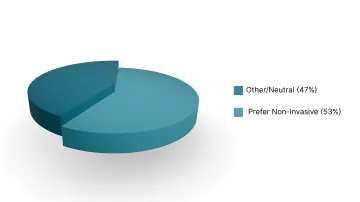
53% said they would strongly prefer non-invasive diagnostic options if available.
These findings indicate that both procedural discomfort and recovery duration significantly affect patient experience and decision-making, highlighting the need for precise, low-trauma biopsy tools such as high-quality disposable punches.
Balancing diagnostic precision with patient comfort is especially important given the wide range of conditions that require tissue sampling.
Common Conditions Diagnosed Using a Biopsy Punch

Biopsy punches are used primarily in dermatology, primary care, and oncology for diagnosing:
- Melanoma, basal cell carcinoma, and squamous cell carcinoma: Used to sample suspicious pigmented or neoplastic skin lesions for histopathologic confirmation.
- Inflammatory conditions like psoriasis and eczema: Enable evaluation of dermal and epidermal inflammatory changes that clinical examination alone cannot resolve.
- Deep skin infections requiring tissue culture: Helps obtain tissue for pathology and culture when surface swabs are inconclusive.
- Rashes and lesions of unknown etiology: Used as a diagnostic tool when clinical assessment does not clearly identify the cause.
Once you understand what a disposable biopsy punch is, it offers helpful context for identifying the features that define a high-quality instrument.
4 Key Features of a High-Quality Disposable Biopsy Punch
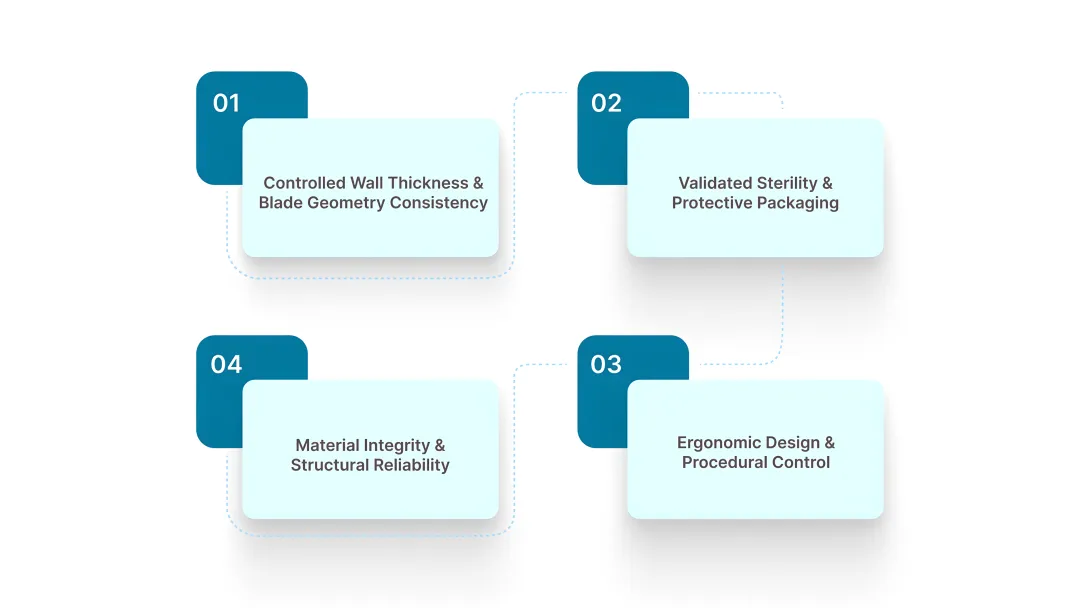
Choosing the right disposable biopsy punch is essential for obtaining accurate tissue samples while ensuring patient safety and comfort. The key features that distinguish high-quality biopsy punches include:
1. Controlled Wall Thickness and Blade Geometry Consistency
High-quality biopsy punches rely on precise wall thickness and bevel geometry, which directly affect penetration force and tissue quality.
Key considerations include:
- Thin-wall construction () for smoother entry
- Consistent bevel angle (≤300°) to reduce resistance during rotation, with sharpness <0.10 mm at tip.
- Uniform cutting edge across the full circumference
Engineering consistency in these parameters ensures minimal tissue distortion and predictable cutting performance, which improves diagnostic reliability.
2. Validated Sterility and Protective Packaging
Medical-grade disposable punches must meet sterility standards, typically achieved through terminal sterilization methods such as gamma radiation or ethylene oxide.
Devices sold as sterile must be individually packaged with tamper-evident seals, clear expiration dates, and lot numbers for traceability, ensuring sterility until use.
3. Ergonomic Design and Procedural Control
Proper handle design affects control during rotational cutting and perpendicular orientation to the skin. Look for these features:
- Ribbed grips that improve traction during rotation
- Comfortable diameter and length that reduce hand fatigue
- Clear tactile feedback when the blade penetrates through the dermis into the subcutaneous tissue
Well-designed handles reduce hand fatigue during multiple procedures and improve precision, particularly critical when biopsying cosmetically sensitive areas like the face.
4. Material Integrity and Structural Reliability
Medical-grade stainless steel blades and high-quality plastic handles ensure structural integrity during use, preventing blade separation or handle breakage mid-procedure. Critical safety features include:
- Protective caps for safe disposal and blade edge protection before use
- Blade designs that minimize accidental healthcare worker injury
- Sharps-safe construction compliant with OSHA and CDC guidelines
Once the tissue sample is obtained, attention shifts to effective wound closure to support healing and minimize scarring.
Smaller incisions may be closed with skin adhesive or steri-strips.
Closing larger incisions, however, benefits from bioabsorbable subcuticular closure systems such as SubQ It! SU-10, which offers an alternative to traditional surface sutures by placing fasteners beneath the skin. This eliminates the need for removal and supports cosmetic outcomes.
While these features define overall quality, selecting the right disposable biopsy punch also requires careful consideration of specific clinical needs and procedural factors.
4 Factors to Consider When Selecting the Best Disposable Biopsy Punch
Selecting the optimal biopsy punch requires matching instrument specifications to clinical requirements, lesion characteristics, anatomical location, and desired diagnostic outcomes.
The following factors help clinicians connect instrument choice to practical clinical results.
1. Punch Size Selection Based on Clinical Indication
When choosing the appropriate punch size, match the instrument to the clinical need, considering lesion size, location, and the depth of the suspected pathology.
Size choice directly affects both diagnostic adequacy and cosmetic outcome, especially in visible areas such as the face.
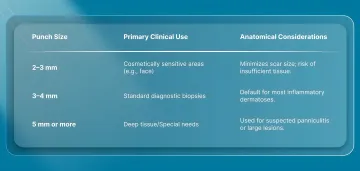
- Standard diagnostic biopsies (3–4 mm): It is commonly used for most inflammatory dermatoses and typical lesions, providing sufficient full‑thickness tissue for histological evaluation while balancing healing and scarring.
- Cosmetically sensitive areas (2–3 mm): Smaller punches may be selected for delicate areas like the face or other visible sites to help minimize scar size, though they may carry a higher risk of yielding insufficient tissue for some diagnoses.
- Larger lesions or special needs (5 mm or more): Larger punch sizes are useful for conditions requiring deeper or more extensive sampling of subcutaneous tissue, such as suspected panniculitis or granulomatous conditions.
2. Blade Sharpness Affecting Specimen Quality
Sharper blades create cleaner incisions with minimal compression and crush artifacts, preserving cellular architecture for accurate interpretation.
Dull instruments, by contrast, can deform tissue and introduce artifacts that may complicate diagnosis.
Key considerations include:`
- Clean incisions with sharp blades to reduce compression and preserve histological detail.
- Higher risk of artifact with dull instruments, including crush, fragmentation, splitting, and hemorrhage.
- Lower incidence of surgical artifacts with punch biopsies, when sharp and properly applied, compared with traditional scalpel or incisional techniques.
- The role of instrument design and cutting mechanism in supporting specimen integrity and diagnostic accuracy.
Studies confirm that inflammatory and tumor cells are particularly sensitive to crush artifacts, which can compromise pathologic evaluation.
3. The True Cost of Disposable vs. Reusable
While disposable punches may have a higher per-unit purchase price than reusable instruments, published cost analyzes do not consistently show that the total cost of ownership always favors disposables.
Economic comparisons of reusable versus disposable biopsy tools indicate that reusable instruments can become more cost-effective per use when utilized repeatedly.
This is because cleaning, sterilization, and replacement costs are distributed across multiple procedures.
Additional hidden costs include:
- Reusable instruments incur reprocessing costs, including cleaning chemicals, equipment, and technician labor.
- Both reusable and disposable instruments pose an infection risk if not handled properly.
- Staff time for cleaning and sterilization of reusable instruments and for ongoing equipment maintenance are real cost components, but they vary widely by facility and procedure volume.
4. Choosing a Reliable Manufacturer
Choose well‑established manufacturers with reliable operations, such as:
- Consistent quality control: A strong quality management system that ensures products meet safety and performance standards across production batches.
- Documented track records: Experience in medical device manufacturing with compliance to regulations, showing a history of meeting quality and regulatory expectations.
Final Thoughts
Choosing the right biopsy punch has a lasting impact beyond the immediate procedure. It plays a crucial role in shaping patient recovery, reducing scarring, and improving overall diagnostic accuracy.
As the demand for precision and faster healing increases, advanced skin closure solutions have become more important.
In this context, SubQ It! SU-10 offers a bioabsorbable subcutaneous closure system for post‑biopsy and small surgical incisions. The system places the fasteners beneath the skin to precisely approximate wound edges.
Because the fasteners are bioabsorbable and placed subcutaneously, there's no need for a follow-up visit to remove the staples.
Contact us to explore how SubQ It! SU-10 can support post-biopsy healing and cosmetic outcomes, and learn more about this advanced closure solution.
FAQs
1. What is a biopsy punch used for?
Biopsy punches obtain cylindrical, full-thickness skin samples that include both the epidermis and dermis for microscopic examination. They're used to diagnose skin cancers, inflammatory conditions, infections, and other dermatologic disorders that require tissue-level analysis.
2. Does a punch biopsy wound close on its own?
Small punch biopsies (4 mm in depth) may heal without sutures, particularly when the wound is shallow or in low-tension areas. Larger or deeper biopsies (8 mm in depth) often require skin glue or sutures to support healing and optimize cosmetic outcomes.
3. How painful is a punch biopsy?
With proper local anesthesia, punch biopsies are generally painless during the procedure. Patients may feel brief discomfort from the initial anesthetic injection, but the biopsy itself should not cause pain.
4. What is the difference between a punch biopsy and other types of biopsy?
A punch biopsy obtains full-thickness cylindrical specimens, making it ideal for diagnosing deep lesions and inflammatory conditions. On the other hand, a shave biopsy removes only superficial tissue, typically for raised lesions, whereas an excisional biopsy completely removes the lesion for tumor staging.
5. What size biopsy punch is mainly used?
Punch biopsy sizes typically range from 2 mm to 8 mm, with 3–4 mm commonly used for most diagnostic purposes. Smaller sizes may be used in sensitive areas, while larger punches are selected when deeper tissue sampling is required.
6. Are disposable or reusable biopsy punches better?
Disposable punches ensure sterility, maintain consistent blade sharpness, and reliability. They are often favored for overall safety and convenience.