Choosing between a reusable autoclavable skin stapler and a single-use device is rarely as simple as comparing sticker prices. Surgeons have to weigh sterilization workflow, handle lifespan, staple quality across cycles, and the cosmetic result patients take home.
In fact, the downstream cost of getting closure wrong is significant. A 2025 analysis reported an additional cost of $24,230 per case for a single surgical-site infection in orthopedic and trauma surgery. It outweighs the savings from reusing a stapler handle many times over.
This post covers what an autoclavable skin stapler is and how it performs across repeated cycles. You’ll also find how reusable, single-use, and bioabsorbable closure options actually compare with each other. By the end, you’ll be able to evaluate the right fit for their practice.
Key Takeaways
- A surgical skin stapler autoclavable is a reusable closure device with a sterilizable handle and reloadable cartridges, used across select surgical settings where per-unit cost outweighs reprocessing overhead.
- Reusable staplers appear cheaper up front, but the true per-case cost includes reprocessing labor, tracking, storage, and device replacement over a typical ten-year service life.
- Sterilization is reliable when performed correctly every time, though reprocessing remains vulnerable to human error at multiple steps.
- Metal staple closures have been associated with higher wound complication rates than sewn closures in both cesarean and hip replacement procedures.
- Railroad-track scarring from metal staples remains a known cosmetic concern, particularly in visible or high-tension areas.
What Is a Surgical Skin Stapler That's Autoclavable?
A surgical skin stapler that's autoclavable is a reusable closure device with a handle designed to withstand repeated high-heat steam sterilization. The device pairs a durable handle with a disposable or reloadable staple cartridge, allowing the same instrument to be used across many cases.
These staplers appear in select surgical settings where procurement teams prioritize lower per-unit costs over the convenience of single-use devices. The handles are typically constructed from stainless steel or high-grade polymer.
Cartridges carry stainless steel staples in standard counts such as 35 per pack, with reuse limits that vary across manufacturers.
In a typical procurement scenario, for example, a surgery center purchases an autoclavable skin stapler handle in the $40 to $50 range and restocks sterile cartridges for each case. The handle cycles through the sterilizer between patients while a fresh cartridge is loaded each time.
The workflow is similar to other reusable instrument sets, though the operational and clinical tradeoffs deserve closer review.
How Does an Autoclavable Skin Stapler Actually Work in Practice?
An autoclavable skin stapler combines a reusable handle with a sterile staple cartridge, with the handle cycled through high-heat steam sterilization between cases. The clinical mechanics are familiar to any surgeon who has placed metal staples. The surrounding workflow requirements introduce complexity.
The Sterilization Cycle and What It Demands
A standard autoclave cycle uses pressurized steam to sterilize the instrument, followed by drying and cooling before the handle can be repackaged for the next case. In a busy surgery center, the complete loop extends well beyond the autoclave itself once pre-cleaning, inspection, and packaging are counted.
The handle must also be visually inspected after every cycle for residue, corrosion, or mechanical damage that could affect staple formation on the following case. Reprocessing is only as reliable as its weakest step.
Handle Lifespan and Cartridge Reload Logistics
A well-maintained reusable surgical instrument typically remains functional for ten years when properly reprocessed throughout its service life. That lifespan assumes consistent handling, accurate cycle tracking, and quick replacement of cartridges that have reached their limit.
A commonly overlooked overhead is the staff time spent cleaning and repackaging instruments that were opened for a case but never used.
Where Autoclavable Staplers Commonly Fit
Autoclavable staplers see meaningful use in high-volume hospital surgical settings where closure volume is large enough to justify the reprocessing overhead. They fit less naturally in lower-volume cosmetic or private-practice environments.
Reprocessing labor is expensive in those settings. Patient scarring expectations are also stricter, which puts added weight on the cosmetic profile of the closure method.
Practices that want closure speed without the reprocessing workflow or the removal visit often find SubQ It! a strong fit. The bioabsorbable design places dissolving tissue fasteners beneath the skin, which removes both the sterilization cycle and the return appointment from the care pathway.
What Does an Autoclavable Surgical Skin Stapler Really Cost per Case?
The true per-case cost of an autoclavable surgical skin stapler is higher than the sticker price suggests. It includes reprocessing labor, tracking, storage, cartridge restocks, and eventual device replacement. The sticker price is only the first variable in the equation.
Sticker Price vs. Total Cost of Ownership
Reusable autoclavable handles typically fall in the $27.50 to $55 range, with cartridges running around in the range of $15 per pack of sterile staples, depending on manufacturer and staple count. The sticker price covers only the device itself.
The total cost of ownership expands to include reprocessing cycles (which consume meaningful staff time once pre-cleaning, packaging, and tracking are counted), storage, inventory management, and replacement when the handle reaches the end of its service life.
The Real Cost Driver Is Complication Avoidance
Closure method costs look small next to the downstream cost of a single complication. A 2023 US commercial claims study tracking 26,097 primary total knee replacement patients reported an added one-year cost of roughly $14,300 to $29,200 for a superficial incisional infection, and $41,400 to $59,500 for a deep incisional infection.
A parallel 2023 hip replacement claims analysis calculated an added superficial cost of $21,400 to $42,900. The added deep infection cost ranged from $53,900 to $76,500.
How Do Autoclavable Staplers Compare to Other Options?
Comparing reusable autoclavable staplers alongside single-use staplers and bioabsorbable subcuticular closure clarifies the tradeoffs that matter most.
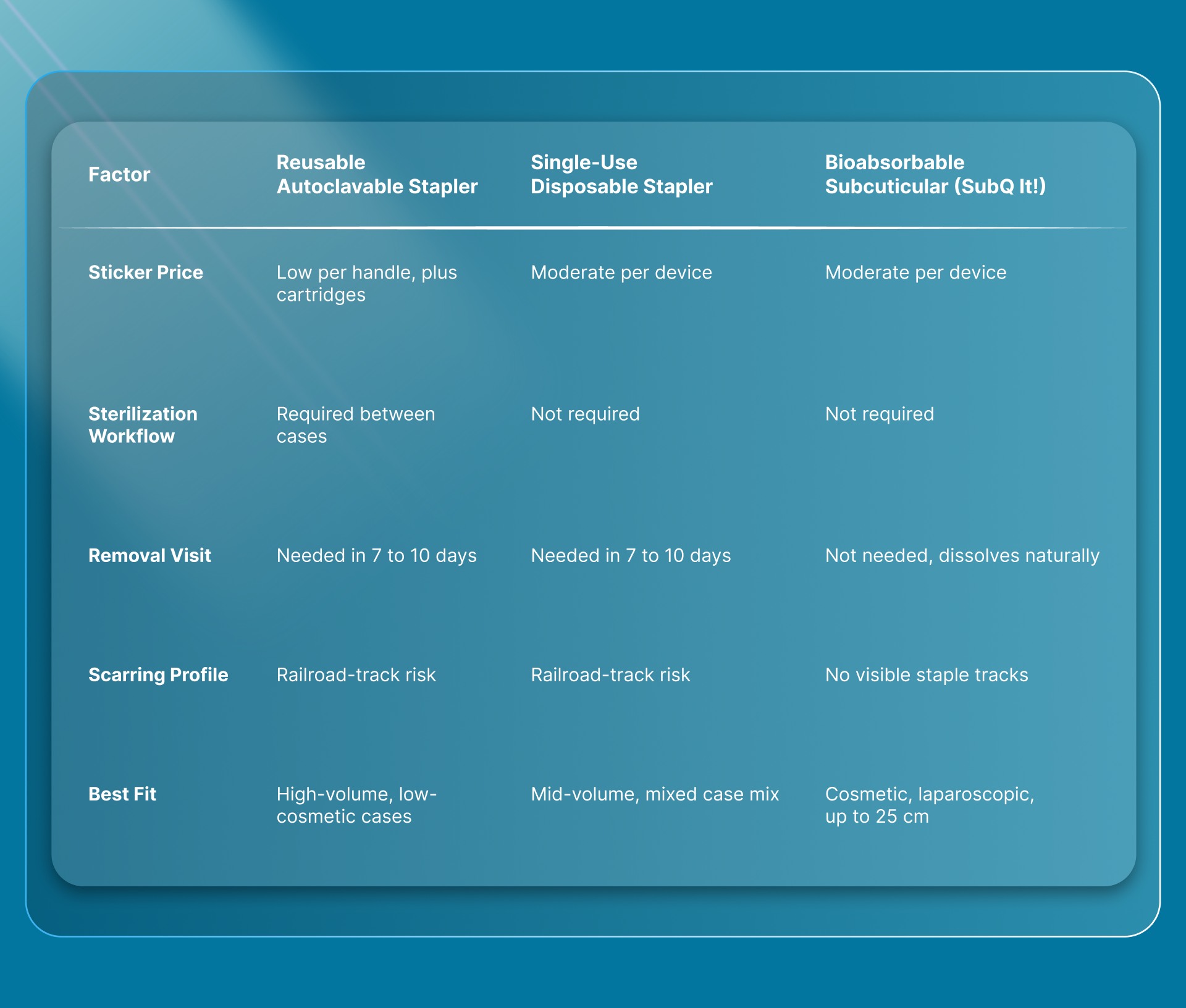
Practices weighing disposable skin stapler price alongside reusable options typically find that the decision rests on case mix, sterilization capacity, and the indirect costs associated with scarring and follow-up care.
How Reliable Is Sterilization Across Repeat Autoclave Cycles?
Sterilization is highly reliable when every step of the reprocessing cycle is completed correctly. Reprocessing itself remains vulnerable to human error at several stages. A reusable device carries the cumulative risk of every cycle it has been through.
A 2023 review in the American Journal of Infection Control reported that approximately 1 in every 100 surgical cases involves a decontamination issue identified by OR staff. Roughly half of those are tied to residual biological material on reprocessed instruments.
The same review noted that when a validated sterilization cycle runs correctly from end to end, the probability of the instrument itself causing an infection approaches zero. The core reliability factors associated with reusable staplers include:
- Cycle Compliance: Every reprocessing step must be completed correctly, on every cycle, for sterilization to remain dependable.
- Residue Detection: Biological material can persist on reprocessed instruments when pre-cleaning is rushed or incomplete.
- Device Wear: Repeated cycles gradually affect the mechanical components that control staple formation, which influences closure quality across the handle's lifespan.
- Handling Exposure: Reusable instruments are handed off multiple times for reprocessing, introducing additional contact points compared to disposable skin stapler formats.
A related concern involves sharps exposure for OR staff. A 2023 meta-analysis estimated that approximately 22% of OR sharps injuries occur during instrument handoff, a relevant consideration in any single-use skin stapler vs. reusable comparison.
The reliability of a reusable system depends on more than the autoclave itself. Every handling event between cases carries a measurable risk profile.
Are Metal Staples Still the Right Choice for Cosmetic Outcomes?
Metal staples are not always the preferred cosmetic choice, particularly in visible areas or high-tension incisions where patients track scarring closely. Peer-reviewed evidence on staple closure has tightened considerably in recent years, affecting both reusable and single-use formats.
A study of 14 randomized trials in cesarean skin closure reported that patients who received sewn closures had roughly half the composite wound complication rate of patients who received stapled closures, a finding that held across body types. Wound separation, the complication most likely to prompt a follow-up visit and patient dissatisfaction, was consistently lower in sewn closures.
In total hip replacement, a 2024 pooled analysis covering 1,084 patients reported that sewn closures were associated with significantly lower rates of superficial infection and wound drainage than stapled closures.
The cosmetic concern is more immediately visible to patients. A 2024 systematic review of facial closure flagged the risk of producing the crosshatched pattern commonly described as railroad-track scarring, a technique-dependent outcome that remains visible to the patient for months after surgery.
For practices whose reputation depends on cosmetic results, railroad-track scars represent a quiet driver of lost referrals. Alternatives such as sutureless closure and bioabsorbable closure options have meaningfully changed the cosmetic calculation.
What Closure Options Should Surgeons Compare Side by Side?
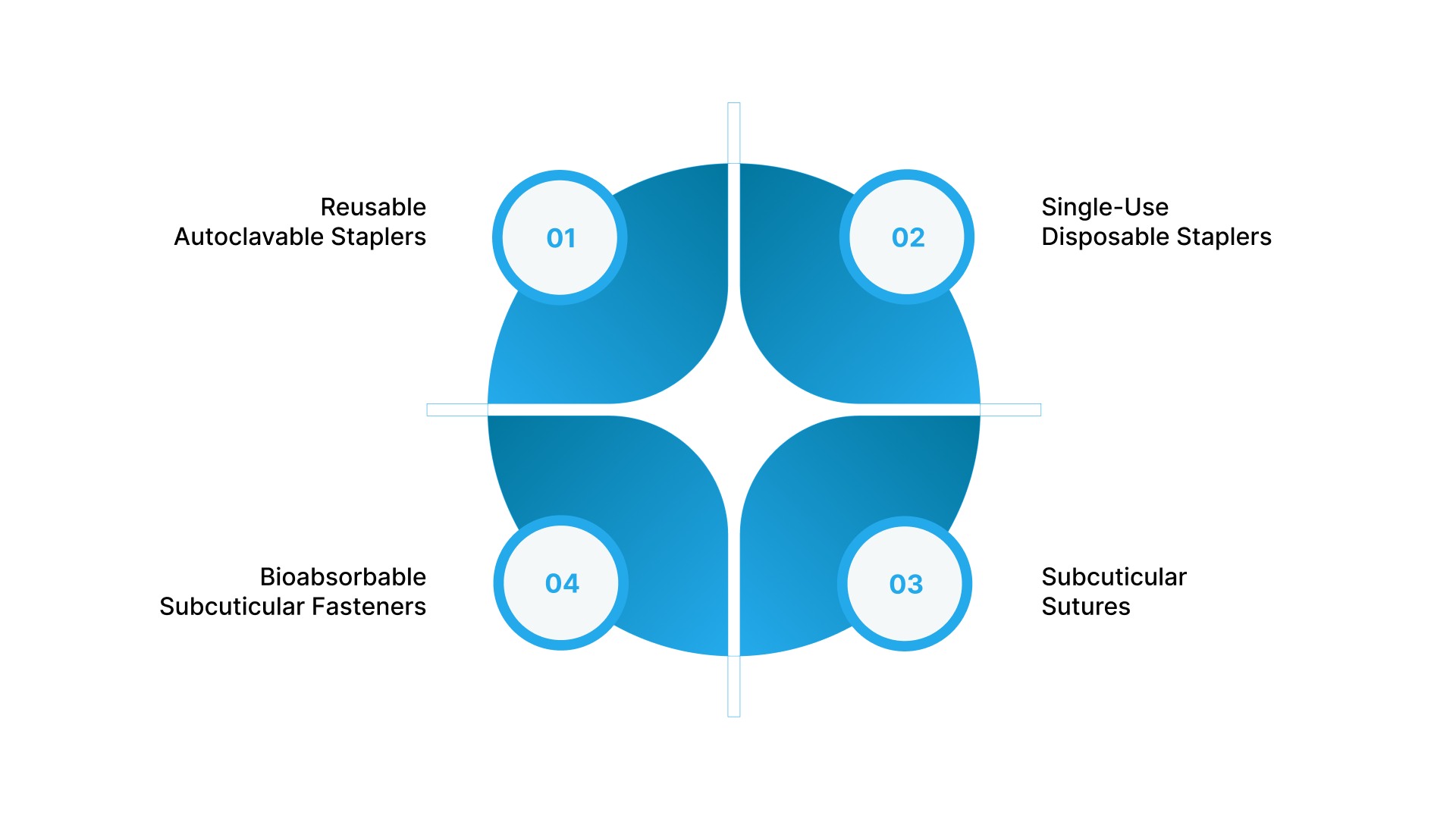
Surgeons evaluating a skin stapler purchase should compare reusable autoclavable staplers, single-use disposable staplers, subcuticular sutures, and bioabsorbable subcuticular fasteners. Each option addresses a different clinical case profile. The strongest decision comes from aligning the closure method with the surgeon's case mix and patient expectations.
Reusable Autoclavable Staplers
Reusable staplers are best suited to high-volume, non-cosmetic settings with well-established reprocessing infrastructure. The primary argument in their favor is a lower per-handle cost.
The offsetting considerations include reprocessing labor, tracking overhead, and the cosmetic limitations shared by any external metal staple.
Single-Use Disposable Staplers
Single-use staplers align well with mixed case mixes where reprocessing capacity is limited, and sterility assurance must remain predictable from case to case. The unit cost is higher than that of a reusable handle, though the workflow is simpler. Railroad-track scarring and removal visits still apply.
Subcuticular Sutures
Sewn subcuticular closure delivers strong cosmetic results and avoids railroad tracks entirely. The tradeoff is time.
Manual sewing adds OR minutes per case, which accumulates across a full surgical day and can cap patient throughput in a private clinic setting.
Bioabsorbable Subcuticular Fasteners
Bioabsorbable subcuticular closure combines the cosmetic profile of sewn closure with closure speed approaching that of a stapler. The SubQ It! SU-10 device closes incisions up to 10 cm with 10 dissolving fasteners. The SU-25 closes incisions up to 25 cm with 25 dissolving fasteners, saving approximately 25 minutes of OR time per case compared to manual sewing.
The fasteners dissolve on their own, so patients don't need a removal visit. Subcuticular placement eliminates railroad-track scarring entirely. For surgeons already comparing types of skin closure, bioabsorbable fasteners deliver better cosmetic results while saving significant time.
Closure decisions are ultimately case-mix decisions. The right answer for a plastic surgery clinic will differ from the right answer for a high-volume orthopedic center. The calculation should always rest on total cost and clinical outcome, not on sticker price alone.
Final Thoughts
An autoclavable surgical skin stapler can be an appropriate choice in the right setting, though the sticker price represents only a fraction of the full cost equation. Reprocessing labor, tracking, storage, replacement cycles, and the clinical cost of any complication all factor into the true per-case figure. Case mix and cosmetic expectations often outweigh per-unit cost.
SubQ It! is designed for practices ready to move past that axis. A bioabsorbable subcuticular closure system places dissolving fasteners beneath the skin, eliminates the removal visit, and delivers cosmetic outcomes closer to sewn closure at closure speeds approaching those of a stapler.
Every week a procurement decision is delayed carries a cost in both revenue and patient satisfaction. Contact us today to request a custom quote.
FAQs
1. How Many Times Can a Surgical Skin Stapler Be Autoclaved?
Reuse limits vary by manufacturer and device model, with each product carrying its own labeled sterilization cycle count before the handle needs to be retired. Always follow the manufacturer's instructions for use and retire the handle when mechanical wear begins to affect staple formation.
2. Can Any Skin Stapler Be Sterilized in an Autoclave?
No, only staplers specifically designed and labeled as autoclavable can be safely sterilized in an autoclave. Single-use disposable staplers are not built to withstand high-heat steam cycles and should be discarded after one case.
3. What's the Difference Between a Reusable and a Disposable Skin Stapler?
A reusable stapler includes a sterilizable handle paired with replaceable staple cartridges, designed for use across multiple cases during its service life. A disposable stapler is a sterile, single-patient device discarded after use, removing the reprocessing workflow entirely.
4. Are Autoclavable Skin Staplers Safe for Human Surgical Use?
Autoclavable skin staplers are considered safe for human surgical use when the manufacturer has designed and labeled the device for that application and when sterilization is completed correctly on every cycle. Clinical safety depends on strict adherence to reprocessing protocols.
5. Do Autoclavable Skin Staplers Leave the Same Scars as Disposable Ones?
Yes, reusable and disposable metal staplers produce similar scarring profiles, because the staple itself creates the track pattern, not the handle. Subcuticular and bioabsorbable closure options avoid external staple tracks entirely.
6. How Long Does It Take to Sterilize a Reusable Skin Stapler Between Cases?
A complete reprocessing cycle includes pre-cleaning, autoclave time, drying, and repackaging, which extends the total turnaround well beyond the autoclave itself. That time commitment is a core consideration when calculating the real cost per case of a reusable device.