
Many surgeons face a subtle pressure to balance closure speed, cosmetic outcomes, and patient comfort, all while managing procedure costs and follow-up care requirements. The choice of adhesive strips, sutures, staples, or bioabsorbable systems directly influences healing, scarring, and infection risk.
Market research estimates the global wound closure strips market at around USD 254–267 million) in 2025, reflecting steady growth driven by demand for minimally invasive closure solutions.
Research indicates that adhesive tape can be used to approximate wound edges, traditionally in low-tension wounds. The outcomes may be comparable in some settings; however, results vary by wound type and study design.
This blog explores when adhesive strips are the right option, step-by-step application techniques, key contraindications, and modern alternatives like bioabsorbable stapler systems that combine the speed of traditional staples with improved cosmetic outcomes.
TL;DR
- Sterile adhesive strips are used to help approximate edges in selected low‑tension wounds.
- Selection depends on wound tension, location, skin condition, and whether the wound can be closed with minimal force.
- Proper application requires clean, dry skin and careful placement that supports the wound edges without pulling them together.
- Avoid high‑tension wounds, infected or heavily contaminated sites, fragile skin, and wounds that require deep‑layer closure.
- For appropriate surgical incisions, consider sutures, staples, or tissue adhesives as alternative closure options.
What Are Adhesive Skin Closure Strips?
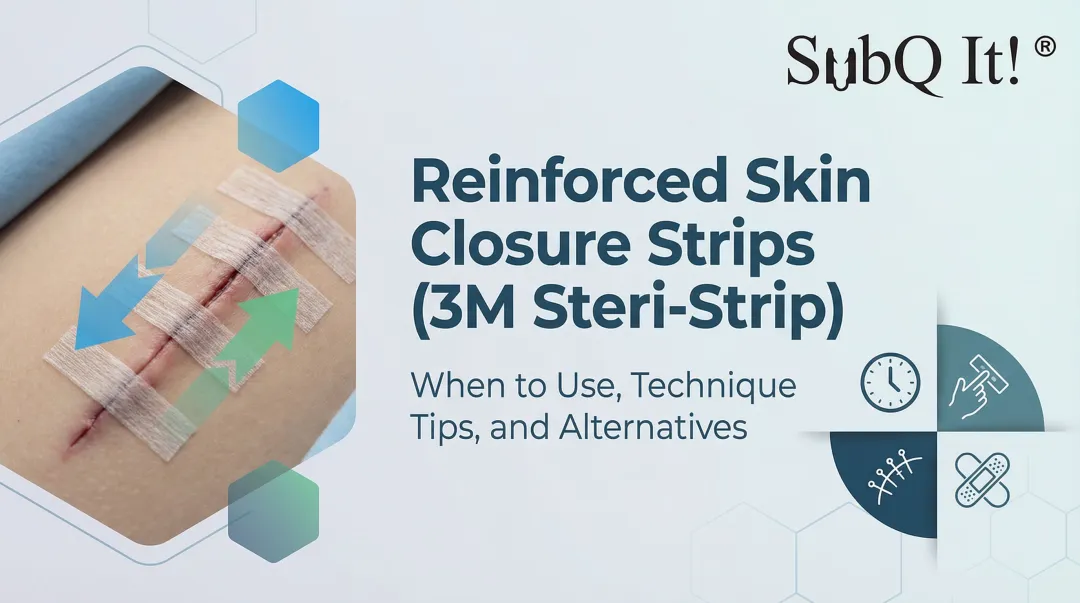
Adhesive skin closure strips are sterile adhesive tapes used to approximate wound edges in certain low‑tension wounds without penetrating the skin. Also known by the genericized trademark "Steri-Strips" (3M's brand name), these devices are external wound closures.
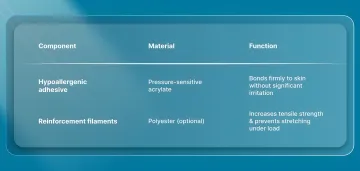
Core Components
The engineering behind adhesive strips includes three essential elements:
5 Proven Benefits of Adhesive Skin Closure Strips
Adhesive strips offer several clinical advantages:
- No skin penetration, reducing infection risk
- Minimal scarring compared to sutures and staples
- No removal appointment needed
- Easy application without specialized training
- Lower cost than suturing procedures
Research demonstrates no significant difference in infection rates between adhesive strips and sutures for appropriate wound types. In pediatric facial lacerations and low-tension surgical wounds, strips have shown cosmetic results statistically equivalent to sutures and tissue adhesives.
Key Factors to Consider When Selecting Adhesive Skin Closure Strips
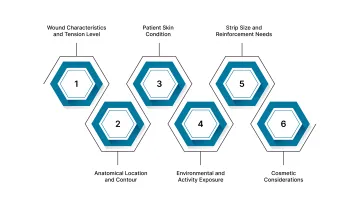
Selecting appropriate closure strips requires evaluating wound characteristics, anatomical location, patient factors, and expected healing conditions. Matching strip specifications to clinical requirements ensures optimal wound closure and healing outcomes.
Wound Characteristics and Tension Level
Adhesive strips are best for superficial, low-tension wounds that can be easily closed by hand. Avoid strips for high-tension or difficult-to-approximate wounds to prevent irritation or complications.
- Low-tension wounds only
- Facial lacerations, superficial surgical incisions
- Easily approximated by fingers
- Not for high-tension or hard-to-close wounds
- Reduces risk of skin irritation and complications
Superficial wounds are ideal candidates for strip closure. Deep lacerations requiring subcuticular layer closure need sutures or alternative closure methods, with strips used only as superficial adjuncts.
Anatomical Location and Contour
Different body locations present unique challenges for strip adhesion and wound closure success. According to the PMC surgical wound closure trial the ideal locations are as follows:
- Flat, low-tension areas with good skin contact are ideal
- Irregular or highly contoured areas may reduce adhesion and effectiveness.
Challenging locations:
- High-mobility joints (consider elastic variants)
- Areas with thick skin require a more robust closure
- Hairy regions where adhesion may be compromised
Patient Skin Condition
Elderly patients, those on long-term corticosteroids, or individuals with compromised skin integrity face a higher risk of Medical Adhesive-Related Skin Injury (MARSI), including skin tears upon removal.
Assessment factors:
- Skin hydration and elasticity
- Presence of dermatological conditions
- History of adhesive sensitivities
- Nutritional status affecting wound healing
Strips are not suitable where exudate, skin oils, or moisture prevent adequate adhesion. Thoroughly dry skin before application.
Environmental and Activity Exposure
Beyond patient factors, consider the environment and activities the closure must withstand.
Some closure systems may include protective dressings, but barrier properties (e.g., bacterial/viral protection) depend on the specific product and are not inherent to all adhesive strips.
Activity restrictions: Patient lifestyle matters. Athletes and manual laborers may require reinforced strips or alternative closure methods to withstand increased mechanical stress.
Strip Size and Reinforcement Needs
Strip length and spacing should follow manufacturer instructions and clinical judgment, ensuring proper wound edge approximation and drainage (instead of fixed cm/mm values).
Reinforcement decisions: Adhesive strips may be used for facial wounds, but evidence does not show improved cosmetic outcomes when added to properly sutured wounds.
Standard non-reinforced or elastic variants work better for contoured sites or areas with potential edema.
Cosmetic Considerations
Evidence shows that cosmetic outcomes with closure strips are generally comparable to sutures in appropriately selected cases, but not uniformly superior. Some studies suggest similar cosmetic outcomes in smaller wounds, but results vary depending on wound characteristics.
For surgical incisions requiring faster closure with superior cosmetic outcomes, bioabsorbable subcuticular closure systems like SubQ It! offer an alternative that combines speed with minimal scarring while eliminating the need for removal.
Step-by-Step Application Technique for Adhesive Skin Closure Strips
Adhesive wound closure strips are used for cutaneous wound closure in low‑tension wounds and can be an effective alternative to sutures or adhesives in appropriate cases.
Pre‑Application Preparation
- Evaluate the wound: Choose strips for wounds where the skin edges are easily approximated and where there’s low tension on the wound.
- Clean the wound and surrounding skin: Wounds should be prepared properly before closure for best outcomes.
- Dry the skin surface: Strips adhere to the skin; areas should be dry for effective bonding.
Strip Placement Technique
- Start with the first strip across the wound: Place the first adhesive strip perpendicular to the wound to approximate the cuticular edges.
- Work outward from the center: Apply additional strips spaced evenly to maintain approximation of skin edges.
- Do not stretch the strips: Strips should hold edges together; they should not be applied under tension or be used to pull edges forcefully.
- Ensure complete apposition: Aim for accurate edge apposition and avoid uneven or overlapping placement that may impair adhesion or healing.
- Use adjunct strips prudently: In some clinical practices, strips may be added to reinforce closure, especially if tension is a concern; however, the primary goal remains precise approximation of the wound edges.
Securing and Finishing
- Verify closure: After placement, ensure the wound edges remain well approximated with no gaps that could lead to dehiscence.
- Cover with a dressing if needed: A sterile dressing may be applied to protect the closure from contamination, absorb exudate, and help maintain adhesion.
Post‑Application Care
- Keep the strips in place: Strips generally remain until they naturally loosen or slough off as the wound re‑epithelializes.
- Avoid excessive tension across the wound: Minimize stretching or movement that could disrupt the approximation until healing progresses.
- Monitor for complications: Watch for signs of infection or wound separation: redness, warmth, discharge, or increasing pain.
- Removal if necessary: If clinical removal is required (e.g., loose or prematurely falling strips), gently peel them off along the skin surface, supporting the wound edges to prevent trauma.
When NOT to Use Adhesive Skin Closure Strips
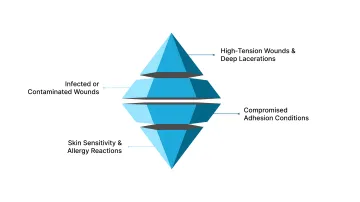
While adhesive strips are versatile, certain wound and patient characteristics make them inappropriate or ineffective. Understanding contraindications prevents closure failure and complications.
High‑Tension Wounds and Deep Lacerations
Adhesive strips are appropriate only for low‑tension wounds where edges can be approximated easily. Clinical evidence shows strips are suitable for low‑tension closure but do not improve outcomes when deeper support (e.g., deep sutures) is required. For more complex wounds, standard suturing is preferred.
Examples of situations to avoid using strips alone:
- Wounds that cannot be brought together without manual support.
- Deep lacerations requiring deep layer approximation.
Infected or Contaminated Wounds
Closing wounds that are active sites of infection or gross contamination should be avoided until the wound is cleaned and decontaminated. This reflects general wound‑closure principles in clinical practice, although specific randomized trials do not focus on strips alone.
Examples of situations to avoid:
- Actively infected wounds.
- Heavily contaminated lacerations.
- Wounds with ongoing drainage, bleeding, or requiring debridement.
Compromised Adhesion Conditions
Adhesive strips require reliable adhesion. They should be avoided where adhesion cannot be easily achieved due to moisture, oily or sweaty skin, dense hair, or granulating tissue.
Examples of compromised adhesion conditions:
- Moist, oily, or exuding wound areas.
- Dense hair at the wound margin without prior removal or prep.
- Inadequately cleaned or wet wounds.
Skin Sensitivity and Allergy Reactions
Although clinical trial evidence focuses on closure technique outcomes, case reports document dermatologic reactions (e.g., blistering, irritation) related to adhesives and closure strips in some patients. These reactions are rare but should be considered when choosing closure techniques.
Examples:
- Allergic or irritant dermatitis under adhesive strips.
- Blistering or maceration under strips.
Comparative Clinical Performance of Adhesive Strips and Other Skin Closure Techniques
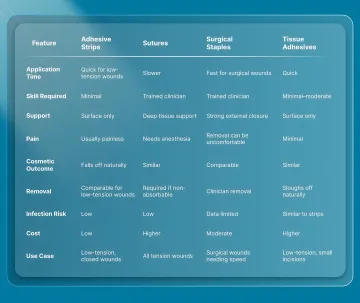
Wound closure method selection depends on wound characteristics, required strength, cosmetic goals, and procedural context. Understanding the strengths and limitations of each method enables optimal clinical decision-making.
Subcuticular Closure Systems as an Alternative
For surgical incisions requiring both subcuticular support and optimal cosmetic outcomes, bioabsorbable subcuticular closure systems like SubQ It! offer distinct advantages.
These systems place fasteners beneath the skin surface for internal wound approximation without external piercing. Key features include:
- It is an FDA 510(k)‑cleared bioabsorbable skin closure system indicated for subcuticular closure in abdominal, thoracic, gynecologic, orthopedic, plastic, and reconstructive surgery.
- The system uses bioabsorbable fasteners placed beneath the skin surface (subcutaneously) without piercing the external epidermis, which eliminates the need for adhesive strips or other closure techniques.
- Each fastener deploys in about 7 seconds, making closure up to ~7× faster than manual suturing under typical operating conditions. Because the fasteners are bioabsorbable, they naturally degrade and do not require a removal visit, reducing follow‑up procedures.
Two configurations are available:
- SU‑10: Contains 10 bioabsorbable fasteners for incisions up to ~10 cm.
- SU‑25: Contains 25 fasteners for incisions up to ~25 cm.
Subcuticular placement helps minimize visible scarring associated with percutaneous metal staples.
Final Thoughts
Wound closure isn’t just a procedural step; it shapes outcomes across surgeons, settings, and patient profiles. For low‑tension wounds, adhesive skin closure strips offer a cost‑effective, practical alternative with comparable infection and cosmetic results.
Traditional sutures remain vital for deeper or high‑tension wounds, providing stronger mechanical support than adhesives. Meanwhile, bioabsorbable subcuticular systems like SubQ It! add a new dimension, closing incisions beneath the skin quickly and efficiently, reducing the need for external staples or follow-up removal, while supporting favorable cosmetic results.
Explore how SubQ It! fits into your surgical workflow and get in touch with the team to learn more.
Frequently Asked Questions
1. What is adhesive skin closure?
Adhesive skin closure uses sterile surgical tape strips to hold wound edges together without penetrating the skin. These strips serve as a non-invasive alternative to sutures for low-tension wounds and can support proper healing while reducing the risk of infection.
2. How long do skin closure strips stay on?
Strips typically remain in place for 5–14 days, depending on wound location and activity level. They naturally loosen and fall off as the wound heals, or can be gently removed after 7–10 days if still adherent.
3. What is the best method for wound closure?
The optimal closure method depends on wound depth, tension, and location. Adhesive strips are suitable for superficial, low-tension wounds; sutures are preferred for deeper or high-tension wounds; and tissue adhesives are often used for small pediatric lacerations or wounds requiring rapid closure.
4. What glue do doctors use to close wounds?
Doctors use medical-grade cyanoacrylate adhesives like Dermabond and Histoacryl. These FDA-approved topical skin adhesives provide waterproof barriers and antimicrobial properties for appropriate wound types.
5. What suture is used for skin closure?
Non-absorbable sutures like nylon and polypropylene require removal after healing. Absorbable sutures like Vicryl and Monocryl dissolve over time and don't require removal, making them ideal for subcuticular closure.
6. Does adding adhesive strips to subcuticular sutures improve scar outcomes?
Evidence from randomized clinical trials shows that combining adhesive strips with buried subcuticular sutures does not significantly improve scar appearance or width at follow‑up compared with subcuticular sutures alone, suggesting strips add limited cosmetic benefit in this context.
7. Do adhesive strips help reduce wound redness or irritation compared to other closure methods?
Meta‑analytic evidence indicates that adhesive closure strips may result in a significantly lower incidence of redness at the incision site compared with sutures or other closure techniques, although overall infection and cosmetic outcomes tend to be equivalent.