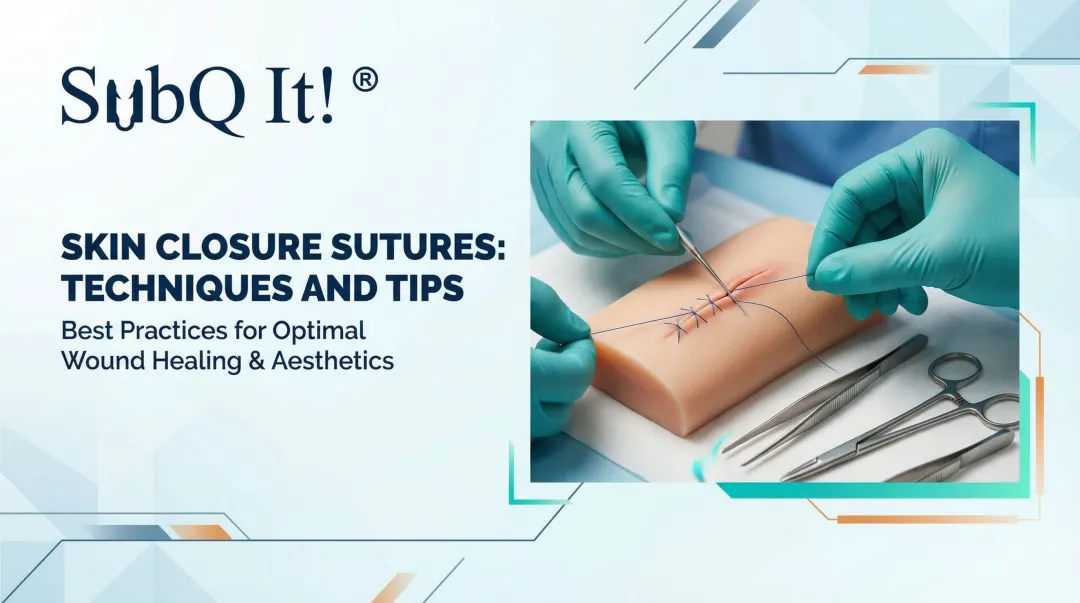

A simple skin laceration can still affect healing, patient comfort, and follow-up care. Given that around 4 million patients undergo emergency general surgery procedures each year, even routine closure decisions carry meaningful clinical and operational impact.
In this context, traditional sutures and staples provide strong closure but involve skin penetration and often require removal.
Reinforced skin closure strips offer a non-invasive alternative for low-tension, superficial wounds, maintaining edge approximation without added procedural burden.
In this blog, you’ll examine how surgeons evaluate reinforced skin closure strips in 2026, including patient selection, wound suitability, comparative performance, and practical limitations.
Key Takeaways:
- Reinforced skin closure strips are designed for superficial, low-tension wounds in which the edges can be easily brought together.
- Proper wound preparation, including a clean, dry surface and controlled bleeding, is essential for effective adhesion.
- Strips should be placed carefully so they hold the wound edges together without pulling or stretching the skin.
- When used in appropriately selected low-tension wounds, strips can provide cosmetic outcomes comparable to sutures and may reduce pain during application and removal.
- Ideal anatomical locations for strips are flat, low-motion areas such as the forehead, chin, and extremities away from joints and high-moisture zones.
What Are Reinforced Skin Closure Strips?
Reinforced skin closure strips are sterile adhesive wound closure devices with a porous, nonwoven backing, typically a rayon–polyester blend, and a pressure-sensitive acrylate adhesive. They approximate wound edges externally without penetrating the skin.
Their defining feature is embedded polyester filaments within the backing, which increase tensile strength compared to non-reinforced surgical tape and provide added wound support.
Once the concept is clear, it becomes easier to determine which wound types benefit most from strip closure.
Types of Wounds Suitable for Strip Closure
Selecting an adhesive strip closure depends on wound tension, depth, and whether the edges can be approximated without force.
These devices are designed for surface-level closure and are only appropriate when mechanical stress on the wound is low.
Ideal wound profiles:
- Clean, linear lacerations with minimal tension
- Wounds limited to the epidermis and superficial dermis
- Wounds where edges can be easily approximated with gentle finger or forceps pressure
- Small, well-controlled wounds where bleeding has been addressed and the skin surface is dry
Contraindications:
- Infected or contaminated wounds
- High-tension wounds, especially over joints or areas with significant movement
- Deep lacerations requiring layered closure of dermal or subcutaneous tissue
- Wounds with significant gaping that cannot be approximated without deep sutures
Once the concept is established, it is important to consider the specific scenarios in which its use is recommended.
When Should You Use Reinforced Skin Closure Strips?
Reinforced skin closure strips are appropriate when wound tension is low, and edges can be approximated without force. Their role is limited to superficial closure or additional support following primary closure methods.
1. Clinical indications
Reinforced strips are used for primary closure of superficial, low-tension lacerations and as adjunctive support after suture or staple removal.
Primary clinical uses include:
- Superficial facial lacerations in cooperative patients
- Reinforcement of surgical incisions after early suture or staple removal during the initial healing phase
- Pediatric patients where avoiding needles reduces procedural distress
- Elderly patients with fragile skin may benefit from less-invasive closure methods, but adhesive-related skin injury should also be considered when selecting.
While reinforced strips are effective in these scenarios, they do not provide structural support when deeper closure or greater consistency is required.
In such cases, SubQ It! SU-10 offers a bioabsorbable subcutaneous closure option for small incisions, placing bioabsorbable fasteners beneath the skin to maintain precise edge approximation without removal.
2. Anatomical considerations
Anatomical location determines whether strips will maintain adhesion and withstand mechanical stress. Low-motion, low-tension areas are most suitable, while regions with moisture or movement increase the risk of failure.
Ideal anatomical locations:
- Forehead and chin
- Chest and abdomen away from high-motion zones
- Extremities with minimal joint involvement
Areas to avoid:
- Scalp (hair interferes with adhesion)
- Hands and feet (high moisture)
- Joints in flexion (knees, elbows)
- Axillae and groin (moisture and movement)
3. Patient selection factors
Patient cooperation and skin quality directly affect outcomes. Adhesive-based closure depends on maintaining a dry, stable environment and avoiding mechanical disruption.
- Cooperative patients achieve more reliable results.
- Pediatric patients benefit from needle-free closure
- Elderly patients require careful removal to avoid Medical Adhesive-Related Skin Injury (MARSI).
Identifying suitable scenarios leads to a closer look at the different types available in practice.
5 Types of Reinforced Skin Closure Strips
Skin closure strips are available in multiple configurations based on material, flexibility, and clinical use. While reinforced variants provide higher tensile support, other strip types are designed for flexibility, cosmetic appearance, or adjunct functions.
1. Reinforced Strips (Standard)
Reinforced strips use a nonwoven backing with embedded polyester filaments to improve tensile strength and wound support.
- Provide greater tensile strength than non-reinforced strips
- Maintain wound edge approximation in low-tension conditions
- Used for routine surgical incisions and lacerations
2. Elastic Skin Closure Strips (Non-Reinforced)
Elastic strips are designed for flexibility in areas subject to movement.
- Conform to contoured or mobile anatomical regions
- Maintain adhesion during motion or mild swelling
- May be considered in mildly contoured or mobile areas, but not in high-tension joints or wounds under significant mechanical stress.
3. Blend Tone (Cosmetic) Strips (Non-Reinforced)
Blend tone strips are designed for improved cosmetic appearance.
- Skin-toned backing reduces visibility
- Used in facial and exposed areas
- Provide lower tensile support than reinforced strips
4. Antimicrobial Skin Closure Strips
Antimicrobial strips incorporate iodophor within the adhesive to reduce microbial presence.
- Provide broad-spectrum antimicrobial activity
- Used in wounds with a higher infection risk
- Serve as an adjunct, not a replacement for aseptic technique
5. Skin Closure Systems (Strip + Film Dressing)
These systems combine adhesive strips with a transparent film dressing.
- Provide additional barrier protection
- Help maintain adhesion in exposed or high-moisture environments
- Used when extended wear or coverage is required
After reviewing the variations, it is important to understand how these strips are correctly applied to ensure optimal closure.
6 Steps to Apply Reinforced Skin Closure Strips Correctly
Reinforced skin closure strips are used when wound tension is minimal, and the edges can be approximated without layered closure. Correct application ensures reliable adhesion, proper alignment, and reduces the risk of blistering or early detachment.
Here’s how to apply reinforced skin closure strips correctly:
1. Wound Preparation
Adequate preparation determines whether strips will adhere and remain effective throughout the initial healing phase.
2. Strip Selection and Placement
Strip selection should be based on wound size and the level of support required, rather than fixed anatomical rules. Proper placement ensures effective edge approximation without compromising skin integrity.
- Select an appropriate strip width based on wound characteristics.
- Ensure sufficient overlap on both sides of the wound to ensure secure adhesion without excessive extension.
- Maintain spacing between adjacent strips.
- Apply strips perpendicular to the wound to achieve uniform edge approximation.
3. Application Technique
Correct technique ensures that wound edges are aligned without introducing tension that may damage the skin. Strips should maintain approximation, not create it through force.
- Start at the wound center and place the first strip at the midpoint
- Secure one side of the strip firmly to the skin
- Approximate wound edges manually and apply the opposite end without stretching the strip.
- Press along the strip to ensure full adhesive contact
- Continue placing strips outward from the center, maintaining even spacing
Critical point: Do not apply strips under tension. Stretching or strapping can lead to blistering or skin injury.
4. Reinforcement and Stability
Additional support may be used in situations with mild residual tension or movement. Reinforcement helps maintain alignment once the primary approximation has been achieved.
- Apply additional parallel strips if needed to improve stability
- Ensure strips lie flat without lifting at the edges
- Avoid excessive layering, as this does not increase closure strength
5. Post-Application Assessment
Immediate assessment confirms that the wound is properly approximated and that the strips are functioning as intended. Early correction reduces the risk of closure failure.
- Wound edges should be closely opposed without gaping or overlap
- Strips should lie flat without puckering
- No blanching or visible skin stress should be present
- Placement should not occlude the wound surface
6. Aftercare and Removal
Post-application care directly affects adhesion longevity and healing outcomes. Clear instructions reduce early detachment and patient-related complications.
- Keep the area dry for at least 48 hours
- Avoid excessive movement or sweating during early healing
- After 48 hours, gentle cleansing around the strips is acceptable; pat dry carefully
- Avoid soaking or prolonged water exposure
Duration and removal:
- Strips typically remain in place until they fall off naturally, depending on the wound
- Remove earlier if signs of infection develop
- For removal, soak and peel the strips parallel to the skin surface, avoiding perpendicular force
Once the application process is clear, attention naturally shifts to their clinical advantages and potential limitations.
What are the Benefits & Limitations of Reinforced Skin Closure Strips?
Reinforced skin closure strips provide a reliable option for low-tension, superficial wounds. Understanding both their advantages and limitations ensures optimal wound management and supports clinical decision-making.
Clinical Advantages
Reinforced strips offer several evidence-based benefits for appropriate wounds:
These benefits make reinforced strips particularly valuable in pediatric patients, minor facial lacerations, and low-tension surgical incisions.
Limitations and Disadvantages
Despite their advantages, reinforced strips have clear clinical limitations:
Once their advantages and constraints are clear, it becomes easier to evaluate how they compare or complement other techniques.
How Reinforced Skin Closure Strips Compare or Combine with Other Methods?
Reinforced skin closure strips are appropriate when wound tension is minimal, and no layered closure is required. Their role is best defined relative to sutures, staples, and tissue adhesives in terms of strength, control, and depth of closure.
Quick decision guide:
- Use strips: Superficial wounds with low tension and easily approximated edges
- Use sutures: When depth, strength, or precise alignment is required
- Use staples: For rapid closure of longer incisions or moderate tension
- Use adhesives: For small, clean, low-tension wounds
Comparison Across Closure Methods
Below is a comparison across different closure methods.
| Parameter | Reinforced Strips | Sutures | Staples | Tissue Adhesives |
|---|---|---|---|---|
| Tissue involvement | Surface only | Multi-layer (dermal/subcutaneous) | Skin penetration | Surface bonding |
| Tensile support | Limited, non-adjustable | High, adjustable | Moderate skin-level support | Limited |
| Edge control | Limited | High precision | Moderate | Limited |
| Speed | Fast (small wounds) | Slower, technique-dependent | Fast (long incisions) | Fast |
| Removal required | No | Sometimes (non-absorbable) | Yes | No |
| Best use case | Low-tension, superficial wounds | Deep or tension-bearing wounds | Long or moderate-tension incisions | Small, clean wounds |
Clinical interpretation: Reinforced strips are not a substitute for sutures or staples. They are only appropriate when the wound does not rely on structural support and the edges can be approximated without force.
How Strips Are Used in Combination?
In practice, reinforced strips are most often used as adjuncts after primary closure has already addressed wound tension. Their role is to support superficial alignment rather than provide structural strength.
- Applied over deep dermal sutures to maintain epidermal edge approximation
- Used after suture or staple removal to support the incision during early healing
- Added in low residual tension cases to provide additional surface-level support
Evidence indicates that adding adhesive strips over dermal sutures does not significantly improve cosmetic outcomes or reduce scar width compared with sutures alone, reinforcing that their value lies in mechanical support rather than in modifying outcomes.
Where Strips Do Not Replace Other Methods?
Reinforced strips are not appropriate when:
- Wound tension is moderate to high
- Layered closure is required
- Precise control of edge alignment is necessary
- Adhesion is likely to be compromised due to moisture, movement, or hair
Final Thoughts
Choosing the right wound closure method can influence patient comfort, follow-up requirements, and long-term cosmetic outcomes. Even minor lacerations benefit from methods that simplify closure while maintaining reliable edge approximation.
In this context, SubQ It! SU-10 offers a bioabsorbable subcutaneous closure system for small surgical incisions. The device places bioabsorbable fasteners beneath the skin to precisely approximate wound edges for incisions up to 10 cm.
Because the fasteners are bioabsorbable and placed subcutaneously, there is no need for a follow-up visit for removal.
Contact us today to explore how SubQ It! SU-10 can support minor incision closure, improve cosmetic outcomes, and streamline your workflow.
FAQs
1. What are reinforced skin closures?
Reinforced skin closures are adhesive strips strengthened with polyester filaments that hold wound edges together without piercing the skin. They are used for superficial, low-tension lacerations and offer a non-invasive alternative to sutures or staples.
2. Do wound closure strips work?
Yes, wound closure strips are clinically effective for appropriate wounds. Evidence shows comparable healing outcomes to sutures for superficial, low-tension lacerations, with advantages including less pain during application and removal, reduced tissue trauma, and favorable cosmetic results.
3. What is the adhesive for wound closure?
Wound closure strips use medical-grade, hypoallergenic, pressure-sensitive acrylate adhesive that bonds to the skin when firm pressure is applied. Compound Benzoin Tincture may be used to improve adhesion in challenging cases, though it can cause allergic contact dermatitis in sensitive individuals.
4. Can reinforced skin closure strips be used on pediatric patients?
Yes. Strips are especially useful in children because they reduce procedural anxiety and pain by avoiding needles. They are most effective for superficial, low-tension lacerations where edges can be approximated without force.
5. Which anatomical areas are ideal for reinforced skin closure strips?
Reinforced strips are best for flat, low-movement areas such as the forehead, chin, and extremities away from high-tension joints. Avoid areas with high moisture, hair, or frequent motion that can compromise adhesion.
6. Are there limitations to using reinforced skin closure strips?
Yes. Strips are not suitable for deep lacerations, high-tension wounds, or wounds that require layered closure. Adhesion may fail in sweaty or oily skin, and strips cannot achieve hemostasis, so bleeding must be controlled first.