
Surgeons face constant pressure to close wounds quickly, safely, and cosmetically, all while minimizing patient discomfort and follow-up visits. Traditional metal staples are fast, but they remain as permanent foreign bodies, create visible “train-track” scars, and require painful removal.
Polylactic acid (PLA) staples offer a biodegradable, subcuticular alternative, maintaining strength during critical healing while naturally absorbing over time. The result? Faster wound closure, minimal scarring, and no removal appointments, without compromising clinical outcomes.
But how do PLA staples truly perform across different surgical specialties, and are they worth the investment for modern operating rooms? This blog dives into the latest evidence, surgical applications, and practical insights for 2026.
TLDR:
- PLA staples degrade naturally into lactic acid after maintaining strength during critical 1-2 week healing
- Eliminate "train-track" scarring through subcuticular placement that never punctures external skin
- Close incisions 7X faster than manual suturing with no removal appointments required
What Are Polylactic Biodegradable Medical Staples?
Polylactic biodegradable staples are bioabsorbable surgical fasteners that secure tissue during healing and naturally dissolve over time. Made from polylactic acid (PLA), these staples are widely used in minimally invasive surgeries and soft tissue closure, offering a safe, convenient alternative to traditional metal staples.
How Do They Work?
Polylactic staples provide reliable tissue closure while gradually being absorbed by the body. Here’s how they work:
- Immediate Stability: Offers mechanical support comparable to metal staples during early healing.
- Gradual Absorption: Hydrolyzes slowly into lactic acid over weeks to months.
- Safe Metabolic Pathway: Lactic acid is naturally broken down into carbon dioxide and water.
Key Features of PLA Staples:
Polylactic staples combine mechanical support with patient-friendly design:
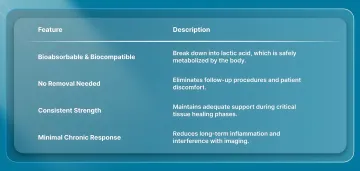
| Feature | Description |
|---|---|
| Bioabsorbable & Biocompatible | Break down into lactic acid, which is safely metabolized by the body. |
| No Removal Needed | Eliminates follow-up procedures and patient discomfort. |
| Consistent Strength | Maintains adequate support during critical tissue healing phases. |
| Minimal Chronic Response | Reduces long-term inflammation and interference with imaging. |
PLA vs PGA vs PLGA: 3 Polymers in Resorbable Medical Devices
Biodegradable polymers support tissues temporarily and safely dissolve in the body. The following table compares common bioabsorbable materials used in surgical skin closure.
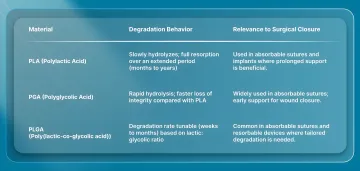
| Material | Degradation Behavior | Relevance to Surgical Closure |
|---|---|---|
| PLA (Polylactic Acid) | Slowly hydrolyzes; full resorption over an extended period (months to years) | Used in absorbable sutures and implants where prolonged support is beneficial. |
| PGA (Polyglycolic Acid) | Rapid hydrolysis; faster loss of integrity compared with PLA | Widely used in absorbable sutures; early support for wound closure. |
| PLGA (Poly(lactic‑co‑glycolic acid)) | Degradation rate tunable (weeks to months) based on lactic: glycolic ratio | Common in absorbable sutures and resorbable devices where tailored degradation is needed. |
Note: Manual sutures and metal staples still work, but results can vary depending on the surgeon’s technique. SubQ It! uses bioabsorbable, subcuticular closure to make outcomes more consistent, reduce scarring, and save patients the hassle of staple removal.
5 Evidence-Backed Tradeoffs Surgeons Must Consider in Skin Closure
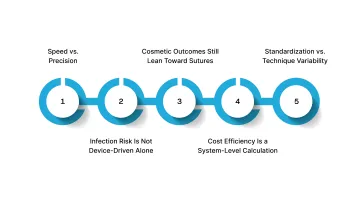
Wound closure decisions aren’t just technical; they directly influence OR efficiency, complication risk, cosmetic outcomes, and overall cost of care.
1. Speed vs. Precision
- Staples consistently reduce skin closure time, especially in longer incisions or high-throughput settings.
- However, faster closure does not necessarily translate into better clinical outcomes.
A recent multi-center RCT (2025) comparing sutures, staples, and tissue adhesives found:
- No statistically significant difference in complication rates across closure methods
- Faster closure with staples, but no downstream benefit in healing or recovery metrics
Speed matters most in OR efficiency and scheduling, not necessarily in patient recovery. The benefit is operational, not clinical.
2. Infection Risk Is Not Device-Driven Alone
Infection risk is often assumed to be device-dependent, but evidence suggests otherwise.
- A 2024 clinical study in spinal procedures reported:
- Lower SSI rates with staples compared to absorbable sutures in that specific cohort
- However, broader analyses show SSI outcomes are heavily influenced by:
- Tissue handling
- Wound tension and perfusion
- Patient comorbidities (e.g., diabetes, obesity)
- Consistency of closure technique
Closure material plays a role, but execution and patient factors often matter more than the device itself.
3. Cosmetic Outcomes Still Lean Toward Sutures
Cosmesis remains one of the few areas with a clearer trend.
- The 2025 STILS RCT found:
- Superior cosmetic outcomes with absorbable sutures compared to staples and adhesives
- Staples can deliver acceptable results, but:
- Outcomes may vary depending on spacing, tension, and placement
- Visible “track marks” remain a concern in certain anatomical areas
For aesthetic-sensitive procedures (e.g., plastics, visible incisions), sutures still provide more predictable results.
4. Cost Efficiency Is a System-Level Calculation
Device cost alone doesn’t reflect the true economic impact.
Key cost drivers include:
- OR time (favoring faster closure methods like staples)
- Material cost (often lower for sutures)
- Follow-up care (e.g., staple removal visits, complication management)
The 2025 RCT concluded:
- Absorbable sutures were the most cost-effective overall when factoring in the total care pathway
Cost decisions should be based on total episode-of-care economics, not per-unit device pricing.
5. Standardization vs. Technique Variability
One of the most practical (and underrated) differences is consistency.
- Sutures:
- Highly technique-dependent
- Outcomes vary with surgeon skill, experience, and fatigue
- Staples:
- More standardized application
- Reduced variability in spacing and approximation
This becomes particularly relevant in the following:
- High-volume ORs
- Multi-surgeon practices
- Training environments
Staples can improve repeatability and workflow consistency, even if clinical outcomes remain similar.
SubQ It!: Faster, Scar-Free Closure Without Staple Removal
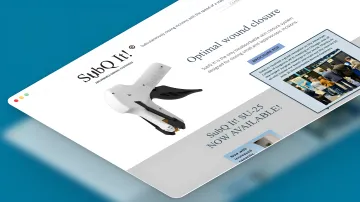
Traditional metal staples sit on the skin surface, require removal in 7–10 days, and often leave visible “railroad-track” scars. SubQ It! replaces this with a bioabsorbable, subcuticular approach, closing incisions beneath the skin and eliminating the need for removal.
Key Features & Benefits
- Bioabsorbable & Subcutaneous: Fasteners are placed under the skin and naturally absorbed during healing — no removal visit required.
- Time-Saving Models
- SubQ It 10: 10 staples, closes up to 10 cm, suited for small and laparoscopic incisions
- SubQ It 25: 25 staples, closes up to 25 cm, designed for longer incisions, saving ~25 minutes of OR time per procedure
- Versatile Across Incision Sizes: Vertical placement enables closure across both very small and longer incisions with the same system.
- Improved Practice Efficiency: Eliminates return visits for staple removal, simplifying post-op workflow
- Clear Cost Consideration: Priced at ~$60–$100 per use, with time savings translating into meaningful revenue potential in high-volume practices
Final Thoughts
PLA-based staples bring a different approach to wound closure, combining temporary mechanical support with controlled degradation that aligns with tissue healing timelines. Their performance, however, still depends on factors like material behavior, handling, and clinical context, so outcomes are not defined by material choice alone.
For more consistent and predictable closure, especially in skin and superficial tissues, bioabsorbable subcuticular systems built on PLA, such as SubQ It!, offer a reliable alternative. They eliminate staple removal, reduce technique variability, and better align with real-world surgical workflows.
Maximize efficiency and closure consistency by choosing solutions that perform where it matters. Reach out to the SubQ It team to see how your workflow can benefit.
FAQs
1. How long do PLA staples take to dissolve completely?
PLA staples take 12-24 months for complete absorption but maintain mechanical strength only during the critical 1-2 week healing window. Functional support ends well before complete resorption.
2. Are biodegradable staples more expensive than traditional metal staples?
Yes, biodegradable staples generally have a higher upfront cost compared to metal staples. However, they can reduce downstream costs by eliminating removal procedures and minimizing follow-up interventions, which may improve overall procedural efficiency and patient experience.
3. Can PLA staples be used for all types of surgical incisions?
PLA-based staples are used across multiple surgical specialties, but their suitability depends on tissue type, wound tension, and healing requirements. They are typically best suited for soft tissue closures where controlled degradation and temporary support are sufficient.
4. Are PLA staples widely used in other medical applications?
Yes, PLA is extensively used in sutures, orthopedic devices, drug delivery systems, and tissue engineering, highlighting its reliability as a bioabsorbable material in clinical settings
5. Do biodegradable staples cause allergic reactions?
Allergic reactions to PLA are extremely rare due to its excellent biocompatibility profile. PLA degrades into naturally occurring lactic acid metabolites that the body routinely processes through normal metabolism, making adverse reactions unlikely.
6. Are PLA staples safe for MRI and CT scans?
Yes, PLA staples are fully compatible with MRI and CT imaging. They produce minimal imaging artifacts compared to metal staples, which is important for oncology follow-up and complication monitoring.