You've closed the case cleanly. Two weeks later, the patient sits in your clinic chair for five minutes of stitch removal and walks out. Those five minutes repeat across every closure you place.
The scissors you reach for during the closure matter. The wrong blade can nick surrounding skin, pull thread through a healing wound, or turn a clean line into a complaint about scarring. Facial-closure research has flagged railroad-track scarring as a known risk of percutaneous closure when technique or timing goes wrong.
This post covers what stitch-cutting scissors are, their different types, and whether the removal step itself should still be part of your workflow.
Key Takeaways
- Stitch-cutting scissors rely on a hooked lower blade and a blunted tip so the instrument lifts the suture off the skin before cutting, rather than cutting against it.
- Standard routine suture removal sits inside a one-to-two-week window after placement, with anatomical location and wound tension driving the specific timing.
- The safer removal sequence is lift the knot, slide the blade under the suture close to the skin, cut below the knot, and pull the stitch out in one motion to avoid dragging the contaminated above-skin segment through tissue.
- Best-practice guidance calls for removing every second suture first and reassessing for wound separation before completing removal.
- A 2024 facial-closure meta-analysis of 804 patients found no statistically significant cosmetic or infection differences between absorbable and nonabsorbable sutures, weakening the clinical case for a routine removal visit.
What Does Scissors for Cutting Stitches Mean?
Scissors to cut stitches are a narrow category of surgical instruments built specifically to lift and divide suture material during post-op removal. They aren't general-purpose dissection scissors, and they aren't bandage shears. The design exists to slide under a tied knot, divide the thread, and leave the surrounding skin untouched.
The main feature is a small hook or curve on one blade. That hook slips beneath the suture close to the skin. The opposite blade then cuts the thread. The geometry keeps the cutting edge off the patient.
A practical example. You placed a running nonabsorbable closure on a forearm laceration 10 days ago. At the removal visit, you need an instrument fine enough to slip under each loop without pressing against healing skin and sharp enough to cut cleanly in one pass. That's what this category is designed to do.
Why Do Stitch Removal Scissors Need A Special Design?
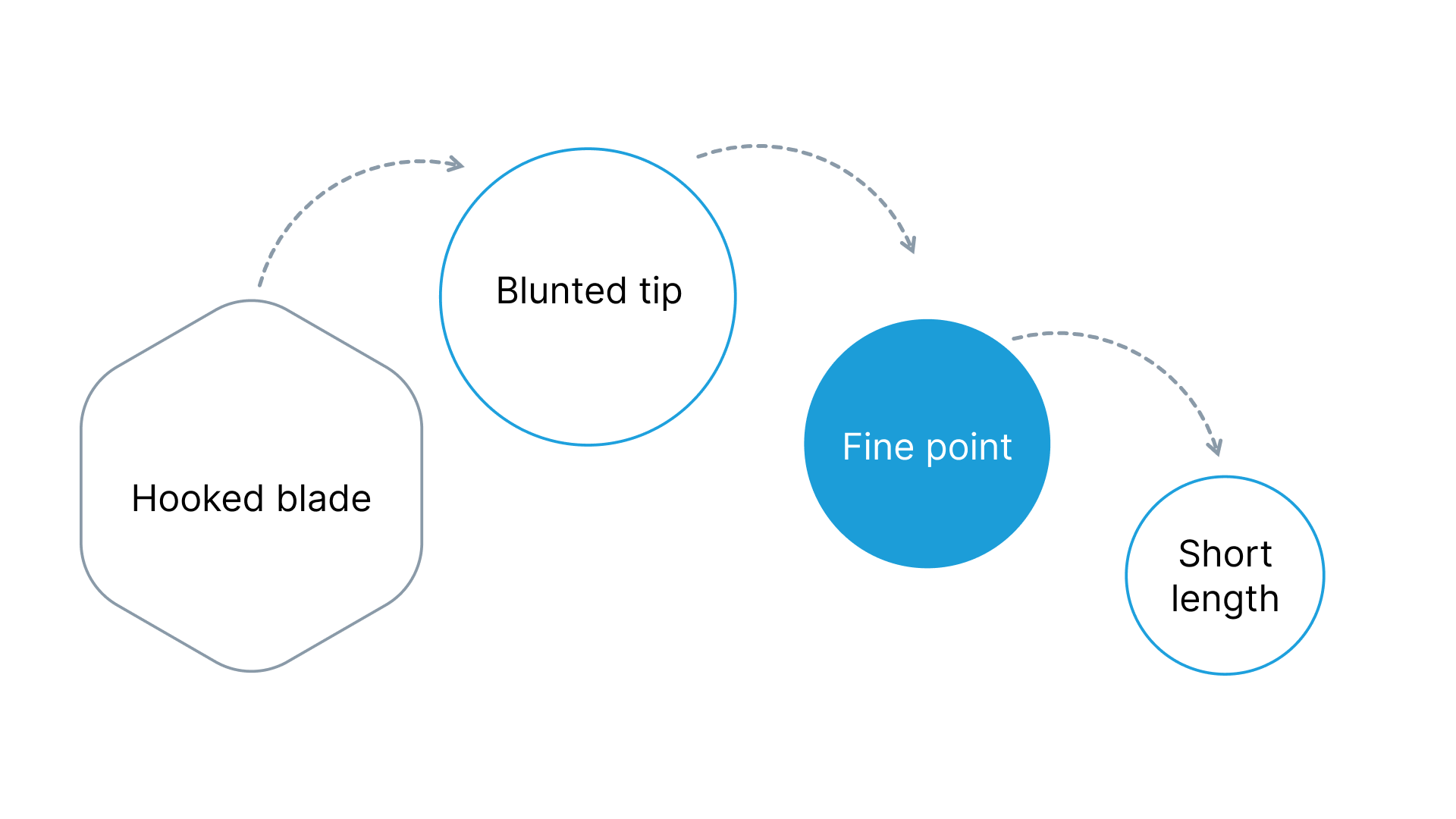
Stitch removal scissors need a special design because the cutting step happens millimeters from healing skin, where a wrong angle or a blunt tip can damage tissue or leave fragments behind. The instrument has to lift the thread, not the skin. Standard surgical scissors don't have the geometry to do that safely.
Here's what the design is built around.
- Hooked blade: The curved lower blade slides under a tied suture and lifts it clear of the skin before cutting.
- Blunted tip: The rounded edge reduces the chance of nicking tissue during the lift-and-cut step.
- Fine point: A narrow working tip handles thin suture material without crushing it.
- Short length: Close-range control matters when the cutting action happens next to a healing wound.
These features are a part of every suture removal workflow your staff runs. However, a worn hook, a dull tip, or a scissor repurposed from another tray turns a clean step into a risk of skin damage.
If the instrument introduces risk near a healing wound, it's worth considering whether it is necessary at all. SubQ It! places bioabsorbable fasteners under the skin during closure, so the removal visit and the scissors that go with it are removed from the workflow.
Which Type of Scissors Do Surgeons Use To Cut Stitches?
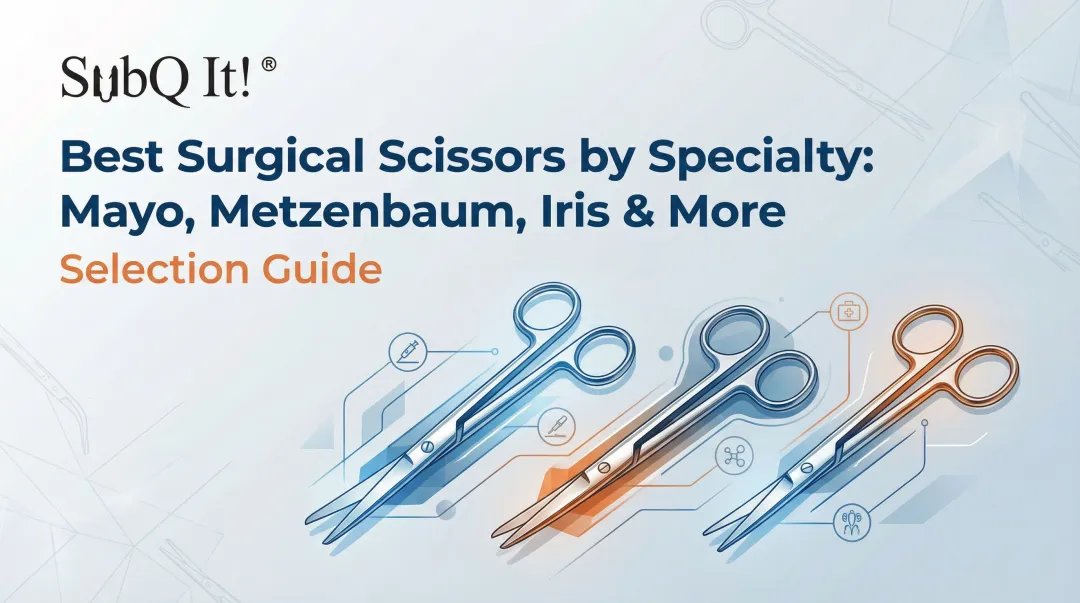
Surgeons use a small group of fine-point, hooked, or curved scissors built for stitch work, matched to the suture material and the location on the body. Here’s a quick overview of the common scissor types:
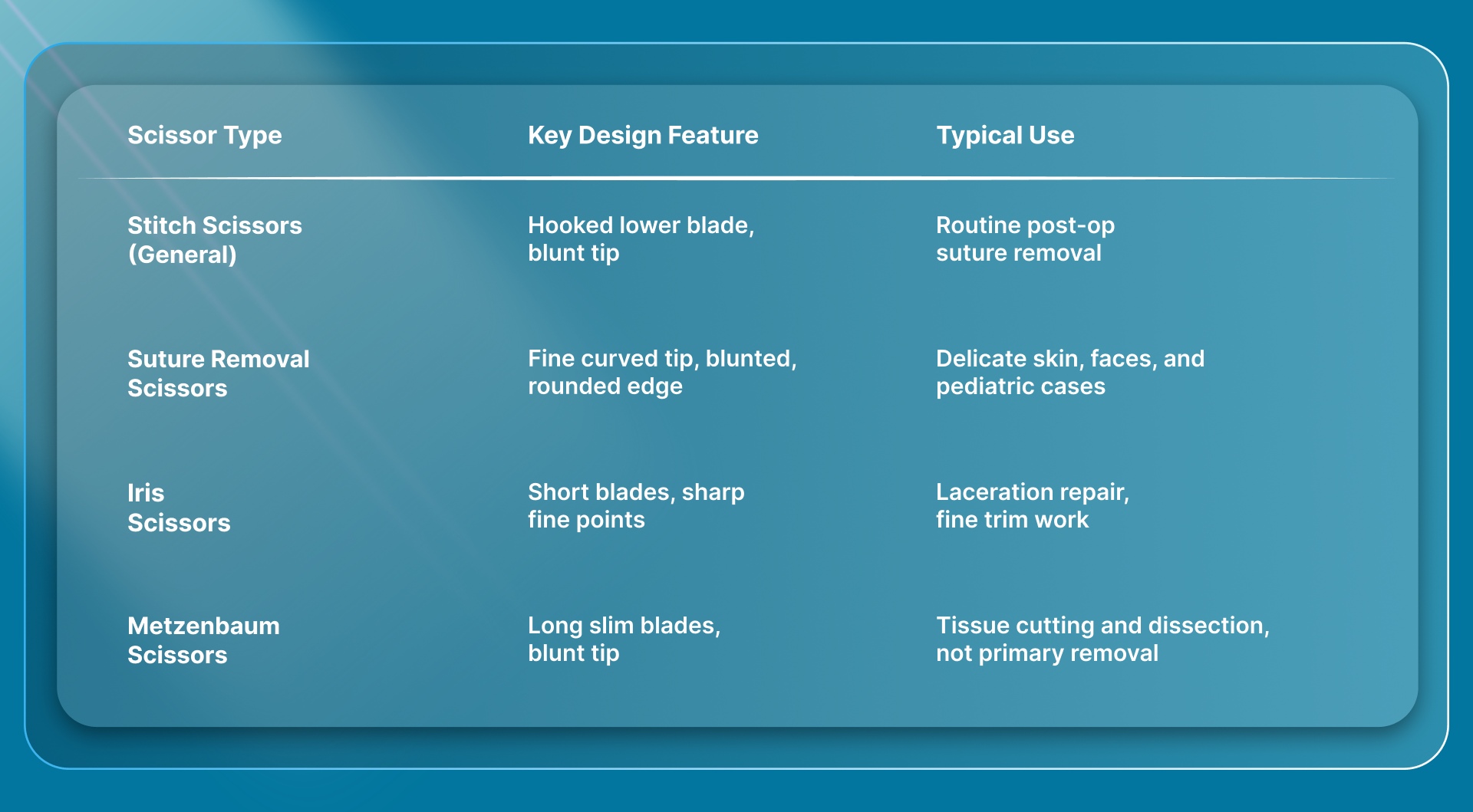
Each type has unique design features and different uses.
Stitch Scissors For Routine Removal
The hooked lower blade is the defining feature of a general stitch scissor. It's designed to slip under a tied loop, lift the thread off the skin, and let the upper blade cut cleanly. These are the standard scissors for most post-op removal visits across general and cosmetic practices.
The hook needs to be intact. A bent or widened hook stops gliding under the loop and starts pressing against the wound. Check the instrument before it hits the tray.
Suture Removal Scissors For Delicate Skin
Suture removal scissors trade some versatility for a blunted, rounded tip that's less likely to catch skin during the lift. They're the practical pick for facial closures, pediatric cases, or any site where the patient is likely to move mid-removal.
The fine curve also makes them easier to maneuver in a shallow working space. On a small laceration near the eye or lip, that margin matters.
Iris Scissors For Laceration Repair
Iris scissors carry short blades and sharp, fine points. They're built for precision cutting during repair, not routine stitch removal. Some surgeons use them to trim suture ends cleanly after knotting.
They lack the hooked lift geometry, so they aren't a first-choice removal instrument. Use them for the tasks they're built for.
Metzenbaum Scissors For Tissue, Not Sutures
Metzenbaum scissors are tissue dissection scissors with longer blades and a blunt tip, designed to separate planes, not lift knots. Using them for stitch removal works in a pinch, but isn't the clinical pick.
Reach for the instrument designed for the job. Cross-use wears down specialized geometry on both sides, which is why practices with high post-op volume stock the best surgical scissors across a few distinct trays rather than sharing one.
How Do You Safely Cut And Remove Stitches?
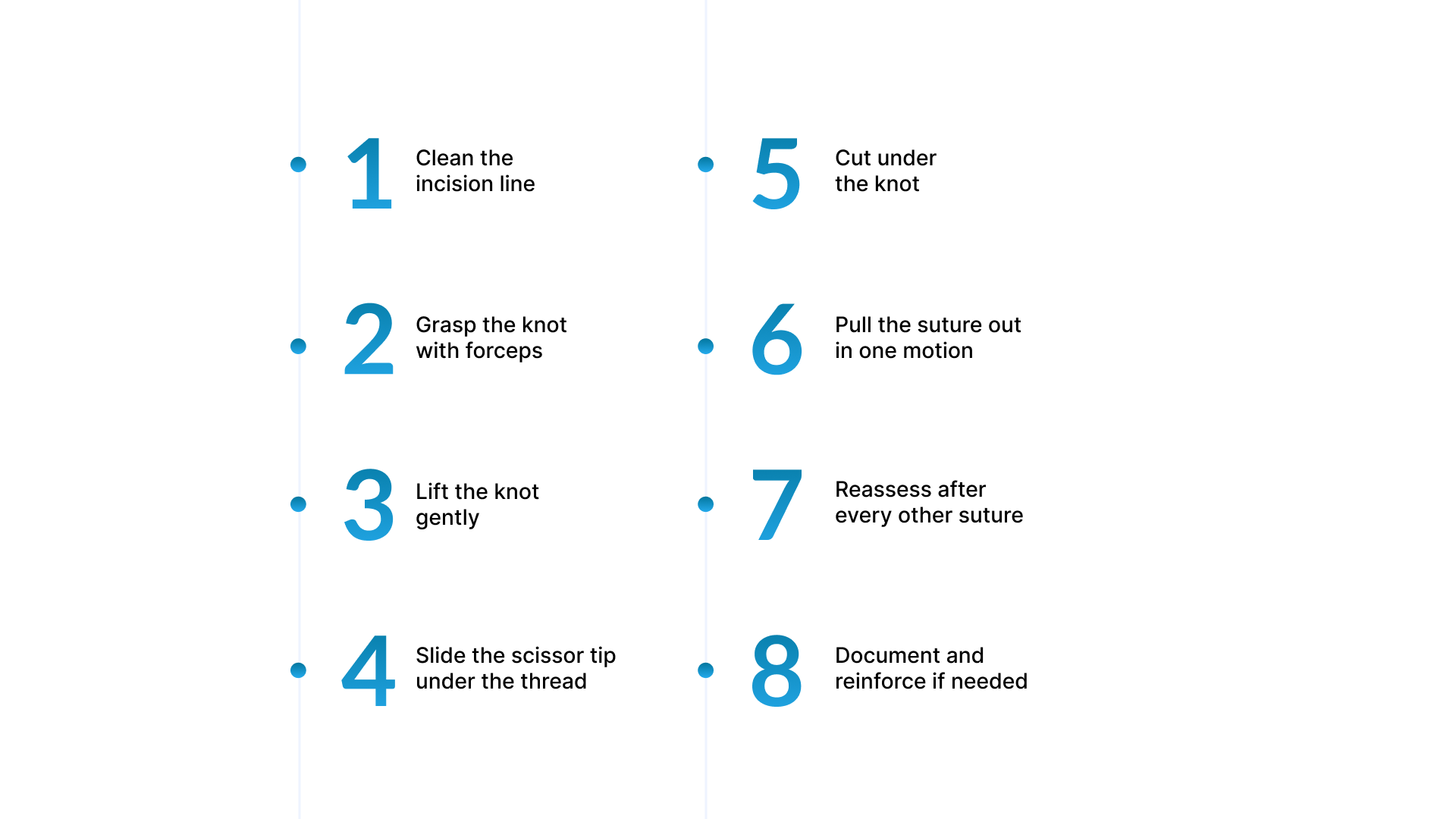 The safer way to cut and remove stitches is to lift the knot with forceps, slide the scissor tip under the thread close to the skin, cut below the knot at the distal end, and pull the suture out in one continuous motion. Cutting below the knot keeps the contaminated above-skin segment from dragging back through tissue.
The sequence below is the standard checklist your staff can run:
- Clean the incision line: Wipe gently with saline or an approved solution to remove crusting and clear the knots for visualization.
- Grasp the knot with forceps: Use suture forceps to hold the knot firmly enough to lift, without stressing the healing wound.
- Lift the knot gently: Expose the portion of the suture that sits below the skin surface.
- Slide the scissor tip under the thread: Position the hooked blade close to the skin, below the knot.
- Cut under the knot: Divide the suture at its distal end, not on the visible above-skin side.
- Pull the suture out in one motion: Use the forceps to draw the thread through in the direction of the closure.
- Reassess after every other suture: Check the wound for any sign of separation before continuing.
- Document and reinforce if needed: If the edges begin to open, stop and apply skin-closure strips rather than continuing to pull.
Common errors show up in the same places. Cutting above the knot drags the outside segment of the needle stitches back through the wound. Skipping the alternate-suture check misses early separation.
Using a pair of scissors without a functional hook presses the blade against the skin. Each of these turns a clean step into a complication risk.
What Does The Stitch Removal Visit Actually Cost A Practice?
The stitch removal visit costs a practice in three places that rarely show up on a line item. Staff time, room turnover, and the opportunity cost of a non-revenue slot on a booked day. In a private clinic, the removal appointment generates no direct revenue while occupying resources that could be running a billable case.
The downstream risk matters too. A 2026 systematic review of surgical site infections in orthopedic and trauma surgery pooled 36 cost-adjusted studies and reported that an infection raised treatment cost by a median of $24,230 per case and more than doubled the relative cost of care. Infections aren't caused by removal visits directly, but late or poor-technique removal sits in the same workflow where these complications develop.
The clinical case for the removal visit is weaker than it looks. A 2024 meta-analysis of facial closure across nine randomized trials and 804 patients found no statistically significant differences between absorbable and nonabsorbable sutures on cosmesis, infection, separation, or scarring.
When the clinical outcome is equivalent, the removal visit becomes a workflow decision, which is why practices are taking a closer look at absorbable wound closure as an alternative to percutaneous placement.
Can You Skip The Scissors Step Entirely?
Yes, you can skip the scissors step entirely with a bioabsorbable closure system that places fasteners under the skin instead of through it. The body resorbs the material on its own, so there's nothing to cut, nothing to pull, and no return appointment for removal.
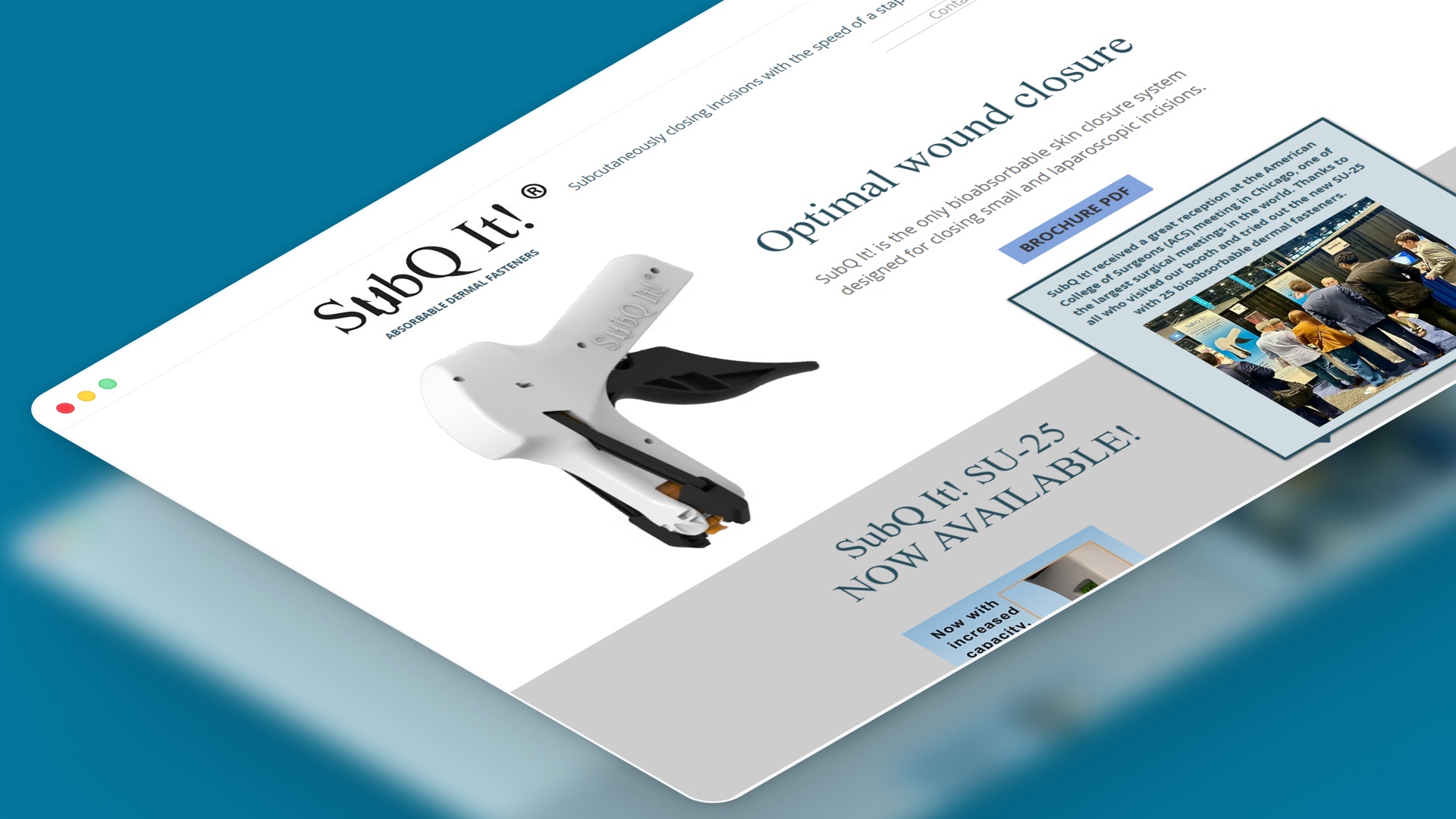
SubQ It! is a bioabsorbable skin closure system that places dermal fasteners under the skin during closure, never piercing the outer surface, and the body resorbs them once healing is complete.
There's no removal visit, no scissors step, and no entry-exit puncture marks on either side of the incision. That approach aligns more closely with the principle behind subcuticular skin closure and delivers it at the speed of a stapler.
The clinical framing matches what the outcomes literature already shows. Cesarean closure with absorbable suture tracked fewer wound complications than metal staples across 14 randomized trials and 3,530 patients. When the closure method avoids surface puncture and the material resorbs, the whole downstream workflow, including the scissor step, becomes optional.
Final Thoughts
Picking the right scissors to cut stitches comes down to three things. Hook geometry that lifts the thread off the skin, a blunted tip that protects tissue during the cut, and a blade size matched to the closure you're removing. The instrument decision is real, and it shows up in patient outcomes and staff efficiency.
Look at your post-op schedule across a typical month. Count the removal appointments. Add up the staff time, the room turnover, and the non-revenue slots those visits occupy. That's the real cost of choosing the scissors.
SubQ It! places bioabsorbable fasteners under the skin during closure, so there's nothing to remove and no return visit to schedule. The SubQ It! SU-10 handles small and laparoscopic incisions, and the SubQ It! SU-25 closes incisions up to 25 cm and saves about 25 minutes per case. Contact us today to request a custom quote and see whether bioabsorbable closure fits your practice.
FAQs
1. What Are Stitch Scissors Called In Medical Terminology?
Stitch scissors are most commonly called suture removal scissors or stitch-cutting scissors in clinical settings. The category covers any fine-point scissor with a hooked or curved lower blade designed to lift a tied suture off the skin before cutting the thread.
2. Can Regular Scissors Be Used To Cut Stitches?
Regular household or office scissors aren't suitable for cutting stitches because they lack the hooked blade that lifts the suture away from the skin. Using them risks nicking tissue, leaving thread fragments, and introducing contamination into a healing wound.
3. How Long Should Scissors For Cutting Stitches Be?
Scissors for cutting stitches are generally short, giving the clinician close-range control near the skin. The exact length depends on the procedure and suture type, but the priority is maneuverability at the wound edge, not reach or cutting force.
4. What Makes Suture Removal Scissors Different From Iris Scissors?
Suture removal scissors carry a hooked lower blade and a blunted tip built for lifting and dividing tied sutures without touching skin. Iris scissors have sharp, fine points and short blades designed for precision cutting during laceration repair, not routine removal.
5. Why Do Suture Removal Scissors Have A Hook On The Blade?
The hook exists to slide under a tied suture and lift the thread off the skin before the upper blade cuts it. This geometry keeps the cutting edge from pressing against healing tissue and reduces the risk of accidental skin injury during removal.
6. How Do You Sterilize Scissors Used To Cut Stitches?
Reusable stitch-cutting scissors are typically cleaned, inspected, and autoclaved following your facility's standard sterilization protocol for fine surgical instruments. Single-use suture removal kits skip the reprocessing step and come sterile-packaged for one patient use.