Instrument selection in the Operating Room (OR) influences how controlled each stage of a procedure remains. Even with routine tools such as surgery scissors, clean division often depends on how well the instrument matches the task.
This importance is reflected in projections that the global surgical scissors market will reach USD 706.37 million by 2033, highlighting continued reliance across specialties. As use expands, consistent selection and handling become increasingly important.
In high-volume settings, that consistency affects both tissue response and workflow continuity. Scissors are used at multiple stages, and their effectiveness depends on design, purpose, and technique.
In this blog, you’ll explore how surgeons choose the right surgery scissors in 2026, including key selection factors, types, and their role in surgical precision and efficiency.
Key Takeaways:
- Surgery scissors are task-specific instruments, and their design directly influences cutting precision, tissue handling, and control during different stages of a procedure.
- Different types, such as Mayo, Metzenbaum, Iris, bandage, and suture scissors, are used based on tissue characteristics, access, and required level of precision.
- Selecting the correct scissors improves cutting efficiency, reduces resistance, and helps maintain consistent performance during dissection and closure.
- Misuse, such as using the wrong type or cutting sutures with dissecting scissors, leads to reduced precision, blade dulling, and inconsistent results.
- Proper selection and role separation ensure predictable tissue response, preserve instrument performance, and support smoother workflow across procedures.
What Are Surgery Scissors & How Are They Used in the OR?
In the operating room, surgery scissors are precision instruments used to cut tissue, perform dissection, and handle sutures during different stages of a procedure.
They are not interchangeable tools. The design of the scissors directly affects tissue handling, cutting precision, and control in the OR.
Surgery scissors are engineered with specific blade thickness, tip configurations, and curvature to match different surgical tasks. Using the correct type ensures clean cuts and controlled tissue handling, reducing unnecessary tissue trauma.
Here’s how surgery scissors are used in the OR:
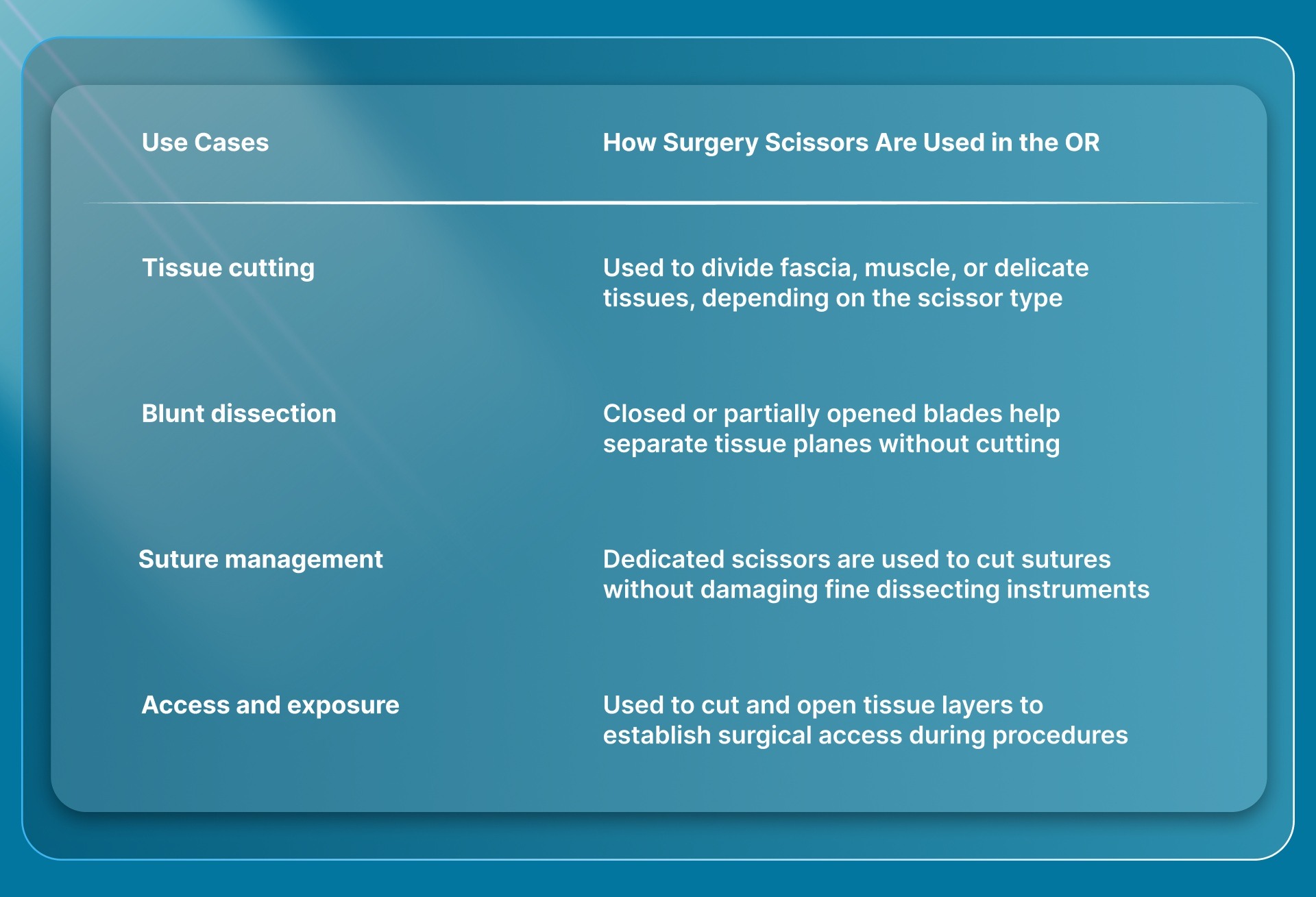
Their use in the operating room also explains why careful selection is important for efficiency and tissue handling.
Why Surgery Scissors Selection Impacts Surgical Efficiency and Tissue Handling?
In the OR, instrument choice influences control during dissection and tissue division. Selecting the appropriate surgery scissors supports controlled movement and consistent cutting performance during procedures.
Scissor design determines how force is applied at the blade tip, which directly influences how tissue responds during cutting or separation.
Here’s how surgery scissors impact surgical efficiency and tissue handling:
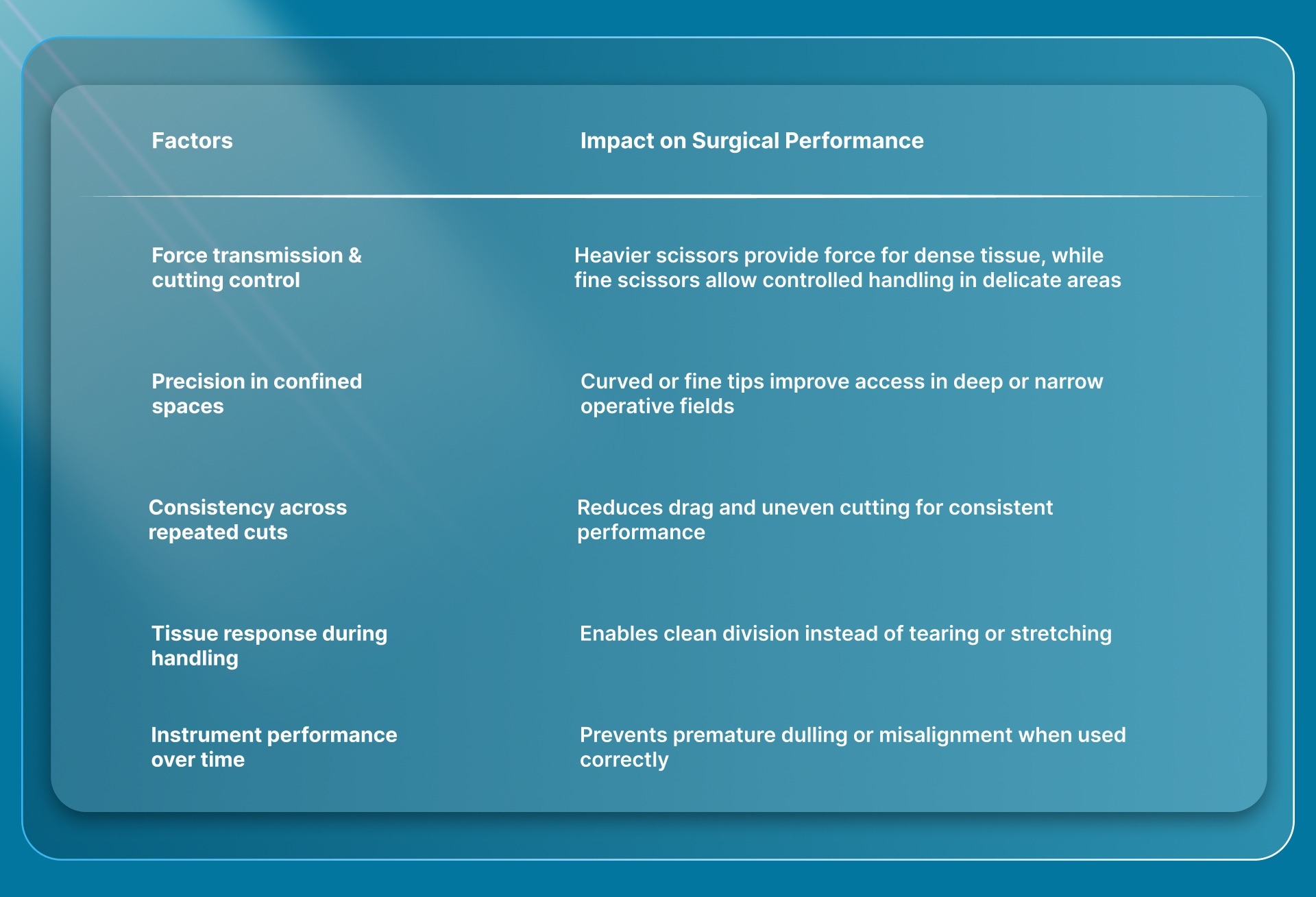
Understanding the impact of selection also helps recognize the different types of surgical scissors used in clinical practice.
5 Types of Surgery Scissors Used in Clinical Practice
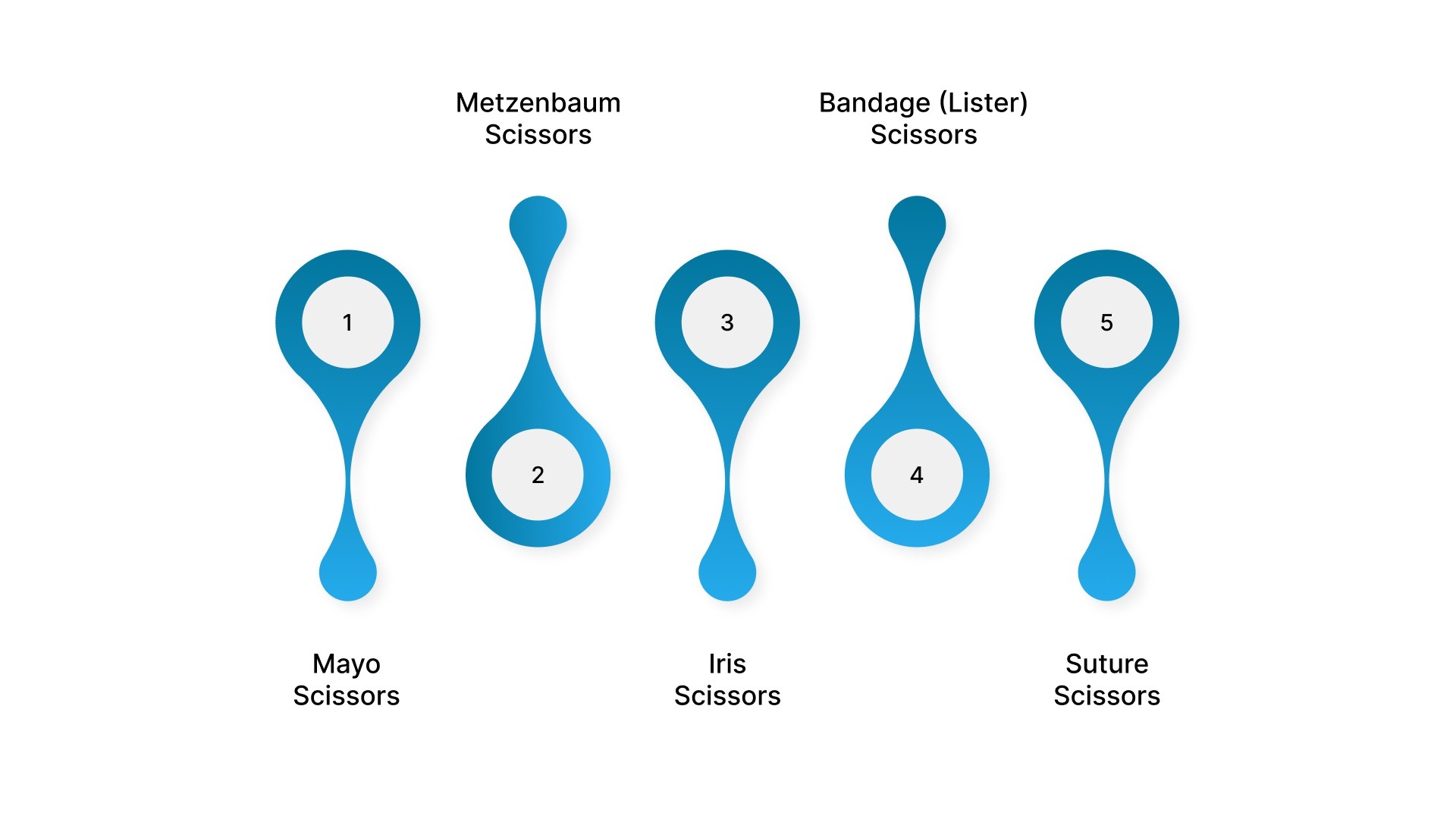
Different surgery scissors are designed to match specific tissue characteristics and operative requirements. Blade thickness, tip configuration, and overall design influence how force is applied and how tissue responds during cutting or dissection.
Below are the types of surgery scissors used in clinical practice.
1. Mayo Scissors
Mayo scissors are heavy-duty instruments with short, thick blades available in straight or curved configurations. Designed for cutting tough, fibrous tissues, they feature strong construction with blunt tips (blunt-blunt configuration).
This design helps reduce the risk of accidental puncture during dissection.
Design specifications:
- Short, thick blades designed for high-force cutting
- Straight or curved blade configurations
- Blunt-blunt or semi-blunt tip configuration for controlled dissection
Common applications:
- Cutting fascia, linea alba, and connective tissue
- Laparotomy procedures requiring fascial incision
- Hysterectomy, mastectomy, and orthopedic dissection
- General surgery and abdominal procedures
Strengths: Provide strong cutting force due to shorter, thicker blades; straight variants offer better control for dense tissue cutting
Limitations: Not suitable for delicate dissection; can cause unnecessary tissue trauma if used inappropriately
2. Metzenbaum Scissors
Metzenbaum scissors are fine dissection instruments with long handles and relatively short, slender blades.
Designed for handling delicate tissue, they typically feature blunt tips that allow controlled movement without penetrating surrounding structures.
This design supports blunt dissection by allowing tissue planes to be separated rather than sharply divided.
Design specifications:
- Long handle-to-blade ratio for improved reach and control
- Slender, lightweight blades for delicate tissue handling
- Blunt or semi-blunt tips, typically curved for deep access
Common applications:
- Dissecting soft tissue such as fat, bowel, and organ surfaces
- Blunt dissection to separate tissue planes
- Thoracic, gastrointestinal, and gynecologic procedures
- Plastic and reconstructive surgery
Strengths: Allow controlled dissection with reduced tissue trauma; suitable for working in confined or deep operative fields
Limitations: Not suitable for cutting dense tissue or sutures; improper use leads to rapid dulling
3. Iris Scissors
Iris scissors are small, fine instruments designed for high-precision cutting in confined surgical fields. Originally developed for ophthalmic procedures, they feature sharp tips that allow controlled engagement with delicate tissue.
This design supports precise cutting where minimal movement is required.
Design specifications:
- Fine, narrow blades for precision cutting
- Typically feature sharp tips for precise cutting
- Straight or curved variants for different access requirements
Common applications:
- Ophthalmic procedures requiring fine control
- Plastic and reconstructive surgery
- Dermatologic and hand surgery
- Microsurgical applications
Strengths: Provide high precision and control in small operative fields
Limitations: Easily damaged if used on thicker or fibrous tissue; not suitable for general-purpose cutting
4. Bandage (Lister) Scissors
Bandage scissors are specialized instruments designed for safe cutting of external materials without injuring underlying tissue. They feature an angled blade design with a blunt, flattened lower tip that can be inserted under dressings without penetrating the skin.
This design helps protect the underlying tissue during cutting.
Design specifications:
- Angled blade design for insertion under materials
- Blunt, flattened lower tip (probe tip) to protect the underlying tissue
- The upper blade is designed for controlled cutting of external materials
Common applications:
- Removing bandages, dressings, and surgical drapes
- Emergency department use for rapid access
- Post-operative wound care
Strengths: Reduce risk of accidental skin injury; allow controlled removal of external materials
Limitations: Not suitable for tissue cutting or surgical dissection
5. Suture Scissors
Suture scissors are small instruments designed specifically for cutting suture material without affecting the performance of dissecting scissors. They typically feature a sharp-blunt tip configuration, allowing controlled access to sutures while minimizing the risk of tissue injury.
Some designs include a notch that helps secure the suture before cutting.
Design specifications:
- Short, fine blades designed for controlled suture cutting
- Sharp-blunt tip configuration to minimize tissue contact
- Optional notch for securing suture material during cutting
Common applications:
- Cutting sutures during procedures
- Post-operative suture removal
- General suture management across surgical specialties
In procedures involving longer incisions, repeated suture cutting during closure can increase operative time. In workflows that use subcutaneous closure systems like SubQ It! SU-25, reliance on suture cutting at this stage may be reduced.
Strengths: Preserve the sharpness of dissecting scissors by handling suture material separately; allow controlled cutting in confined spaces
Limitations: Limited use beyond suture management; not suitable for tissue dissection
Knowing the different types also makes it easier to choose the right surgical scissors for specific procedures.
How to Choose the Right Surgery Scissors for Different Procedures?
Selecting the right surgery scissors depends on how the instrument will interact with tissue at each stage of the procedure.
Matching blade design, tip configuration, and length to the task supports controlled handling and consistent cutting performance.
Here’s how to choose the right surgery scissors for different procedures:
1. Match Scissors to Tissue Type
Different tissues require different levels of cutting force and control. Using an instrument that does not match tissue characteristics can lead to reduced cutting precision or unnecessary tissue stress.
The following distinctions help guide selection based on tissue type:
- Dense tissue (fascia, muscle): Requires heavy-duty scissors such as Mayo scissors that can apply higher force without blade flex
- Delicate tissue (fat, bowel, organ surfaces): Requires finer scissors, such as Metzenbaum, to reduce unnecessary tissue trauma
- Fine structures (microsurgical or ophthalmic work): Require small, sharp instruments such as Iris scissors for precise control
2. Consider Tip Configuration
Tip configuration determines how the scissors interact with tissue, particularly regarding penetration and safety. Selecting the wrong tip type can increase the risk of unintended contact with surrounding structures.
These configurations guide safe and controlled use:
- Blunt-blunt tips: Used for dissection where avoiding unintended penetration is important
- Sharp-sharp tips: Used when precise entry into fine tissue is required
- Sharp-blunt tips: Used for suture cutting, allowing access without damaging surrounding tissue
3. Evaluate Access and Surgical Field
The depth and visibility of the operative field influence how easily scissors can be positioned and controlled. Instrument length and blade shape affect both reach and alignment within the surgical space.
Selection should be adjusted based on the working environment:
- Deep or confined fields: Longer instruments with curved blades improve reach and access
- Superficial fields: Shorter instruments provide better control and stability
- Limited visibility areas: Curved blades allow better alignment with tissue planes
4. Separate Tissue and Suture Use
Using the same scissors for different materials affects cutting performance and instrument lifespan. Tissue scissors are designed for precise cutting, while suture material can degrade their edges over time.
Separating use helps maintain consistent performance:
- Use dissecting scissors only for tissue to preserve edge integrity
- Use dedicated suture scissors for suture material to prevent premature dulling
- Avoid cutting dense material with fine scissors, as this reduces precision in subsequent use
5. Consider Workflow and Instrument Longevity
Scissor selection influences not only immediate performance but also how instruments behave across repeated use.
A 2024 study found that power-assisted scissors reduced muscle activity by 2.3% at low load, 3.9% at average load, and up to 7.5% at peak load. This indicates that instrument design can affect effort and control during repeated cutting tasks.
These considerations help maintain reliability:
- Using the correct instrument supports smoother cutting performance
- Proper use maintains blade alignment and sharpness
- Consistent performance supports predictable handling across procedures
Even with the right selection, careful handling is still needed to avoid common errors during use in the operating room.
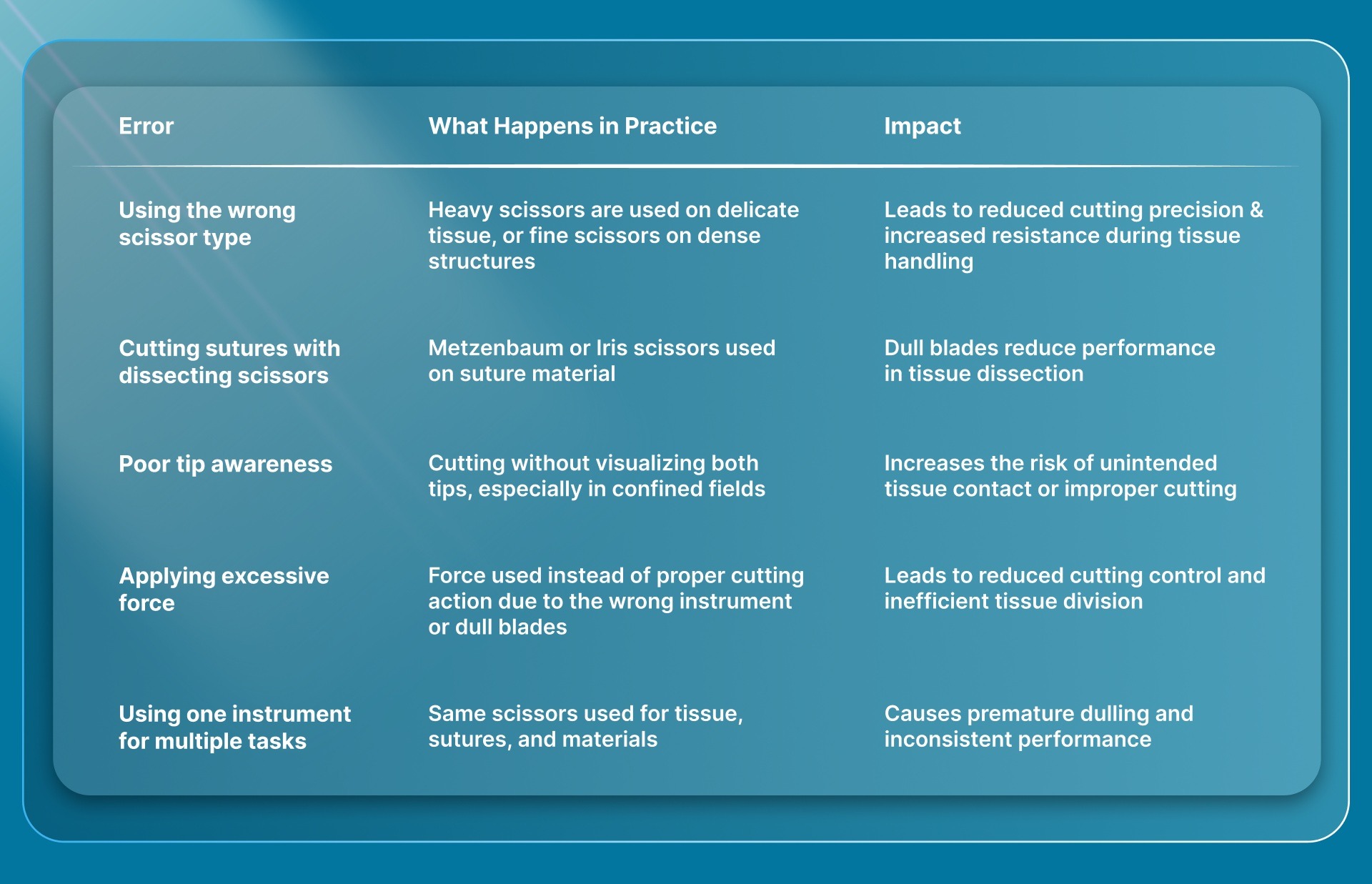
Common Errors When Using Surgery Scissors in the Operating Room
Errors with surgery scissors usually result from incorrect selection or misuse. These directly affect cutting precision, tissue handling, and instrument performance during the procedure.
Final Thoughts
Instrument use in surgery does not end with dissection. It continues to influence closure efficiency, procedure time, and the consistency of outcomes across different cases.
As the need for predictable closure and reduced procedural variability increases, approaches that limit repeated suture handling are gaining more relevance in surgical practice.
In this context, SubQ It! SU-25 offers a bioabsorbable subcutaneous closure system for incisions up to 25 cm.
The device places absorbable fasteners beneath the skin surface, enabling consistent approximation without relying on external staples or repeated suture cutting.
Contact us to explore how SubQ It! 25 fits into your workflow and learn more about this closure approach.
FAQs
1. What factors affect the lifespan of surgical scissors?
Instrument lifespan depends on frequency of use, material quality, and whether scissors are used only for their intended purpose. Cutting sutures or dense materials with fine scissors accelerates edge wear.
2. How often should surgical scissors be inspected or maintained?
Scissors should be checked regularly for blade alignment, sharpness, and tip integrity as part of routine instrument maintenance. Even minor misalignment can affect cutting performance.
3. Do curved and straight scissors perform differently in practice?
Yes. Curved scissors improve access and alignment in deeper or obstructed fields, while straight scissors offer better control for surface-level or linear cutting.
4. Can surgical scissors lose alignment without visible damage?
Yes. Repeated use, improper handling, or cutting inappropriate materials can cause subtle misalignment, leading to inefficient cutting without obvious visual defects.
5. Why is blade sharpness critical in surgical scissors?
Sharp blades allow clean tissue division through shearing action. Dull blades require more force and reduce control during cutting.
6. Are tungsten carbide scissors always preferred over standard stainless steel?
Tungsten carbide scissors retain sharpness longer, but selection depends on use case and cost considerations. They are often used in settings where durability and edge retention are important.