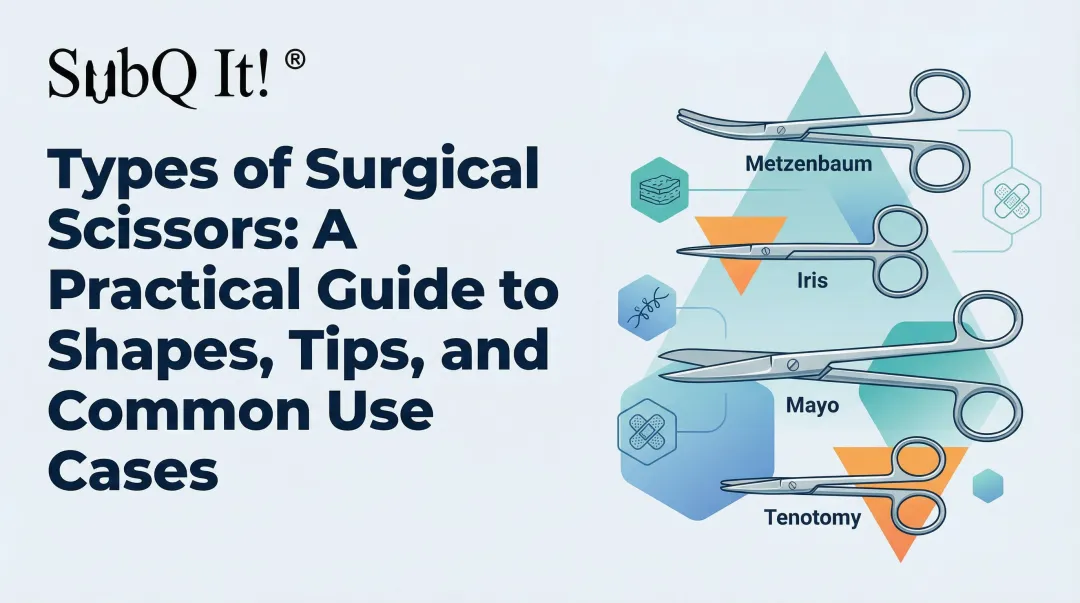
Surgical forceps are essential precision instruments used across all surgical specialties for grasping, holding, and manipulating tissues with control that human fingers cannot safely achieve. These handheld tools function as extensions of the surgeon's hands.
They enable delicate tissue handling during procedures ranging from simple wound closures to complex cardiovascular operations.
With dozens of forceps variants available, choosing the right type directly impacts surgical outcomes, efficiency, and patient safety. Inappropriate forceps selection leads to excessive tissue trauma, inadequate hemostasis, prolonged surgery time, and compromised wound closure.
Studies show that novice surgeons may exert 22.7% more force than experts, increasing injury risk. Proper instrument selection and technique can reduce applied forces by up to 47.9%.
TL;DR
- Surgical forceps provide precision tissue manipulation beyond manual finger control
- Four main categories: hemostatic (bleeding control), tissue forceps (delicate handling), dressing forceps (wound care), and specialty forceps (procedure-specific)
- Selection depends on tissue type, surgical goal, and control method required
- Proper forceps selection improves efficiency and reduces tissue trauma
What Are Surgical Forceps?
Surgical forceps are hinged, handheld instruments that use lever principles to grasp and apply controlled pressure to tissues or objects during medical procedures.
They function as precision extensions of the surgeon's hands, enabling manipulation beyond what fingers can safely accomplish in the surgical field.
Understanding the two fundamental forceps categories helps surgical teams select the right instrument for each task:
Non-locking forceps (thumb forceps/pick-ups):
- Use spring tension between shanks
- Require continuous finger pressure with a pencil grip
- Provide direct tactile feedback for pressure control
- Used for fine tissue manipulation and delicate handling
Locking forceps (clamps with ratchet mechanisms):
- Use ring handles with box-lock and ratchet
- Lock at various closure degrees, freeing hands
- Maintain pressure without manual effort
- Primarily used for vessel occlusion and secure holding
Why Are Surgical Forceps Important in Surgery?
Unlike manual handling, forceps allow surgeons to apply measured and consistent force, reducing unnecessary tissue trauma and improving procedural accuracy.
This precision is essential because different tissues require vastly different force ranges during manipulation. A systematic review of tool–tissue interaction shows that:
- Nervous tissue is handled with extremely low forces (mean ~0.4 N)
- Connective tissue may require much higher forces (mean ~45.8 N)
These variations emphasize the importance of selecting the right forceps type and technique to stay within safe handling limits.
Clinical Impact of Incorrect Forceps Use
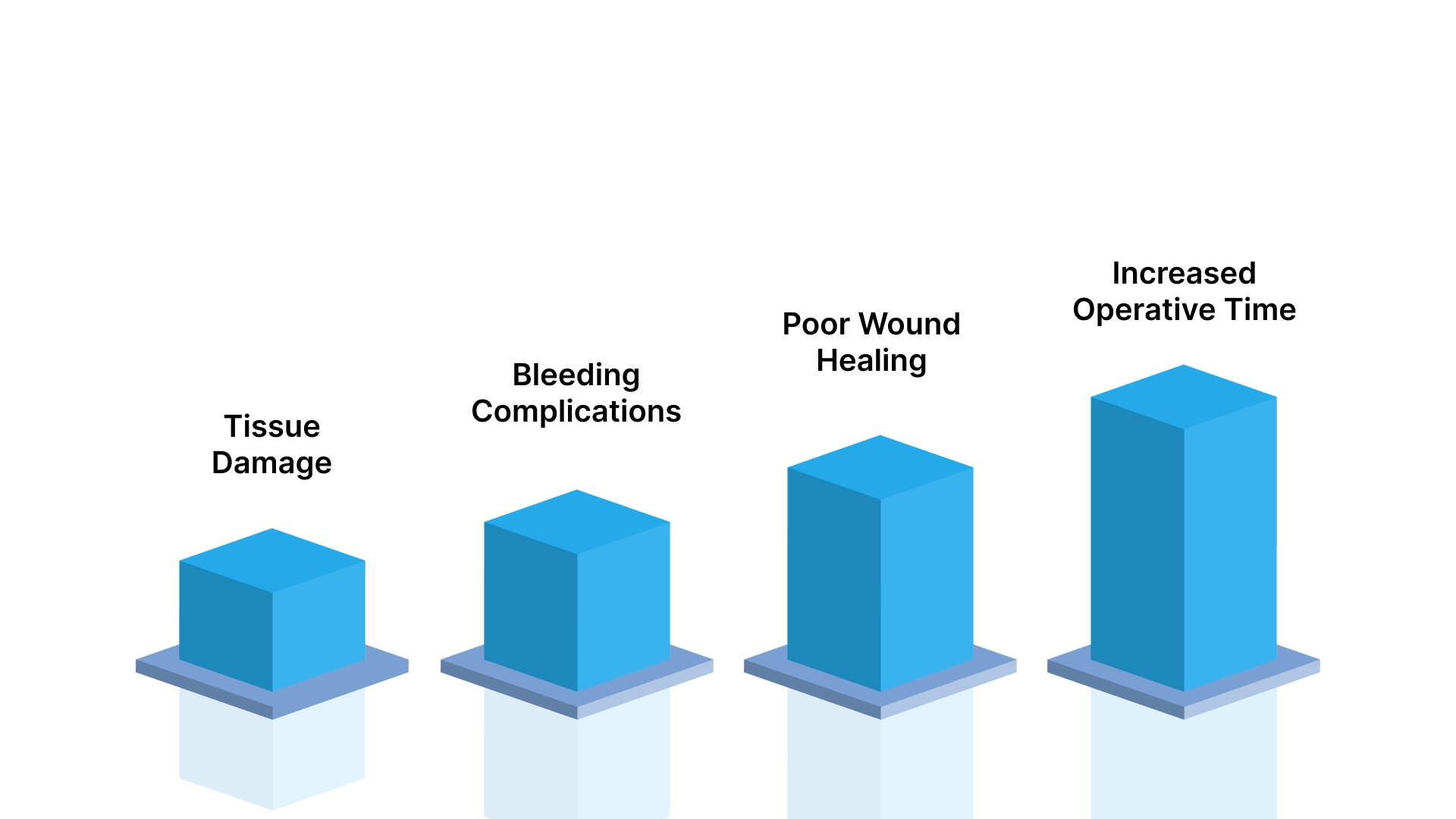
- Tissue damage: Excessive force can cause crush injury, especially in delicate structures like vessels or nerves
- Bleeding complications: Inadequate grip or pressure may fail to control vessels effectively
- Poor wound healing: Slippage or over-compression can damage tissue edges and impair closure
- Increased operative time: Inefficient handling leads to repeated adjustments and delays
Maintaining the correct force is a known surgical challenge; studies show that excessive force increases complications, while insufficient force prevents task completion. Proper forceps selection connects directly to modern surgical priorities, including minimally invasive techniques, faster procedures, and better cosmetic results.
This becomes especially critical in laparoscopic surgery, where diminished tactile feedback makes choosing the right instrument essential for preventing excessive force application and tissue damage.
What Types of Surgical Forceps Do Surgeons Use?
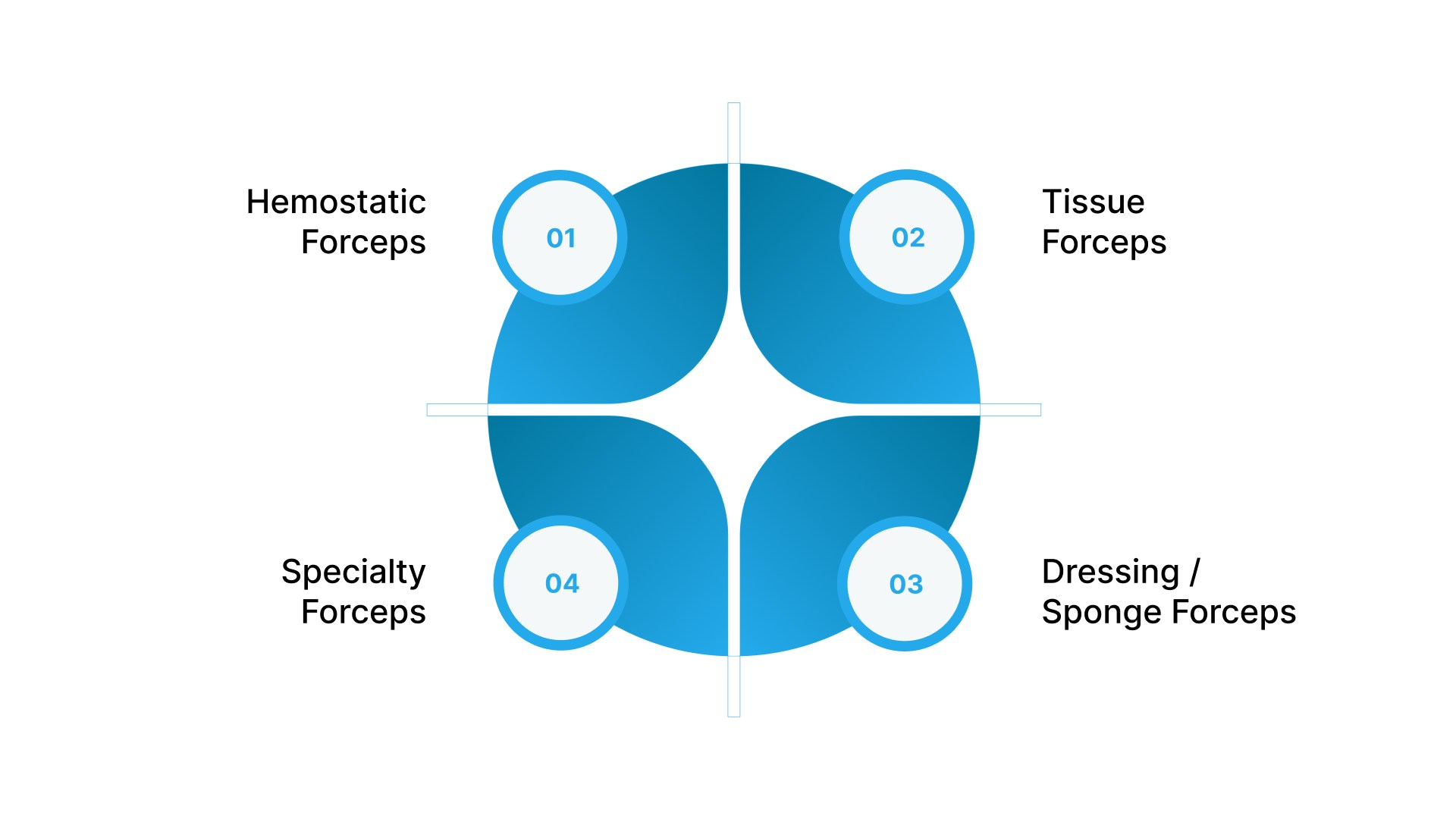
Surgical forceps are broadly classified based on their mechanism (locking vs non-locking) and intended function (grasping tissue, controlling bleeding, or handling materials). This functional grouping reflects how forceps are actually used in clinical practice.
Hemostatic Forceps (Locking / Clamping Forceps)
Hemostatic forceps are hinged instruments designed to grasp and compress blood vessels or tissues, typically using a locking mechanism to maintain closure.
They are commonly used before or after vessel division to control bleeding.
How they function:
- Apply mechanical compression to vessels
- Maintain grip without continuous hand pressure
- Often feature serrated jaws to increase tissue purchase
Best suited for:
- Vessel clamping during surgery
- Temporary control of bleeding (hemostasis)
- Assisting in ligation or cauterization
Key strengths:
- Enable sustained compression during procedures
- Improve efficiency in multi-step surgical tasks
Limitations (evidence-based):
- These are crushing instruments, and excessive pressure can damage tissue
- Over-tightening the ratchet increases tissue trauma risk
Tissue Forceps (Non-Locking / Thumb Forceps)
Tissue forceps are non-locking instruments held in a pencil grip that grasp, stabilize, and manipulate tissues with precision.
They function as an extension of the surgeon’s fingers.
Types based on tip design:
- Toothed (surgical forceps) → secure grip on dense tissue (e.g., skin)
- Smooth (anatomic forceps) → used for delicate structures
How they function:
- Allow real-time force control
- Provide direct tactile feedback
Best suited for:
- Tissue handling during dissection
- Retraction and exposure
- Assisting suturing
Key strengths:
- High precision and control
- Adjustable force application
Limitations (evidence-based nuance):
- Smooth forceps may require higher pressure, increasing the risk of tissue crushing
- Toothed forceps provide better grip, but can still be traumatic depending on use
Dressing / Sponge Forceps
These forceps are used to handle non-tissue materials, such as gauze, sponges, or surgical supplies.
Evidence-based role: Forceps are also used to handle sponges and assist in surgical tasks beyond tissue grasping.
How they function:
- Designed for grasping materials rather than tissue
- Often feature smooth or fenestrated tips
Best suited for:
- Handling dressings and gauze
- Cleaning or preparing surgical areas
- Maintaining sterile technique
Key strengths:
- Reduce direct contact with the surgical site
- Support infection control practices
Limitations:
- Not designed for tissue manipulation
- Limited precision compared to tissue forceps
Specialty Forceps
Procedure-specific forceps are designed for particular surgical specialties or unique tasks, featuring highly specialized design elements optimized for specific tissue types and surgical approaches.
Examples span multiple specialties:
- Adson-Brown forceps: 9×9 interlocking teeth for plastic surgery and dermatology
- Magill forceps: Angled design for anesthesia and intubation procedures
- Obstetrical forceps: Specialized instruments for assisted vaginal delivery
- Biopsy forceps: Cup-like jaws for endoscopic tissue sampling
- Bone-holding forceps: Heavy-duty instruments (Weber, Verbrugge) for orthopedic procedures
Many specialties have developed unique forceps designs addressing tissue-specific challenges.
How different from other types: Specialty forceps feature unique design characteristics—specific angles, tip shapes, jaw configurations, and lengths—that make them superior for intended tasks but less versatile for general use.
Best suited for:
- Specialty procedures where standard forceps are inadequate
- Working with specific tissue types (bone, airway, vascular)
- Procedures requiring unique approach angles or access paths
- Tasks demanding specialized gripping mechanisms
Key strengths:
- Optimized performance for specific procedures
- Often enable techniques impossible with general forceps
- Designed by specialists who understand unique procedural challenges
- Can significantly improve outcomes in target applications
Limitations:
- Limited versatility outside intended use
- Often more expensive than general-purpose instruments
- Require specialized training for proper use
- Not cost-effective for occasional use in general practice
How Do Surgeons Choose the Right Surgical Forceps?
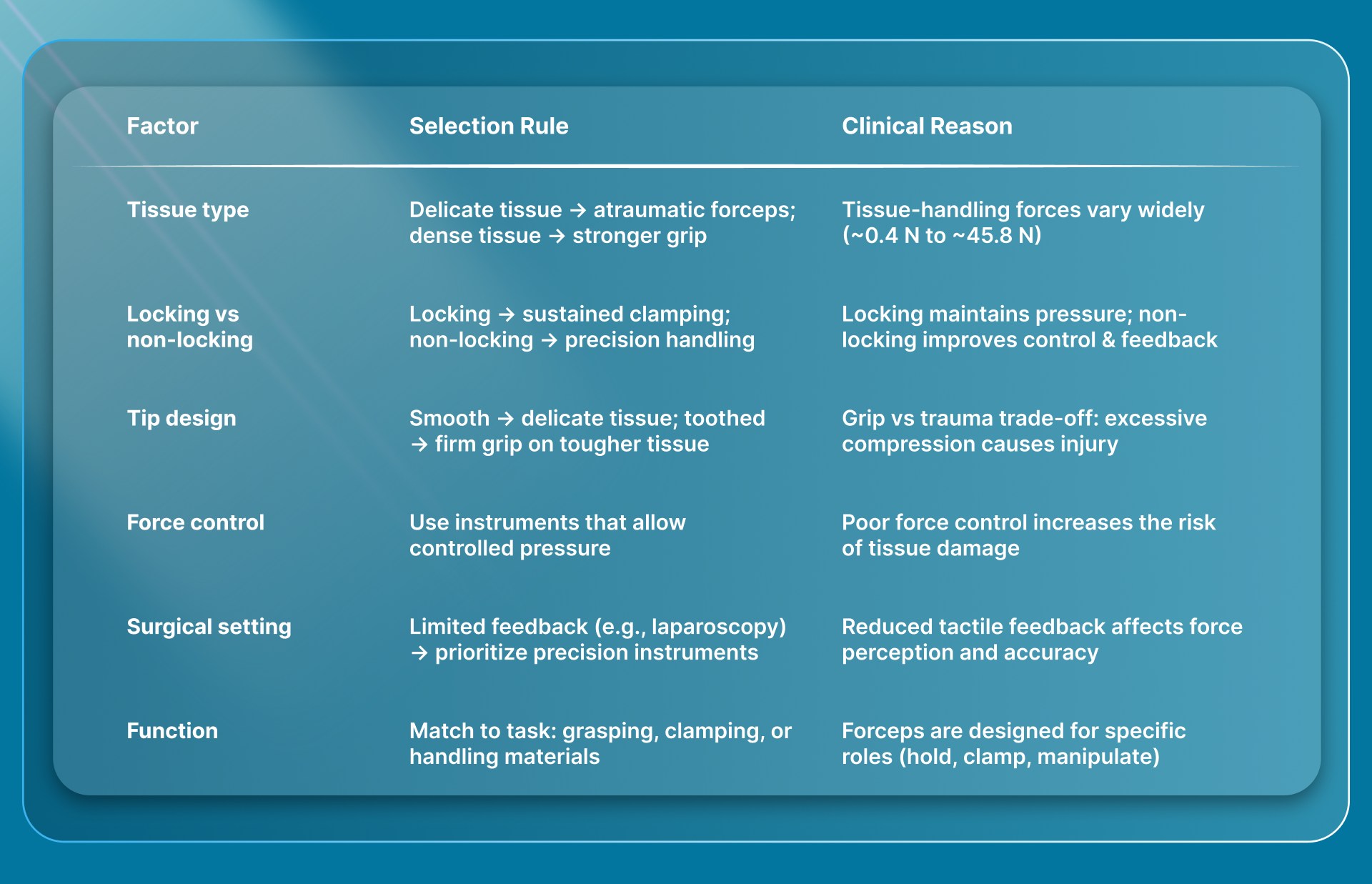
Selecting the appropriate surgical forceps requires balancing tissue characteristics, procedural goals, and force control, rather than relying on routine instrument choice. Evidence shows that tool–tissue interaction forces directly influence surgical safety, efficiency, and outcomes.
1. Match Forceps to Tissue Type and Force Requirements
Different tissues require significantly different levels of force during manipulation:
- Nervous tissue: ~0.4 N (very low force)
- Epithelial and muscle tissue: moderate force range
- Connective tissue (including bone): up to ~45.8 N
This wide variation highlights why instrument selection must align with tissue sensitivity.
- Delicate tissues → require fine, atraumatic forceps and minimal pressure
- Dense tissues → tolerate higher gripping forces and stronger instruments
2. Locking vs Non-Locking Forceps
The choice between locking and non-locking forceps depends on whether sustained pressure or dynamic control is required.
Locking forceps (e.g., hemostatic)
- Maintain constant pressure without continuous hand effort
- Useful for vessel occlusion or retraction
Non-locking forceps (thumb forceps)
- Allow continuous adjustment of applied force
- Provide better tactile feedback and precision
Studies show that a lack of force feedback can impair precision, especially during delicate procedures.
3. Consider Tip Design and Tissue Interaction
Forceps tip configuration plays a critical role in balancing grip stability and tissue safety:
- Smooth tips
- Reduce puncture injury risk
- May require a higher compressive force to maintain grip
- Toothed or textured tips
- Improve grip stability
- Allow effective handling with lower overall compressive force in some contexts.
The goal is to achieve secure grasping while minimizing unnecessary pressure, as excessive compression is known to cause tissue injury.
4. Account for Surgical Environment and Access
Instrument choice should reflect procedural access and visibility constraints:
- Open surgery → allows greater tactile feedback and flexibility
- Minimally invasive surgery → reduced tactile sensation
In such settings, surgeons rely more heavily on visual cues and instrument design, making force control more challenging.
5. Prioritize Force Control and Surgeon Feedback
One of the most critical factors in forceps selection is the ability to maintain controlled, appropriate force:
- Excessive force → tissue injury and complications
- Insufficient force → incomplete task execution
Studies show that:
- Surgical trainees often apply higher forces than experts
- Feedback mechanisms can significantly reduce the applied force
This reinforces that instrument choice and handling technique must work together to maintain safe force levels.
Final Thoughts
Surgical forceps function as a practical tool for tissue handling when precision, control, and consistent force application are critical. Their value is most evident in procedures that require delicate manipulation, precise grip, and minimal tissue disruption across diverse anatomical structures.
Unlike bulk instruments, forceps are not designed to manage high-force tasks or broad retraction. Their advantage lies in delivering controlled, targeted interaction with tissue, allowing surgeons to balance grip security with tissue preservation.
For teams aiming to streamline surgical workflows, combining precise tissue handling with efficient closure methods becomes essential. In such cases, SubQ It! offers a bioabsorbable subcuticular closure system that supports consistent closure with reduced need for removal, aligning well with procedures where controlled handling and clean closure are priorities.
To explore how SubQ It! can support your surgical practice, connect with the SubQ It! team.
Frequently Asked Questions
1. What is the difference between locking and non-locking forceps?
Locking forceps (hemostats) use ratchet mechanisms to maintain constant pressure without hand contact. Non-locking forceps (thumb forceps) require continuous finger pressure but provide superior tactile feedback for delicate tissue manipulation.
2. When should I use toothed versus smooth tissue forceps?
Toothed forceps are preferred for most tissue handling because teeth provide a secure grip with less compressive pressure. Smooth forceps are reserved for delicate structures like blood vessels and bowel, where puncture must be avoided.
3. What are hemostatic forceps, and when are they used?
Hemostatic forceps are locking clamps designed to occlude blood vessels and control bleeding during tissue dissection. Common types include mosquito clamps for small vessels and Kelly or Crile forceps for larger vessels.
4. How do I choose the right forceps length for a procedure?
Select length based on incision depth and cavity size. Standard instruments (4-3/4" to 5-1/2") work for superficial procedures, long versions (9" to 12") for abdominal work, and extra-long forceps (14"+) for thoracic or deep pelvic surgery.
5. Can the same forceps be used for different types of tissue?
While some general-purpose forceps work across tissue types, optimal outcomes require matching forceps design to specific tissue characteristics and surgical tasks. Using vascular forceps on fascia or heavy forceps on nerves increases trauma risk and compromises surgical efficiency.
6. What makes specialty forceps different from standard surgical forceps?
Specialty forceps feature unique designs—specific angles, tip shapes, and jaw configurations—optimized for particular procedures or surgical specialties. These specialized features make them superior for intended uses but less versatile than general-purpose instruments.