Control during suturing depends on how effectively tissue is stabilized at each step, yet this is often overlooked in routine practice. Even small variations in forceps use can affect needle control and edge alignment.
As surgical workflows expand, maintaining consistency in instrument handling becomes important, particularly in high-volume settings where minor inefficiencies can introduce variability across cases.
This emphasis on precision is reflected in the global surgical equipment market, projected to reach USD 18.67 billion by 2033.
Within this context, toothed forceps are used to improve grip during suturing, though their effectiveness depends on correct selection and technique.
In this blog, you’ll explore what surgeons should know about suture forceps in 2026, including selection principles, handling techniques, and their role in closure consistency.
Key Takeaways:
- Suture forceps are used during suturing to stabilize tissue, guide needle passage, and maintain alignment, especially at the wound edge.
- Forceps selection directly affects tissue control, influencing needle accuracy, edge positioning, and the amount of handling required during closure.
- Different suture forceps types, including 1×2, 2×3, Adson, Brown-Adson, and DeBakey, are designed for specific tissue conditions and handling needs.
- Improper use, such as excessive force, poor positioning, or repeated grasping, can increase tissue stress and affect the consistency of closure.
- In modern workflows, suture forceps are used at specific steps to position and stabilize throughout the closure.
What Are Suture Forceps & How Are They Used During Suturing?
Suture forceps are precision instruments used to grasp, hold, and stabilize tissue during suturing, particularly at the wound edge. They support accurate tissue handling and consistent needle placement during closure.
During suturing, they help stabilize tissue and allow controlled handling during needle passage, especially when tissue is mobile, under tension, or difficult to access.
Clinical studies have measured maximum forceps pressure and medial traction force during suturing tasks. These studies show that optimized techniques significantly reduce applied force (p < 0.001), reinforcing the importance of controlled instrument use.
Once the role of suture forceps during suturing is clear, the impact of proper forceps selection becomes more evident.
Why Suture Forceps Selection Impacts Tissue Control & Closure Outcomes?
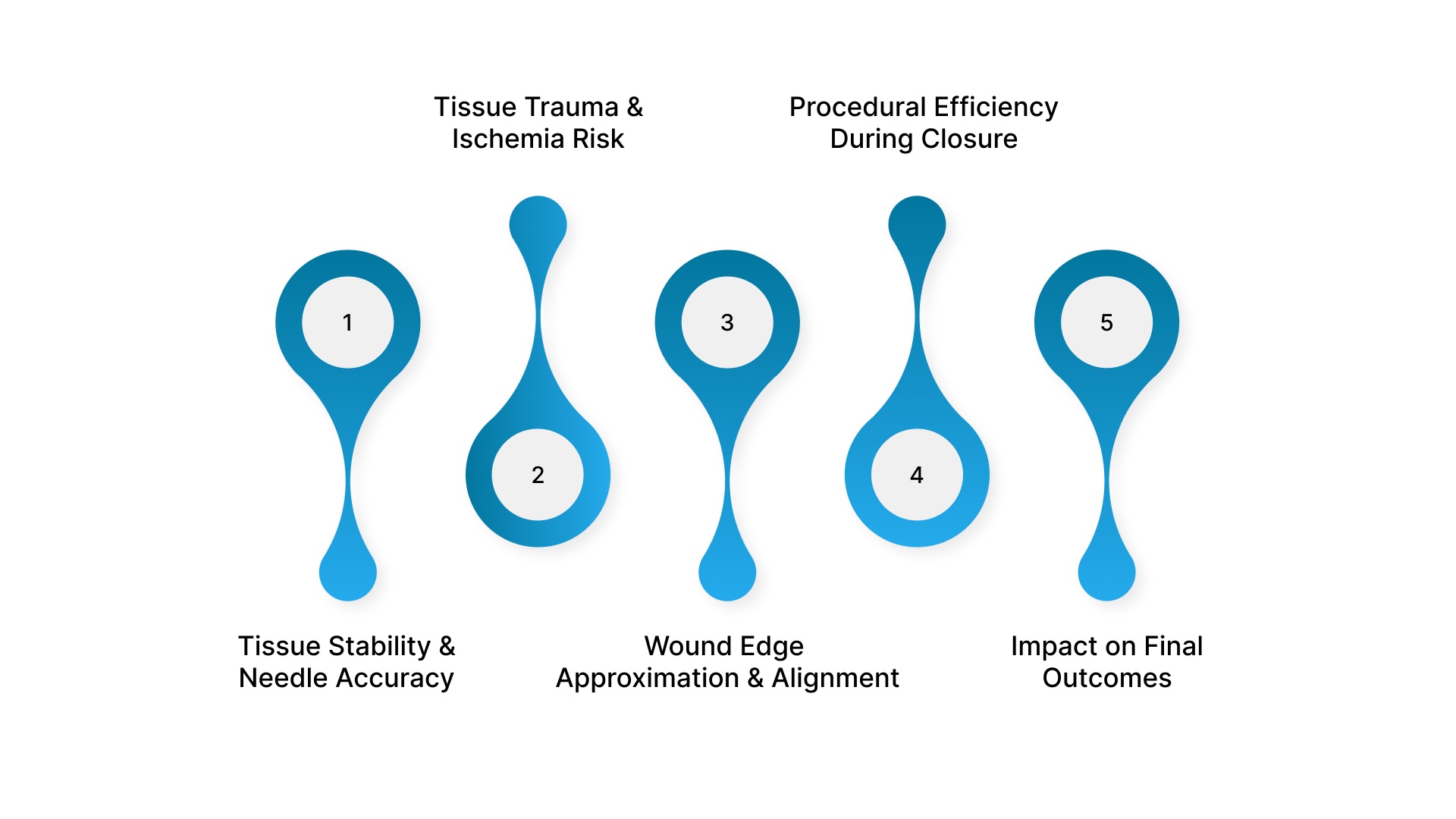
Suture forceps selection affects both the security with which tissue is stabilized and the accuracy with which sutures can be placed during closure.
The instrument’s design influences the balance between grip security and tissue preservation, supporting controlled tissue handling throughout suturing.
Here’s why suture forceps selection impacts tissue control and closure outcomes:
1. Tissue Stability and Needle Accuracy
Accurate suturing depends on maintaining stable tissue during needle passage, especially in areas with tension or limited exposure.
Forceps that match tissue characteristics help reduce movement and support consistent stitch placement. This level of control is most relevant during:
- Reduces tissue movement during needle passage: Stabilizing tissue helps limit shifting at entry and exit points, allowing more controlled needle placement
- Improves consistency of stitch placement: Controlled grip supports uniform bite depth and spacing during suturing
- Helps reduce repeated needle passes: Better initial control can reduce the need for repositioning or correction
2. Tissue Trauma and Ischemia Risk
Forceps that require excessive compression can damage tissue at the wound edge, particularly with repeated handling.
Selecting the appropriate tooth pattern allows a secure grip with lower applied force. This becomes more relevant during repeated tissue handling:
- Excessive compression increases tissue injury risk: High gripping force can cause localized crush injury at the wound edge
- Repeated grasping can increase cumulative tissue stress: Multiple handling points may contribute to additional tissue disruption.
- Tissue damage may affect healing quality: Compromised tissue can contribute to delayed healing or increased risk of complications.
3. Wound Edge Approximation and Alignment
Consistent closure requires controlled positioning of tissue edges throughout suturing. Forceps selection influences how accurately edges can be aligned without distortion.
This directly affects tissue positioning during:
- Supports accurate edge positioning during closure: Stable grip helps maintain proper alignment of wound edges
- Reduces uneven approximation or inversion: Controlled handling helps limit distortion during suturing
- Contributes to consistent tissue positioning: Reliable manipulation supports uniform alignment across the incision
4. Procedural Efficiency During Closure
Forceps that provide a reliable grip reduce the need for repeated adjustments during suturing. It influences how smoothly closure progresses, particularly in high-volume settings.
This difference becomes apparent during continuous suturing:
- Reduces the need for repeated adjustments: Secure tissue control can limit repositioning during suturing
- Supports smoother workflow during closure: Fewer interruptions help maintain continuity during the procedure
- Helps reduce variability in closure time: Efficient handling contributes to more predictable procedural flow
Closing longer incisions, however, often involves repeated stabilization during suturing. Systems like SubQ It! SU-25 offers an alternative by placing bioabsorbable fasteners beneath the skin, reducing the need for stepwise tissue handling.
5. Impact on Final Outcomes
The cumulative effect of stable handling, reduced trauma, and accurate approximation contributes to overall healing quality. Tissue handling during closure is one of several factors that influence outcomes.
This is reflected in:
- Helps preserve tissue integrity during suturing: Controlled manipulation limits unnecessary mechanical damage
- Supports predictable wound healing: Consistent handling can contribute to more uniform healing patterns
- Improves consistency during closure: Better control helps reduce variability in technique execution
Once the importance of proper selection is clear, the different types of forceps and their specific roles become more relevant.
5 Types of Suture Forceps & Their Role in Tissue Stabilization
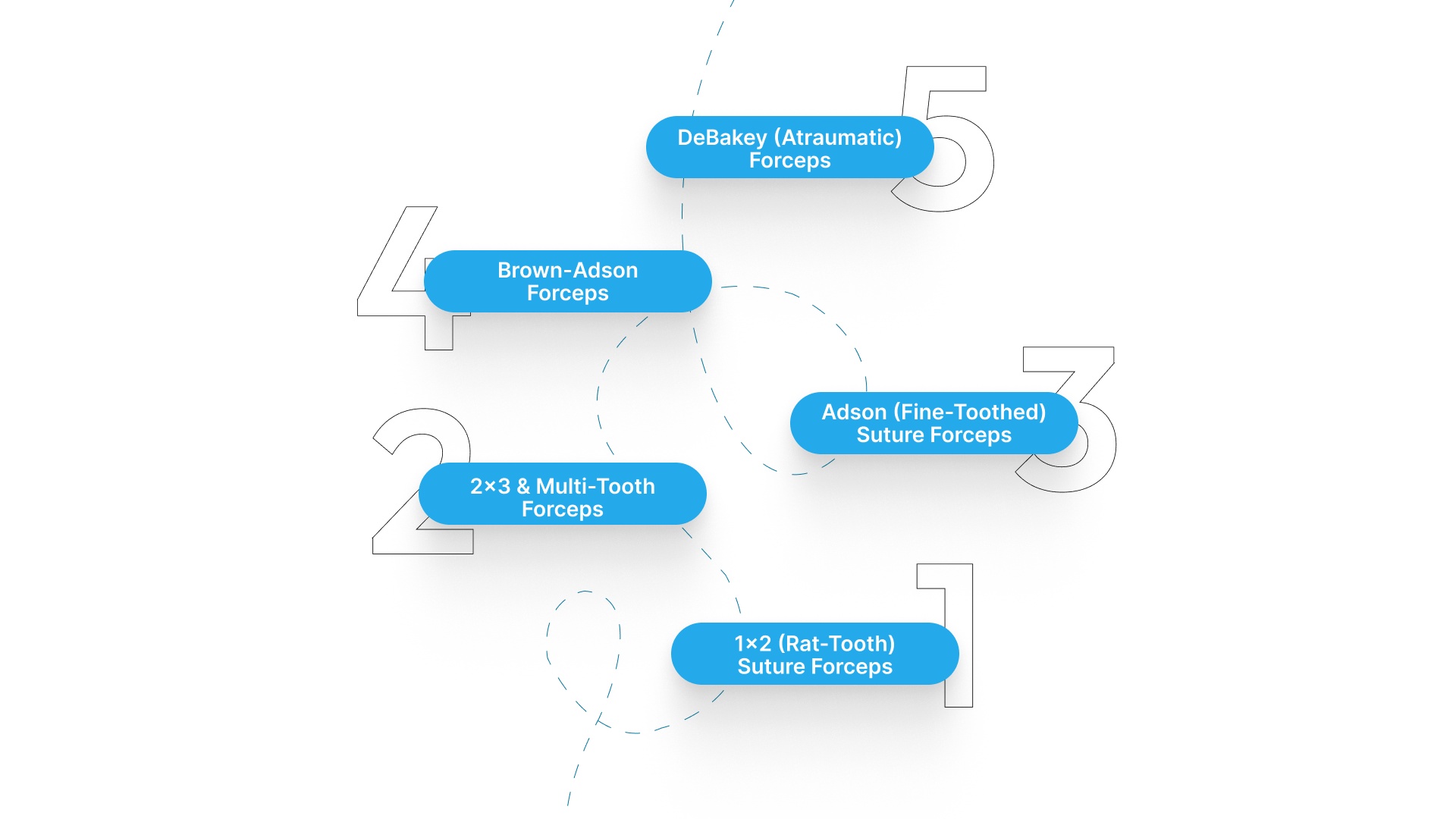
Suture forceps are selected based on their ability to stabilize tissue while minimizing unnecessary trauma during suturing.
Different designs are suited to specific tissue types and handling requirements, which supports controlled tissue manipulation during needle placement.
1. 1×2 (Rat-Tooth) Suture Forceps
The 1×2 configuration provides a single-point interlocking grip, making it suitable for denser tissue where secure stabilization is required during suturing.
It is commonly used when maintaining control during needle passage is critical. This becomes especially relevant when handling:
- Dense fascia and tough tissue: The concentrated tooth design provides a more secure grip on resistant structures, supporting stable control during deeper or forceful needle penetration
- High-tension wound edges: A firm grip helps maintain tissue position when edges are under tension, reducing movement during suturing
- Situations prone to slippage: The single-point contact helps improve stability in areas where smooth or multi-tooth forceps may not hold tissue as effectively
2. 2×3 and Multi-Tooth Forceps
Multi-tooth forceps distribute gripping force across a broader surface, making them more suitable for fibrous or moderately dense tissue that requires controlled handling.
They provide a balance between grip security and reduced focal pressure. This is most useful when working with:
- Fibrous connective tissue: The distributed tooth pattern helps reduce the risk of tearing while maintaining sufficient grip for controlled manipulation
- Moderate tension closures: Broader contact allows stable handling without requiring excessive compression at a single point
- Wider tissue surfaces: Increased contact area supports improved stability when handling larger or less uniform tissue edges
3. Adson (Fine-Toothed) Suture Forceps
Adson forceps feature fine, closely spaced teeth, allowing precise handling of delicate tissue with minimal disruption.
They are commonly used in situations where edge control directly affects cosmetic outcome. This is particularly important when handling:
- Skin edges during closure: Fine teeth allow controlled eversion and accurate alignment without excessive penetration or pressure
- Superficial and delicate tissue: Reduced tooth size helps limit crush injury, making them suitable for thin or sensitive tissue layers
- Cosmetically sensitive areas: Improved precision supports consistent edge approximation, which contributes to better scar quality
4. Brown-Adson Forceps
Brown-Adson forceps use a multi-tooth configuration (commonly 7×7) to distribute gripping force across fragile tissue surfaces.
They are designed to improve grip while reducing localized pressure. This becomes relevant in situations involving:
- Thin or fragile skin: The broader tooth pattern spreads force, helping reduce the risk of focal tissue damage during manipulation
- Plastic or reconstructive procedures: Even force distribution supports tissue integrity while allowing precise positioning
- Broad surface contact requirements: Multiple teeth provide stable control across a larger area without aggressive penetration
5. DeBakey (Atraumatic) Forceps
DeBakey forceps use longitudinal serrations instead of teeth, allowing tissue to be stabilized without puncturing it. While not typically used for skin suturing, they are relevant when handling delicate internal structures.
This is most applicable when working with:
- Vascular or visceral tissue: The serrated design provides grip without penetrating tissue, helping reduce the risk of injury
- Soft tissue requiring atraumatic handling: Gentle contact supports preservation of tissue integrity during manipulation
- Situations where tissue preservation is critical: Reduced mechanical stress allows safer handling of sensitive structures
Knowing the role of each forceps type also helps identify the errors that can affect tissue control during closure.
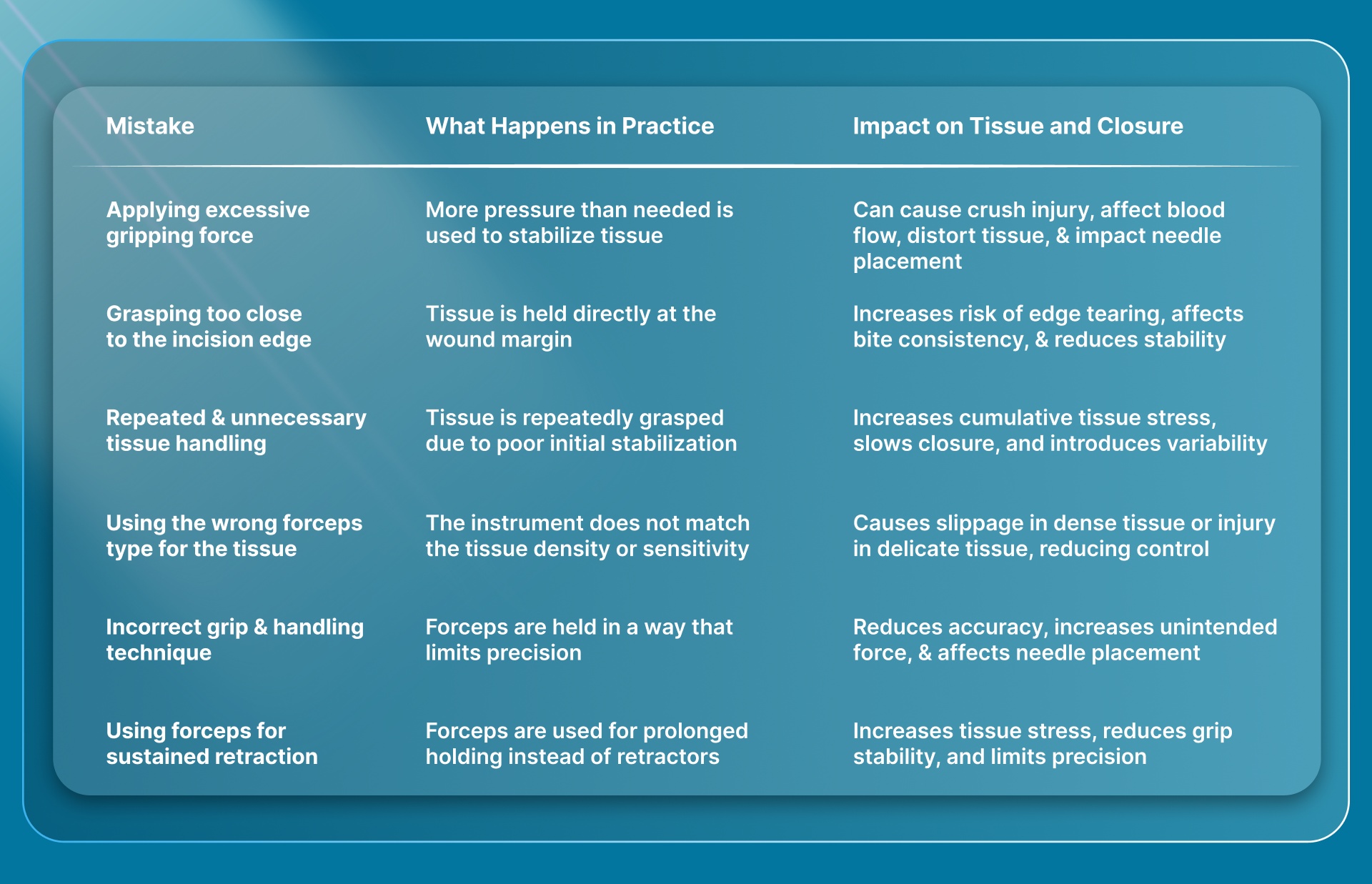
Common Mistakes When Using Suture Forceps During Closure
Suture forceps are used throughout closure, but small handling errors can introduce tissue trauma, poor alignment, and inconsistent control during suturing.
These mistakes often occur under time pressure or in challenging tissue conditions.
Beyond avoiding common mistakes, it is important to understand how suture forceps integrate into modern surgical closure workflows.
Where Suture Forceps Fit in Modern Surgical Closure Workflows?
Suture forceps are used throughout closure, but their role is defined by where they are applied within the sequence of steps, not by continuous use.
In practice, they are integrated at specific points in the workflow where controlled, intermittent stabilization and positioning are required.
1. Use at the Start of Closure
At the beginning of closure, forceps are used to establish correct tissue positioning before suturing progresses. Their role is focused on initial alignment and preparation for needle placement.
This is most relevant during:
- Initial edge alignment: Forceps are used to bring wound edges into position before the first stitch is placed
- Stabilization for first needle entry: Controlled contact helps prepare tissue for accurate needle passage
- Adjustment of tissue orientation: Minor repositioning ensures edges are aligned before closure proceeds
2. Use During Sequential Suturing Steps
As closure progresses, forceps are used intermittently to support tissue stabilization at specific steps. Their role is to enable controlled handling during each stage of suturing.
This becomes evident during:
- Pre-bite stabilization: Tissue is briefly held in place immediately before needle passage
- Edge support between stitches: Forceps assist in maintaining alignment as closure advances along the incision
- Repositioning between steps: Small adjustments are made to maintain consistency across successive sutures
3. Role in Managing Access and Exposure
In certain procedures, forceps are used to support access and improve exposure in a controlled manner. This use depends on incision size and operative field constraints.
This is most applicable in:
- Limited working space: Forceps help position tissue within confined areas without requiring larger instruments
- Variable exposure along the incision: Local adjustments support access at specific points during closure
- Targeted tissue control in deeper layers: Short-duration handling supports access without prolonged manipulation
Final Thoughts
Closure with suture forceps does not end with final stitch placement. It continues to influence tissue handling consistency, procedural efficiency, and the predictability of outcomes across cases.
As expectations for efficient closure and reduced variability increase, approaches that minimize repeated tissue manipulation become more relevant in the overall closure workflow.
In this context, SubQ It! SU-25 provides a bioabsorbable subcutaneous closure system designed for longer incisions, with 25 staples supporting closure up to 25 cm. The system places absorbable fasteners beneath the skin to approximate wound edges without external penetration.
Because the fasteners are bioabsorbable and placed subcutaneously, there is no need for a follow-up visit for staple removal, while also saving approximately 25 minutes per case.
Contact us to explore how SubQ It! SU-25 fits into your closure workflow, and learn more about its clinical application.
FAQs
1. What is the difference between suture forceps and tissue forceps?
Suture forceps refer to tissue forceps used during suturing to stabilize and position tissue. While both serve similar functions, the term “suture forceps” highlights their role during wound closure.
2. Can suture forceps be used to hold the needle during suturing?
Suture forceps can assist with receiving or repositioning the needle, but they are not designed to drive it through tissue. A needle holder provides a more stable grip and control for precise needle passage.
3. Are toothed suture forceps always preferred over non-toothed forceps?
Not always. Toothed forceps are used when a secure grip is required, especially for skin or fascia, while non-toothed or atraumatic forceps are better suited for delicate tissues that require gentle handling.
4. How often should suture forceps be checked for wear or damage?
Suture forceps should be inspected regularly as part of routine instrument maintenance. Misalignment, worn teeth, or tip damage can reduce grip accuracy and affect tissue handling during suturing.
5. What role does forceps size play in suturing control?
Forceps size influences both reach and precision. Shorter forceps allow better control in superficial or confined areas, while longer forceps are used for deeper operative fields where additional reach is required.
6. Can the choice of suture forceps affect consistency during closure?
Yes, appropriate forceps selection supports stable tissue control, which helps maintain consistent needle placement. Poor grip or mismatched instruments can introduce variability during suturing.