Skin scissors are used throughout skin surgery, and their selection directly affects control during dissection and the cleanliness of tissue preparation for closure.
Even small differences in blade design and size can influence precision and consistency across procedures.
As demand for surgical instruments grows, with the surgical scissors market projected to reach USD 532.6 million by 2035, the range of available designs continues to expand. As a result, selection increasingly depends on procedural requirements rather than standard sets.
Most surgical trays include multiple scissor types, each suited to a specific task. In this blog, you’ll explore what surgeons should know about skin scissors in 2026, including types, selection factors, and their role in closure workflow.
Key Takeaways:
- Skin scissors are used for controlled dissection, tissue trimming, and wound edge preparation at the skin and subcutaneous levels.
- Different scissor types serve distinct roles, with selection based on tissue density, depth, and required precision.
- Choosing the right scissors improves control during dissection and supports consistent preparation before closure.
- Skin scissors work alongside forceps, clamps, retractors, and closure instruments as part of a coordinated surgical workflow.
- Proper tissue preparation with scissors directly influences edge alignment, closure consistency, and the need for intraoperative adjustments.
What Are Skin Scissors in Surgery?
Skin scissors are surgical instruments used to cut, trim, and dissect tissue at the skin and subcutaneous levels during procedures. They are designed for controlled tissue division and help prepare wound edges before closure.
In practice, skin scissors are used for:
- Dermal and subcutaneous dissection, including skin elevation and undermining
- Trimming wound edges to create clean, even margins before closure
- Blunt dissection, where controlled separation of tissue planes is required
- Suture-related tasks, when using scissors designed specifically for cutting sutures
This preparation directly influences how consistently wound edges can be approximated during closure, whether using sutures, staples, or subcutaneous systems such as SubQ It! SU-10.
Once the basic definition is clear, it becomes easier to understand the main types of skin scissors and the situations in which each is used.
3 Key Types of Skin Scissors and When Surgeons Use Them
Different scissor designs are selected based on tissue density, depth, and the level of control required during the procedure. Using the appropriate type at each stage helps maintain efficiency and ensures the wound is prepared cleanly for closure.
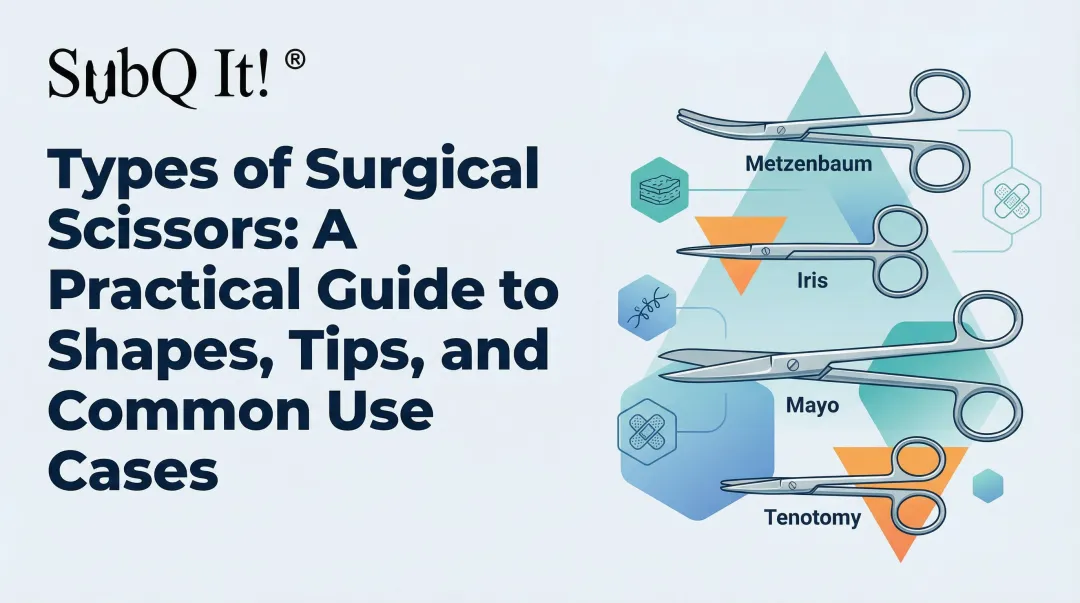
1. Mayo Scissors
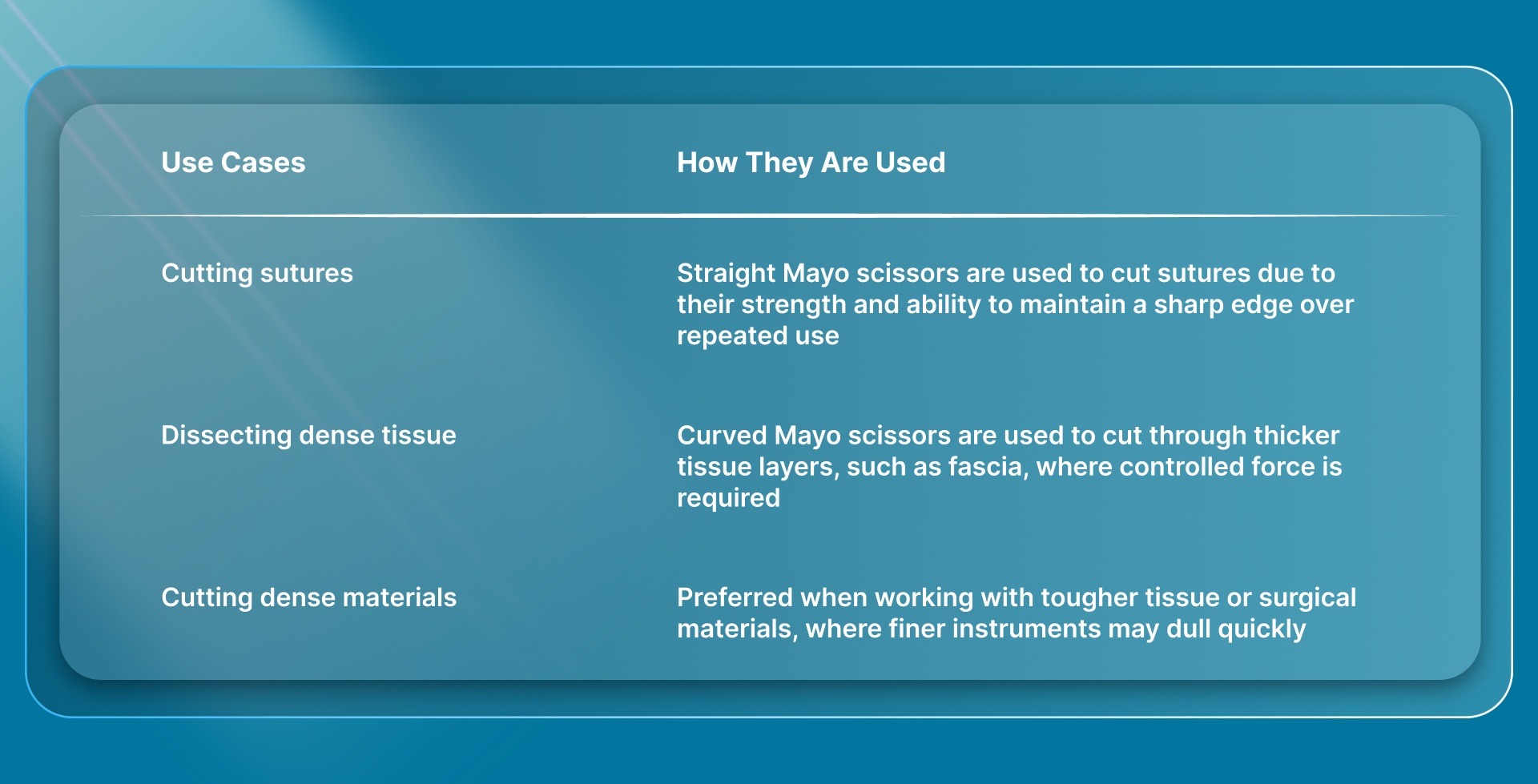
Mayo scissors are heavy-duty instruments with thicker blades and a balanced handle-to-blade ratio, designed to deliver controlled cutting force.
They are built for durability and are typically used when working with dense tissue or materials that require strength rather than fine precision.
Mayo scissors are used for:
2. Metzenbaum Scissors
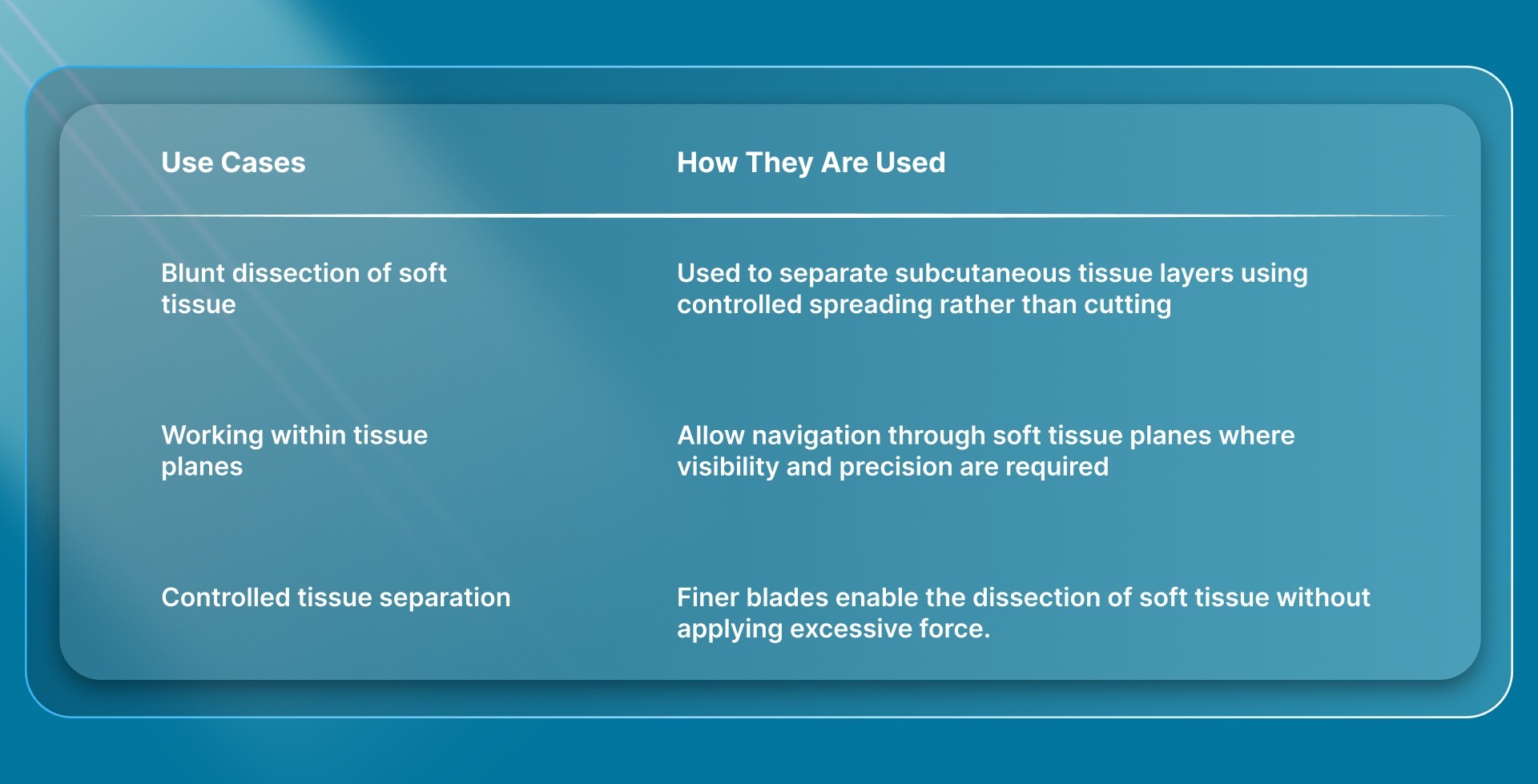
Metzenbaum scissors have longer handles and shorter, finer blades, allowing controlled movement within deeper or more delicate tissue planes. Their design supports precise dissection while enabling controlled tissue separation.
Metzenbaum scissors are used for:
3. Iris Scissors
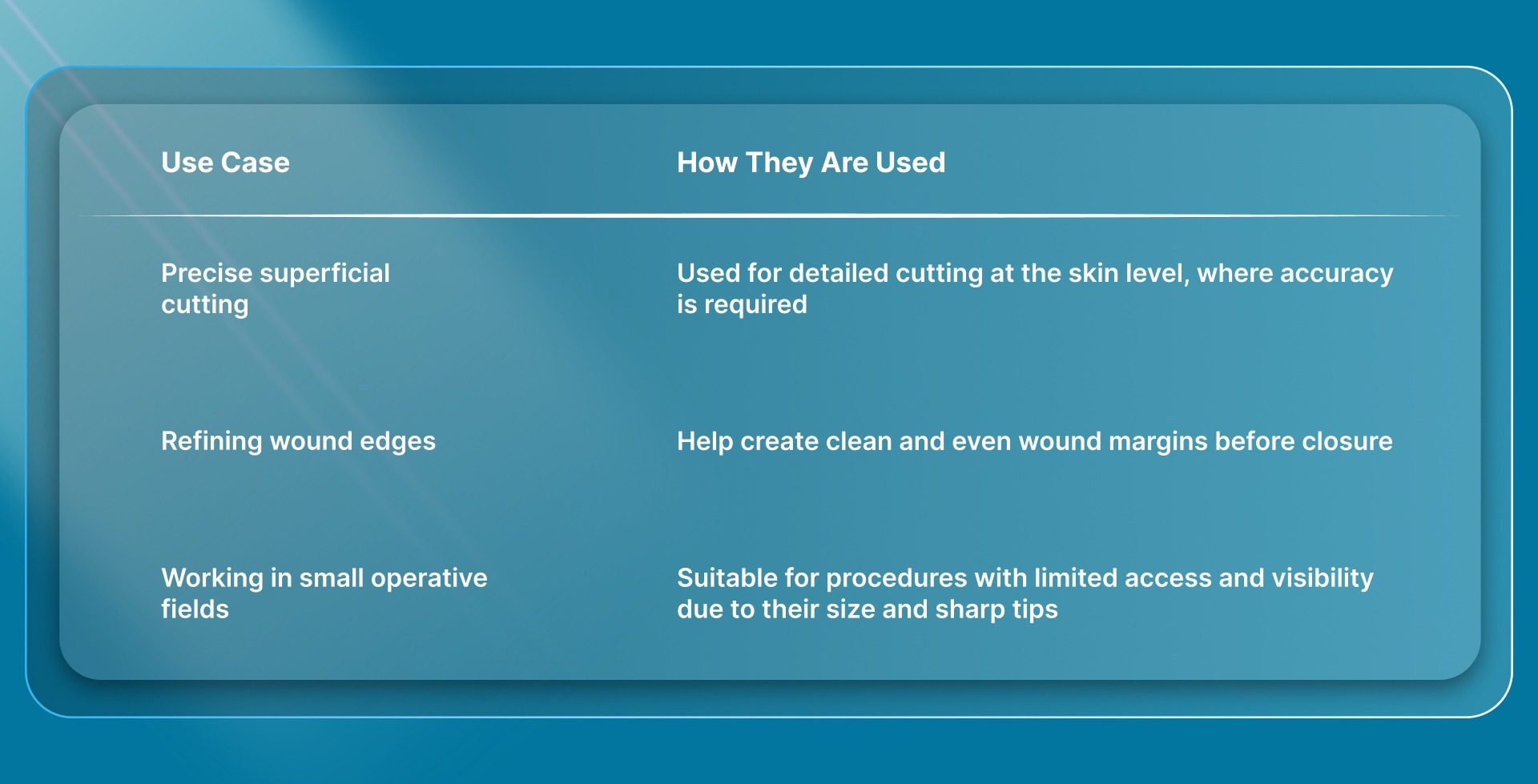
Iris scissors are small, sharp-tipped instruments designed for fine, superficial work where precision is critical. Their compact size allows accurate cutting in limited spaces, particularly in procedures requiring detailed control.
Iris scissors are used for:
Understanding the differences among these types also helps clarify how to select the most appropriate skin scissors for a specific procedure.
How to Choose the Right Skin Scissors for Your Procedure?
Selecting skin scissors is a case-specific decision based on tissue characteristics, operative depth, and the level of control required at each stage. The right choice supports efficient dissection and consistent preparation before closure.
1. Match the Scissor to Tissue Density
Tissue type determines the amount of force required and how the instrument performs during dissection. Using a scissor that does not match tissue resistance can reduce control and affect efficiency.
Key considerations include:
- Dense tissue: Thicker, more resistant structures require scissors with stronger blades that can maintain cutting performance without dulling quickly. This is particularly relevant when working through fascia or other high-resistance tissue.
- Soft tissue: Finer blades are better suited for softer tissue layers, allowing controlled dissection without applying unnecessary pressure. This supports more consistent and controlled tissue separation.
2. Consider the Depth of Dissection
Depth influences both visibility and the instrument's ease of maneuverability within the operative field. Choosing the right proportions helps maintain control without frequent repositioning.
Selection depends on:
- Superficial work: Shorter, more compact scissors provide better hand control when working close to the skin surface. This supports precise movements in well-visualized fields.
- Deeper planes: Longer handles allow better reach into deeper tissue layers while maintaining stable hand positioning. This supports smoother and more controlled dissection.
3. Evaluate the Need for Precision vs Cutting Strength
Different procedural steps require different levels of control and cutting force. Balancing these factors ensures the instrument matches the task being performed.
This trade-off is seen in:
- Precision-focused steps: Fine control is important when working near wound edges or in confined areas where small movements affect the final result. Instruments with finer tips allow more accurate cutting in these situations.
- Force-driven steps: When tissue resistance is higher, stronger blades are required to maintain consistent cutting performance. In these cases, stability and durability are more important than fine tip precision.
4. Align With the Stage of the Procedure
Scissor selection often changes as the procedure progresses, depending on the task being performed. Matching the instrument to each stage helps maintain workflow efficiency.
Typical usage patterns include:
- Early-stage work: Instruments suited for initial tissue division or exposure are used to establish access and visibility.
- Mid-procedure dissection: Controlled separation of tissue layers becomes the focus, requiring instruments that enable steady, predictable movement.
- Pre-closure preparation: The emphasis shifts to refining wound edges to support consistent alignment before closure.
5. Factor in Procedure Type and Case Volume
The type of procedure and the number of cases performed influence the selection and use of instruments. Consistency becomes more important as case volume increases.
Key factors include:
- Minimally invasive procedures: Smaller operative fields require instruments that can function effectively within limited space while maintaining control.
- Longer or open procedures: These involve multiple tissue layers and varying resistance, requiring flexibility in instrument selection throughout the case.
- High-volume settings: Repeated use demands instruments that maintain performance and support a consistent workflow across cases.
6. Ensure Compatibility With Closure Workflow
Instrument selection should support the final stage of the procedure, where tissue condition directly affects the quality of closure. Poor edge preparation can make closure more difficult and less consistent.
This impacts:
- Edge preparation: Clean, even margins support accurate tissue alignment during closure.
- Workflow continuity: Efficient instrument use allows a smoother transition from dissection to closure without unnecessary delays.
Selection decisions also highlight the supporting instruments that work alongside skin scissors during different stages of a procedure.
What Other Instruments Work Alongside Skin Scissors?
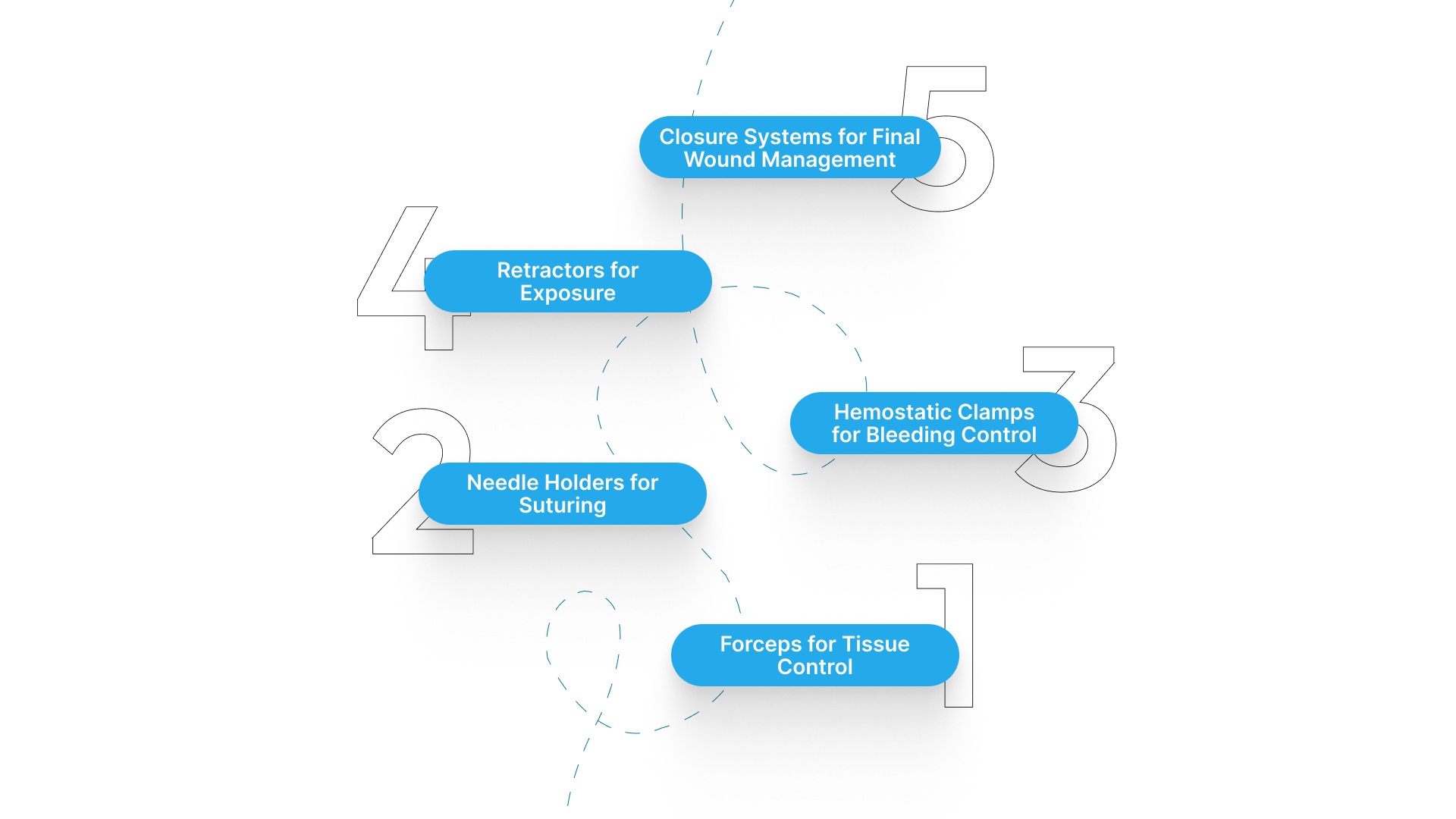
Skin scissors are used alongside a set of supporting instruments that enable controlled dissection, exposure, and preparation for closure. Each instrument serves a defined role, and how they are used together affects visibility, control, and overall procedural flow.
Below are the key instruments commonly used alongside skin scissors, and here’s how they contribute during a case.
1. Forceps for Tissue Control
Forceps are used to grasp and stabilize tissue during dissection, allowing more controlled use of cutting instruments. Without adequate tissue control, scissor movement becomes less precise and harder to direct.
Common roles include:
- Stabilizing tissue during cutting: Forceps hold tissue in position, allowing scissors to cut with greater accuracy and control.
- Providing counter-traction: Gentle traction helps expose tissue planes, making dissection more predictable.
- Positioning wound edges: Forceps assist in aligning tissue before closure, particularly in superficial layers.
2. Needle Holders for Suturing
Needle holders are used during closure to control and guide the surgical needle through tissue. Their role becomes relevant once dissection is complete and wound approximation begins.
Key functions include:
- Driving the needle through tissue: Provides controlled needle placement during suturing.
- Maintaining needle stability: Prevents rotation and ensures consistent suture placement.
- Supporting accurate closure: Helps maintain alignment when placing sutures along the wound edge.
3. Hemostatic Clamps for Bleeding Control
Hemostatic clamps are used to control bleeding during dissection, helping maintain a clear operative field. This is important when working through tissue with visible vascularity.
Hemostatic clamps are used for:
- Clamping blood vessels: Controls bleeding to maintain visibility during the procedure.
- Managing small bleeders: Allows dissection to continue without interruption.
- Maintaining a clear operative field: Supports consistent visibility when using cutting instruments.
4. Retractors for Exposure
Retractors are used to hold tissue aside and maintain exposure throughout the procedure. This improves access to the operative field and supports more controlled use of instruments.
Their role includes:
- Maintaining visibility: Keeps the surgical field open during dissection.
- Reducing the need for continuous manual retraction: Helps maintain stable exposure during longer steps.
- Improving access to tissue planes: Allows more controlled use of scissors in deeper or confined areas.
5. Closure Systems for Final Wound Management
Once tissue preparation is complete, closure instruments are used to approximate the wound. The condition of the tissue at this stage affects how efficiently closure can be performed.
Common approaches include:
- Suturing: Uses needle holders and sutures to manually approximate tissue.
- Metal staples: Provide rapid closure but require removal and leave external puncture marks.
- Bioabsorbable closure systems: Systems place staples beneath the skin, eliminating the need for removal while supporting consistent edge approximation.
Once you understand the supporting instruments, it helps to clarify how skin scissors integrate into the broader wound closure workflow.
Where Skin Scissors Fit Into Wound Closure Workflow?
Skin scissors are used during the transition from tissue dissection to final closure, where preparation of wound edges is critical for accurate closure. Their role at this stage is to ensure tissue edges are properly aligned and prepared before closure begins.
1. Refining Tissue Before Closure
Before closure begins, wound edges often require adjustment to ensure they are even and properly aligned. Skin scissors are used at this stage to make controlled refinements without introducing additional tissue trauma.
Key steps include:
- Trimming irregular edges: Uneven or frayed tissue margins are corrected to create a uniform closure line. This helps ensure both sides of the incision meet consistently during closure.
- Removing small tissue tags: Excess or loose tissue that may interfere with approximation is carefully excised. This prevents obstruction during closure and supports smoother alignment.
- Creating uniform wound margins: Consistent edge preparation allows more predictable placement of sutures, staples, or closure systems.
2. Supporting Final Exposure of the Wound
Clear visibility of the wound edges is required before any closure method is applied. Skin scissors are used alongside other instruments to maintain access and ensure well-defined tissue planes.
This involves:
- Removing small obstructing tissue elements: Minor obstructions are cleared to improve access to the wound edges. This allows closure instruments to be applied without interference.
- Maintaining defined tissue planes: Clear separation of tissue layers ensures closure is performed at the appropriate level. This supports more accurate placement of closure devices.
- Allowing unobstructed instrument movement: Proper exposure enables controlled use of sutures, staples, or other closure systems.
3. Preparing for the Chosen Closure Method
The way tissue is prepared directly affects how closure is performed, regardless of the method used. Skin scissors help ensure the wound is in a condition that supports consistent approximation.
Preparation supports:
- Consistent suture placement: Even tissue edges allow sutures to be placed with uniform spacing and tension.
- Accurate staple placement: Uniform margins help ensure staples are applied evenly along the incision.
- Compatibility with subcutaneous closure systems: Proper edge preparation supports accurate internal placement without requiring additional adjustment.
4. Enabling a Smooth Transition to Closure
Once tissue preparation is complete, the procedure moves into the closure phase. Efficient use of skin scissors at this stage supports a more direct transition without unnecessary adjustments.
This results in:
- Reduced need for intraoperative adjustments: Proper preparation limits the need for corrections during closure.
- Improved procedural flow: The transition from dissection to closure becomes more efficient.
- More consistent closure: Well-prepared tissue supports predictable alignment and closure outcomes.
Final Thoughts
Choosing the right instruments affects how smoothly procedures progress toward closure and how well the wound edges align. Even in small incisions, precise preparation supports predictable closure with fewer adjustments.
In this context, SubQ It! SU-10 offers a bioabsorbable subcutaneous closure system for small and laparoscopic incisions. The device delivers 10 staples to close incisions up to 10 cm, placing fasteners beneath the skin to support consistent edge approximation.
Because the fasteners are bioabsorbable and placed subcutaneously, there is no need for a follow-up visit for removal.
Contact us today to learn how SubQ It! SU-10 can support your closure workflow and request a sample for your practice.
FAQs
1. Why do the right surgical scissors matter in plastic surgery?
Surgical scissors are used for controlled dissection and edge preparation, both of which influence how cleanly tissue is handled and aligned before closure. Using the appropriate type supports precise cutting and reduces unnecessary tissue trauma, which is critical in procedures where cosmetic outcomes matter.
2. What are the tips for using surgical scissors?
Surgical scissors should be used with controlled technique, cutting at the point where the blades meet to ensure clean tissue division and avoid tearing. Using the correct scissors for the task and avoiding misuse on hard materials helps maintain blade sharpness and consistent cutting performance.
3. Does scissor length affect control during skin surgery?
Yes. Shorter scissors generally offer more control in superficial fields, while longer scissors allow access to deeper tissue planes without excessive repositioning. The choice depends on exposure, tissue depth, and the degree of confinement of the operative field.
4. When should skin scissors be sharpened or replaced?
They should be serviced when cutting becomes less precise, tissue begins to fold rather than divide cleanly, or resistance increases during routine use. Delayed maintenance can reduce precision and affect procedural efficiency.
5. Can the wrong skin scissors affect closure quality even if the closure method itself is unchanged?
Yes. If tissue edges are not prepared cleanly, closure becomes less predictable regardless of whether sutures, staples, or subcutaneous systems are used. Edge quality directly affects tissue approximation, alignment, and the need for intraoperative adjustments.
6. Are curved and straight scissors interchangeable in skin surgery?
Not always. Their shape affects access, angle of approach, and how tissue is divided within the operative field. Using the wrong configuration can reduce precision, particularly in deeper or more confined areas.