Introduction
During a routine abdominal closure, a circulating nurse reaches for cutting instruments but pauses—should she hand the surgeon scissors or shears? This seemingly minor decision carries significant weight. The wrong choice can lead to damaged instruments, increased tissue trauma, or compromised patient safety.
The distinction between surgical scissors and shears matters more than many realize. While the terms are often used interchangeably in everyday conversation, these tools serve fundamentally different purposes in healthcare settings.
Scissors are precision instruments designed for delicate tissue work during procedures, while shears are heavy-duty tools built for cutting tougher materials like bandages and clothing. Understanding when to use each tool directly impacts surgical efficiency, instrument longevity, and ultimately, patient outcomes.
TLDR
- Surgical scissors are precision instruments for tissue cutting, sutures, and fine dissection
- Surgical shears are heavy-duty tools for cutting bandages, dressings, clothing, and other non-tissue materials
- Key differences include blade strength, tip design (blunt safety tips vs. sharp precision points), and cutting capacity
- Use scissors for tissue work; shears for prep, dressing removal, and emergencies
- Proper tool selection prevents instrument damage, reduces procedure time, and improves patient safety
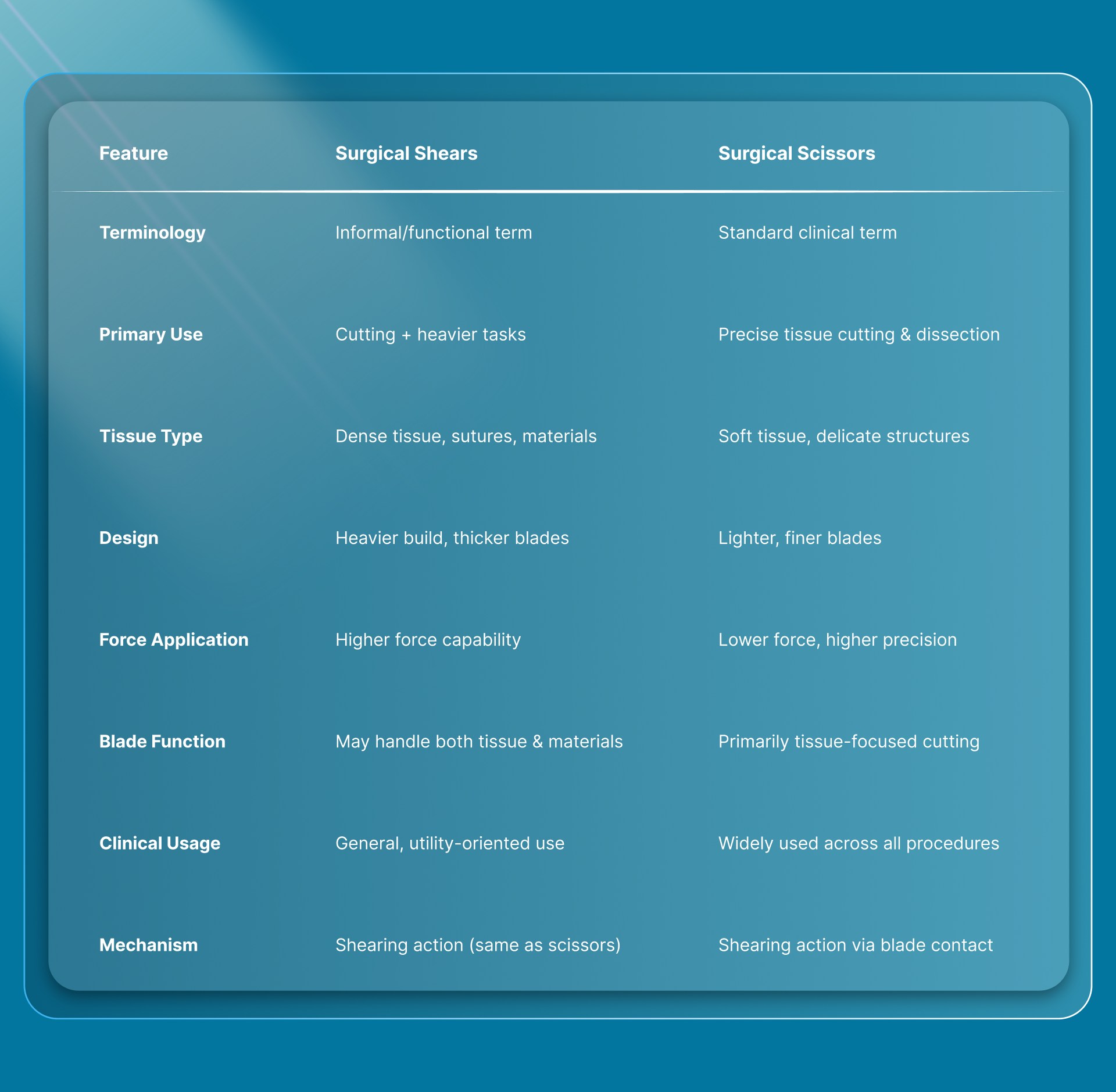
Surgical Scissors vs Shears: Quick Comparison
| Feature | Surgical Scissors | Surgical Shears |
|---|---|---|
| Primary Purpose | Cutting biological tissues, vessels, and sutures during surgery with precision | Cutting tough non-tissue materials: bandages, dressings, clothing, tape, and heavy fabrics |
| Blade Design | Fine, sharp blades (surgical stainless steel or tungsten carbide) that shear tissue cleanly with minimal force | Reinforced, often serrated blades with greater thickness; angled at ~150° for leverage |
| Tip Configuration | Three options: blunt/blunt (tissue dissection), sharp/sharp (precise incisions), or blunt/sharp (suture cutting) | Wide, blunt probe tips that slide safely under bandages and along skin without injury |
| Handle Mechanics | Ring handles or spring forceps design; minimal force with tactile feedback for precise control | Ergonomic handles with greater leverage for forceful cutting; less precision required |
| Typical Applications | Tissue dissection, vessel isolation, suture work, confined anatomical spaces, cosmetic procedures | Pre-op preparation, bandage removal, emergency clothing removal, dressing changes, trauma care |
| Key Advantage | Precision and controlled cutting depth to prevent tissue trauma | Rapid, forceful cutting of tough materials without dulling |

What Are Surgical Scissors?
Surgical scissors are precision instruments constructed from surgical stainless steel, often enhanced with tungsten carbide inserts. They cut biological tissues, sutures, and surgical materials through a shearing action where two blades meet precisely to cut cleanly without crushing tissue.
Construction materials significantly impact performance. Standard stainless steel provides corrosion resistance and durability, while tungsten carbide—often identified by gold-colored handles—creates harder, sharper edges that maintain precision longer than standard steel.
This superior edge retention is critical. Blunt scissors crush rather than cut tissue, leading to contusion and compromised wound healing.
Surgical scissors come in two main mechanical types. Ring scissors feature standard finger loops and represent the most common design.
Spring forceps scissors, used primarily in microsurgery and ophthalmology, provide enhanced control for extremely delicate work in confined spaces.
The three tip configurations serve distinct purposes:
- Blunt/Blunt: Safest option for tissue dissection, allowing surgeons to separate tissue layers without piercing underlying structures
- Sharp/Sharp: Provides maximum precision for incisions in dense or delicate tissues
- Blunt/Sharp: Combines safety with precision, commonly used for suture cutting where one blunt tip protects the patient while the sharp tip cuts effectively
Core benefits include:
- Surgical precision with controlled cutting depth
- Minimal tissue trauma that promotes faster healing
- Maintained sterility through proper design
- Specialized variations for different anatomical areas

Types and Specialized Variations
Surgical scissors come in numerous specialized types designed for specific procedures and anatomical areas. The diversity reflects the varying demands of different surgical specialties—from cardiovascular surgery requiring extremely delicate vessel work to orthopedic procedures needing scissors that can handle tougher tissue structures.
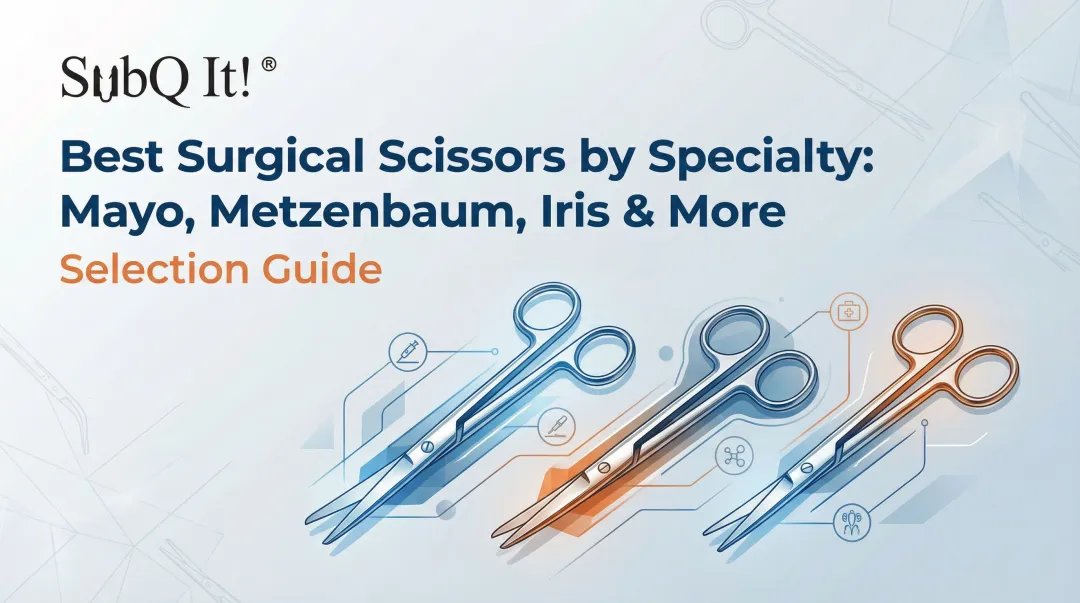
Mayo Scissors: Heavy-duty construction with semi-blunt tips, available in straight or curved configurations. Designed for cutting tough tissues like fascia, muscle, and dense connective tissue. Curved blades allow deeper penetration into surgical sites.
Metzenbaum Scissors: Feature long shanks with shorter, more delicate blades and blunt tips. The gold standard for delicate tissue dissection and blunt dissection techniques where surgeons spread tissue layers rather than cut them.
Iris Scissors: Very small scissors with fine, sharp tips available in straight or curved designs. Essential for ophthalmology, plastic surgery, and dermatologic procedures requiring extreme precision in tight spaces.
Tenotomy Scissors: Long handles with thin, tapered blades designed for delicate dissection in confined anatomical spaces, particularly in ophthalmic and neurosurgery applications.
Potts-Smith Scissors: Fine, angled scissors (45° or 90°) with long blades specifically designed for precise incisions in blood vessels during vascular surgery.
Suture Scissors: Feature blunt/sharp or blunt/blunt tip configurations, often with a hook or notch to lift sutures safely away from tissue before cutting.
The Association of periOperative Registered Nurses (AORN) catalogs dozens of distinct scissor designs used across surgical specialties, reflecting the critical importance of matching the precise instrument to the specific tissue type and surgical task.

Common Surgical Applications
Surgical scissors are essential for intraoperative tissue cutting, vessel isolation, suture placement and removal, and fine dissection in confined anatomical spaces. The precision these instruments provide directly impacts surgical outcomes.
Procedures heavily reliant on precision scissors include:
- Laparoscopic surgery: Small incisions require scissors that can work through limited access points
- Plastic and reconstructive surgery: Cosmetic outcomes depend on clean incisions with minimal tissue trauma
- Cardiovascular surgery: Delicate vessel work demands instruments that won't damage fragile vascular structures
- Ophthalmic procedures: Extremely confined spaces require miniature scissors with exceptional precision
Research confirms that instrument sharpness is a key parameter in cutting soft tissues, with sharp blades producing high-quality wounds that heal with less scarring.
Conversely, blunt instruments require greater force, increasing tissue deformation and trauma. This mechanical damage can impede healing and increase infection risk.
The quality of the initial surgical incision sets the foundation for successful wound closure. Clean wound edges with minimal trauma create optimal conditions for healing and enable efficient closure with advanced techniques.
What Are Surgical Shears?
Surgical shears are robust cutting instruments designed for heavy-duty applications, primarily used for cutting through tougher materials like bandages, dressings, clothing, thick tissue layers, and emergency access situations. Unlike precision surgical scissors, shears prioritize cutting power and patient safety over fine precision.
Trauma shears—often called "Tuff Cuts" or EMT shears—feature rugged construction with plastic handles and metal blades bent at approximately 150 degrees. This angled design provides mechanical leverage for cutting through heavy materials that would damage delicate surgical scissors.
The wide, blunt probe tip slides across the patient's skin, minimizing injury risk while cutting clothing or bandages.
Shears feature reinforced blades with enhanced serrations on the lower edge that grip materials like denim, leather, or seatbelts to prevent slippage during cutting.
The ergonomic handles provide greater leverage than standard scissors, allowing healthcare providers to cut through tough materials with less hand fatigue.
Key design differences from surgical scissors include:
- Angled blades for improved cutting leverage
- Protective blunt tips to prevent patient injury during rapid cutting
- Serrated edges for gripping tough materials
- Heavier construction to withstand repeated use on non-tissue materials
Core benefits include:
- Rapid material cutting in emergency situations
- Enhanced patient safety during dressing removal
- Emergency preparedness for trauma scenarios
- Exceptional durability for repeated use on materials that would quickly dull precision surgical scissors

Types and Specialized Variations
The main categories of surgical shears used in healthcare settings reflect different clinical needs and emergency scenarios.
Bandage Shears (Lister Shears): Smaller than trauma shears, typically made of stainless steel. Feature a distinctive blunt nodule on the lower blade that safely lifts bandages away from the skin before cutting. Angled design allows better visibility and control during dressing changes.
Trauma Shears (EMT Shears): Heavy-duty design capable of cutting through car seatbelts, leather, denim, and even thin metal. Studies comparing clothing removal techniques found trauma shears removed clothing in 142 seconds, though specialized cutting hooks proved faster at 78 seconds. Strictly for external use, never for invasive surgical procedures.
Utility Shears: General-purpose cutting tools for medical supplies, packaging, tubing, and other non-biological materials in healthcare settings. Less specialized than trauma shears but more durable than standard scissors.
Specialized features enhance functionality:
- Integrated tools like oxygen wrenches or ruler markings on some emergency models
- Fluoride coatings for rust resistance in harsh environments
- Autoclavable materials for sterility maintenance in surgical settings
- Varying blade lengths and thicknesses for different cutting capacities
Trauma shears can cut through materials up to several millimeters thick, including leather boots, heavy denim, and synthetic protective materials.
This cutting capacity makes them essential in emergency departments and pre-hospital care settings.
Common Healthcare Applications
Surgical shears prove most valuable in emergency departments for trauma care and rapid clothing removal, pre-operative preparation for cutting dressings and tapes, post-operative care for bandage changes, and field medicine where durability and versatility are essential.
Scenarios requiring shears include:
- Accident victims: Rapid garment removal without moving injured patients, minimizing risk of worsening spinal or orthopedic injuries
- Burn patients: Careful dressing changes without disturbing fragile healing wounds or causing pain through adhesive removal
- Surgical site preparation: Cutting away existing bandages, tapes, and dressings before procedures
In emergency settings, time is critical. The blunt safety tip design prevents patient injury during rapid cutting movements, a crucial feature when treating trauma patients who may be combative, disoriented, or unable to remain still. The 150-degree angle provides leverage that allows emergency personnel to cut through multiple layers of clothing quickly without repositioning the tool.
Research on trauma patient exposure demonstrates that proper tool selection impacts outcomes. While trauma shears remain the standard due to their versatility and safety features, comparative studies show specialized cutting tools can reduce exposure time by nearly 50%, suggesting that emergency departments benefit from having multiple cutting tool types readily available.
The safety profile of shears makes them essential for post-operative care. The blunt probe tip slides under bandages without risk of catching on sutures or staples, allowing nurses to remove dressings confidently without causing secondary injuries or disrupting healing incisions.
Scissors vs Shears: Which Should You Use When?
Proper instrument selection depends on several critical factors:
- Material being cut (living tissue vs. non-tissue materials)
- Precision requirements (fine dissection vs. bulk cutting)
- Procedural phase (intraoperative vs. pre/post-operative)
- Patient safety concerns specific to the situation
When to Choose Surgical Scissors
Scissors are essential for all intraoperative cutting of tissues, vessels, and organs where precision and controlled depth are critical. The shearing action of properly maintained scissors creates clean tissue edges that heal with minimal scarring.
Choose scissors for:
- Suture placement and removal where one blunt tip protects tissue while the sharp tip cuts effectively
- Fine dissection work requiring separation of tissue planes without damaging underlying structures
- Any procedure where tissue trauma must be minimized to optimize healing outcomes
- Working in confined anatomical spaces around critical structures like nerves and vessels
- Procedures where cosmetic outcomes matter, such as plastic surgery or visible incision sites
Clinical protocols emphasize matching specific instruments to tissue type. Heavy Mayo scissors are appropriate for dense fascia and muscle, while delicate Metzenbaum scissors are reserved exclusively for fine tissue dissection. Using the wrong scissor type—such as applying Metzenbaum scissors to tough tissue—compromises the instrument's integrity and can cause tissue trauma.
Surgical precision matters most when initial incision quality directly affects closure methods. Clean wound edges created by sharp scissors provide optimal conditions for advanced closure systems.
These systems can dramatically reduce closure time while maintaining superior aesthetic outcomes. For example, bioabsorbable subcuticular closure devices achieve closures 7X faster than manual sutures when working with properly prepared wound edges.

Shears for Non-Tissue Applications
While scissors handle tissue work, shears excel at pre-operative preparation tasks including cutting away existing dressings, tapes, and clothing around the surgical site. The reinforced construction and protective tips make shears ideal for these applications.
Shears are best for:
- Post-operative care requiring safe removal of bandages without disturbing healing incisions or causing patient discomfort
- Emergency situations requiring rapid access, such as trauma care where clothing must be removed quickly to identify injuries
- Burn treatment where dressings must be changed carefully without adhering to or pulling on damaged tissue
- Any scenario where speed and patient safety during material cutting are paramount
Emergency medicine protocols recognize trauma shears as standard equipment because the blunt tip prevents injury during rapid cutting movements. In trauma scenarios, every second counts—the ability to quickly expose the patient for assessment can be lifesaving.
The angled blade design provides mechanical advantage, allowing healthcare providers to cut through multiple layers of heavy fabric without excessive hand fatigue. This ergonomic benefit matters most during extended shifts in emergency departments or when treating multiple trauma patients.
Common Selection Mistakes
Frequent errors include using heavy-duty scissors when shears would be more efficient and safer, attempting to cut tough materials with delicate scissors (causing instrument damage), or using shears for tissue work (risking excessive trauma).
Consequences of improper selection:
- Damaged instruments: Using Metzenbaum or Iris scissors to cut sutures, mesh, or bandages causes nicks and dulling, rendering them useless for delicate tissue work and requiring costly replacement
- Increased procedure time: Struggling with inappropriate tools slows surgical workflow and extends anesthesia time
- Potential patient harm: Using precision scissors on tough materials may require excessive force, leading to sudden slips that could injure the patient
- Compromised outcomes: Blunt scissors crush tissue rather than cutting cleanly, leading to contusion and compromised wound healing
Proper instrument selection training for surgical teams is essential. Facilities should maintain both tool types readily available and establish clear protocols for when each should be used. Regular instrument inspection and sharpness testing according to ISO 7740 and ASTM F1079 standards ensures reliability and prevents the use of damaged instruments that could compromise patient care.
Real-World Application: How Tool Selection Impacts Surgical Outcomes
Appropriate cutting instrument selection directly impacts surgical success. Proper scissors use during incision and dissection creates clean wound edges with minimal trauma, improving healing quality, scarring, and closure effectiveness.
Research confirms that sharp instruments produce high-quality wounds that heal with less scarring and pain. Clean shearing creates wounds with aligned tissue edges that approximate naturally during healing. In contrast, crushed or torn tissue from blunt instruments creates irregular wound edges that heal more slowly with greater scarring.
Surgical teams optimize outcomes by matching instruments to tasks throughout the procedure. The workflow progresses from precision scissors for initial incisions and tissue work to appropriate closure methods that complement wound preparation quality.
Initial cut quality sets the foundation for everything that follows.
Modern wound closure innovations work best when surgeons use appropriate precision instruments for initial cutting. Bioabsorbable subcuticular closure systems like SubQ It! depend on clean wound edges created by proper scissor technique.
These closure methods can be 7X faster than traditional sutures while eliminating staple removal, but their effectiveness begins with initial incision quality.
Studies examining instrument quality and selection show correlations with surgical outcomes including:
- Infection rates
- Healing times
- Patient satisfaction scores
Instruments with tungsten carbide inserts maintain their edge longer, ensuring consistent cutting performance and reducing intraoperative instrument changes.
Proper tool selection extends beyond the operating room. Post-operative care using appropriate shears for dressing removal prevents disruption of healing incisions and reduces patient anxiety. The blunt safety tips allow confident bandage removal without risk of catching on closure materials or damaging newly formed tissue.
Conclusion
While surgical scissors and shears may appear similar at first glance, they serve distinctly different purposes in healthcare settings.
Scissors are precision instruments designed for tissue work during surgery, where clean cuts and controlled depth directly impact healing outcomes. Shears are safety-focused tools built for cutting tough materials during preparation, emergency, and care phases.
Understanding this distinction guides proper instrument selection. Surgical teams should maintain both types and choose based on the specific task:
- Use scissors when cutting tissue, vessels, or sutures where precision matters
- Choose shears when cutting bandages, dressings, or clothing where cutting power and patient safety matter most
Proper training ensures team members understand not just which tool to use, but why the distinction matters for patient outcomes.
The right tool choice contributes to surgical efficiency by reducing procedure time, enhances patient safety by preventing instrument-related injuries, and ultimately delivers better healing outcomes through appropriate tissue handling. Investing in quality instruments and maintaining them according to established standards protects both patients and the healthcare facility's equipment investment.
Frequently Asked Questions
What are the different types of surgical shears?
Main types include bandage/trauma shears with blunt tips for safe dressing removal, utility shears for cutting medical supplies and packaging, and emergency shears for heavy materials like clothing, leather, and seatbelts.
What is the difference between surgical shears and suture scissors?
Suture scissors are precision instruments with blunt/sharp tips for cutting stitches without damaging tissue. Surgical shears are heavy-duty tools with reinforced blades for cutting bandages and materials—never use them on sutures.
Can surgical scissors be used for cutting bandages?
While technically possible, it's not recommended. Scissors designed for tissue cutting lack safety features like blunt probe tips and using them on tough materials damages precision blades needed for surgical work, compromising their effectiveness for delicate tissue dissection.
What makes trauma shears different from regular scissors?
Trauma shears have angled blades (150 degrees) for leverage, wide blunt tips to prevent injury, serrated edges for gripping tough materials, and ability to cut through seatbelts and heavy fabric. Many feature fluoride coatings for durability.
How do you maintain surgical scissors and shears?
Use proper sterilization protocols for the instrument type, conduct regular sharpness checks using standardized test materials (never paper, which dulls blades), avoid using instruments on inappropriate materials that could damage blades, and follow manufacturer guidelines specific to tungsten carbide or stainless steel construction.
Are there specialized scissors for minimally invasive surgery?
Yes, laparoscopic and endoscopic procedures use specially designed scissors with long insulated shafts (typically 36 cm), miniaturized blades at the distal tip, pistol-grip handles for precise control, and often articulating tips with electrosurgical capabilities for simultaneous cutting and coagulation.