Introduction
Selecting the wrong disposable skin stapler manufacturer can compromise patient safety, surgical outcomes, and hospital costs. Malfunctioning devices, misfires, or inconsistent staple formation put patients at risk of complications, infections, and delayed recovery.
Surgical site infections (SSIs) cause nearly 20% of healthcare-associated infections, extending hospital stays by over a week and adding tens of thousands of dollars per case. Beyond patient harm, faulty devices can trigger recalls, regulatory penalties, and legal exposure, creating operational and financial headaches for hospitals.
Choosing a trusted, compliant manufacturer safeguards patients and reduces risk. This blog outlines exactly what to verify from ISO-certified quality systems and validated sterilization to regulatory approvals, production capacity, and minimum order requirements, helping procurement teams ensure safe, reliable, and cost-effective wound closure solutions.
Key Takeaways
- Verify ISO 13485 certification and quality processes to ensure consistent device performance.
- Confirm sterilization methods (gamma, EO, electron-beam) and FDA/CE approvals for sterility assurance.
- Review the manufacturer’s production capacity, lead times, and minimum order requirements to prevent supply delays.
- Check post-sale support, including training, warranty, and complaint resolution procedures.
- Assess the total cost of ownership, including shipping, returns, and potential device failures that could impact patient safety.
What is a Disposable Skin Stapler?
A disposable skin stapler is a single-use surgical device designed to close skin edges quickly, precisely, and safely during wound closure procedures. External staplers are FDA-classified under 21 CFR 878.4740 for surgical skin closure, ensuring they meet regulatory safety standards.
Types of disposable skin staplers:
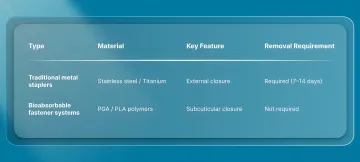
- Traditional metal staplers: Use stainless steel or titanium staples and typically require removal 7–14 days after surgery.
- Bioabsorbable fastener systems: Made from synthetic polymers such as PGA or PLA. Some are FDA-approved for subcuticular closure, eliminating staple removal and often reducing scarring.
Core Components
Every disposable skin stapler includes these essential parts:
- Handle mechanism with ergonomic grip
- Staple cartridge pre-loaded with fasteners
- Firing system for consistent release
- Safety features with automatic needle retraction and safety stops for consistent staple formation
Why Does Manufacturer Selection Matter for Skin Staplers?
Most disposable skin stapler manufacturers check the same boxes—ISO certification, sterilization claims, regulatory listings. These are baseline requirements, not differentiators.
The real distinction shows up in how devices perform outside controlled conditions in varied tissue types, across surgeons, and over time.
- Protect Patients: Poorly performing staplers can cause misfires, inconsistent staple formation, or wound dehiscence, directly increasing complications, infections, and recovery time.
- Control Costs: Device failures and resulting SSIs can extend hospital stays, trigger expensive recalls, and lead to legal liability, far outweighing any initial savings from cheaper suppliers.
- Risk-Based Design Controls: Leading manufacturers perform risk assessments on every component to anticipate failure modes, including rare or extreme-use scenarios.
- Support for Surgical Education: Training materials, simulation kits, or on-site demonstrations improve safe use and optimize device adoption.
- Supply Chain Transparency: Manufacturers who cannot trace raw material origins or subcontracted processes increase the risk of defects, recalls, or regulatory issues.
What to Verify When Evaluating Disposable Skin Stapler Manufacturers
Thorough manufacturer verification protects healthcare facilities from quality failures, regulatory violations, and supply chain disruptions. The following six criteria provide a comprehensive framework for evaluating manufacturer reliability and product quality.
Quality Control Systems
Essential Verification Steps:
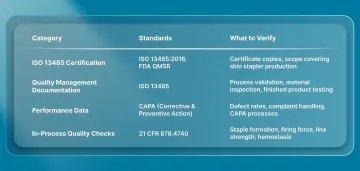
- ISO 13485 certification status: Obtain copies of current certificates with scope statements covering skin stapler production. FDA's Quality Management System Regulation (QMSR)), effective February 2026, mandates strict alignment with ISO 13485:2016
- Quality management documentation: Review process validation protocols, incoming material inspection procedures, and finished product testing requirements
- Performance data: Ask for defect rates, customer complaint handling procedures, and Corrective Action Preventive Action (CAPA) processes
- In-process quality checks: Verify the manufacturer performs specific testing required by 21 CFR 878.4740:
- Staple formation verification in maximum and minimum tissue thicknesses
- Firing force measurement to ensure usability and prevent jamming
- Staple line strength testing to prevent dehiscence
- Hemostasis confirmation to verify effective bleeding control
ISO 13485 Clause 7.4 mandates rigorous purchasing controls, requiring manufacturers to evaluate and monitor their own suppliers. This ensures raw material quality—a critical factor in finished product reliability.
Sterility Assurance and Validation
Critical Requirements:
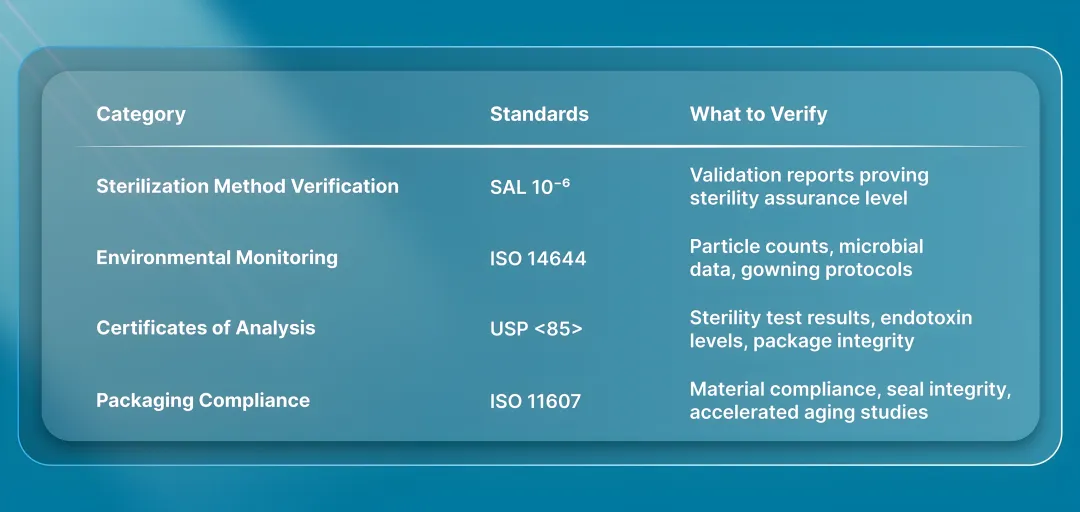
- Sterilization method verification: Confirm whether gamma irradiation, ethylene oxide (EO), or electron beam sterilization is used. Request validation reports demonstrating Sterility Assurance Level (SAL) of 10⁻⁶
- Environmental monitoring program: Review particle counts, microbial monitoring data, and personnel gowning protocols for production clean rooms classified under ISO 14644
- Certificates of analysis: Obtain COAs for each production lot showing sterility test results, endotoxin testing per USP <85>, and package integrity validation
- Packaging compliance: Verify that packaging materials meet ISO 11607 standards (Part 1 for materials/design, Part 2 for process validation). Request accelerated aging study data proving package seal integrity over shelf life
For EO sterilization, manufacturers must demonstrate compliance with ANSI/AAMI/ISO 11135 and prove that EO residuals are below hazardous levels per ISO 10993-7.
For radiation methods, validation must comply with ANSI/AAMI/ISO 11137.
Regulatory Compliance and Documentation
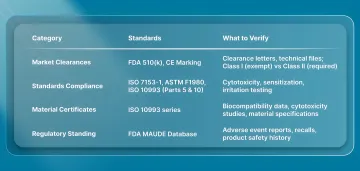
Mandatory Verifications:
- Market clearances: Verify FDA 510(k) clearance for US sales or CE marking for European distribution. Obtain copies of clearance letters and technical files. External skin staplers are generally Class I and 510(k) exempt, while internal staplers require Class II clearance
- Standards compliance: Confirm adherence to ISO 7153-1 (surgical stapling instruments), ASTM F1980 (surgical staplers), and biocompatibility testing per ISO 10993 series, including cytotoxicity (Part 5), sensitization (Part 10), and irritation (Part 10)
- Material certificates: Obtain documentation showing biocompatibility testing, cytotoxicity studies, and material specifications for staples and device components
- Regulatory standing: Check the FDA's MAUDE database for adverse event reports and recall history
SubQ It! maintains FDA 510(k) clearance (K131563) and ISO 13485 certification, demonstrating the quality standards expected from compliant manufacturers.
Minimum Order Quantity (MOQ) and Pricing Structure
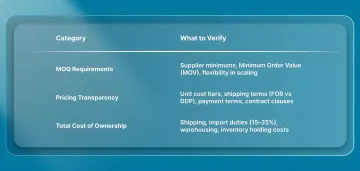
Once regulatory compliance is verified, commercial terms become the next critical evaluation factor.
Key Considerations:
- MOQ requirements: Clarify minimums, which typically range from 500-1,000 units for standard products to 3,000-5,000 units for private label or customized configurations. Some suppliers enforce Minimum Order Values (MOVs) at the contract level
- Pricing transparency: Request detailed breakdowns, including:
- Unit cost with volume discount tiers
- Shipping terms (FOB vs. DDP)—FOB places risk on the buyer once goods are shipped, while DDP includes all duties and delivery costs
- Payment terms and conditions
- Any contract minimums or exclusivity requirements
- Total cost of ownership: Factor in shipping costs, import duties (which can add 15-25% to FOB prices), warehousing requirements, and capital costs for large inventory purchases
Hidden costs often aren't reflected in FOB prices.
A comprehensive TCO model should include acquisition costs, training, and the high costs of quality failures such as readmissions for infections.
Production Capacity and Lead Times
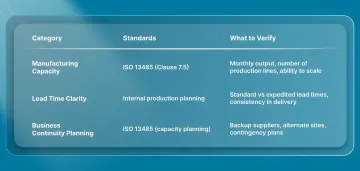
Essential Assessments:
- Manufacturing capacity: Request information on monthly output volumes, number of production lines, and ability to scale for increased demand
- Lead time clarity: Understand standard lead times for regular orders versus expedited orders.
- Business continuity planning: Verify backup supply arrangements, alternative manufacturing sites, and contingency plans for production disruptions, equipment failures, or raw material shortages
Manufacturers with diversified manufacturing bases and robust ISO 13485 capacity planning (Clause 7.5) can better mitigate supply chain disruptions.
After-Sales Support and Technical Assistance
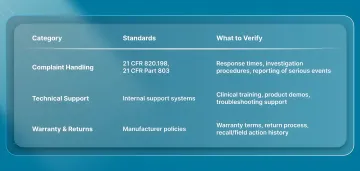
Critical Support Elements:
- Complaint handling: Evaluate response time commitments, investigation procedures per 21 CFR 820.198, and resolution timelines. Under 21 CFR Part 803, manufacturers must report deaths or serious injuries to the FDA
- Technical support availability: Confirm access to clinical staff training, product demonstrations, and troubleshooting assistance
- Warranty and returns: Request information on product warranty terms, return policies for defective units, and the manufacturer's track record for product recalls or field actions
A manufacturer's post-market surveillance capabilities are both a regulatory requirement and a critical buyer protection. Review the manufacturer's recall history in the FDA database as part of due diligence.
Smarter Manufacturer Benchmark: How SubQ It! Raises the Standard
While many disposable skin stapler manufacturers focus on meeting baseline regulatory requirements, true differentiation lies in consistent performance, procedural efficiency, and patient experience in surgical settings.
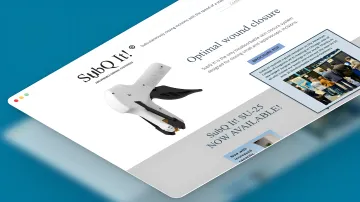
SubQ It! is a manufacturer maintaining ISO 13485 certification and FDA 510(k) clearance (K131563). SubQ It! adheres to the highest regulatory and quality management standards discussed throughout this article.
- Rapid, Standardized Closure: Deploys fasteners in ~7 seconds each, enabling faster and more consistent closure compared to manual suturing.
- Subcuticular Placement: Positions fasteners beneath the skin surface, avoiding external penetration and improving cosmetic outcomes.
- No Removal Needed: bioabsorbable fasteners eliminate staple removal, reducing follow-up visits and patient discomfort.
- Pre-loaded, Single-Use Design: Sterile, ready-to-use units minimize intraoperative variability and setup time.
- Procedure-Specific Configurations: Available in SU-10 (~10 cm) and SU-25 (~25 cm) options for predictable incision coverage.
- Integrated Safety Features: Includes retractable needles and controlled deployment mechanisms to reduce needlestick risk.
- Regulatory & Quality Assurance: FDA 510(k) cleared (K131563) and manufactured under ISO 13485-certified quality systems.
Final Thoughts
Disposable skin staplers may meet the same standards, but they don’t deliver the same level of consistency where it counts. Variations in firing, staple formation, or packaging integrity can slow procedures, increase rework, and impact patient outcomes.
That’s why leading teams evaluate manufacturers based on real-world reliability, not just compliance, looking closely at batch consistency, sterility assurance, and post-market performance.
While traditional staplers remain effective for fast, external closure, bioabsorbable subcuticular systems like SubQ It! provide a more controlled, predictable alternative for planned procedures. It eliminates removal steps and improves overall patient experience.
Better outcomes start with better consistency. Get in touch with the SubQ It! team to see how it can help standardize closure and reduce variability in your surgical workflow.
Frequently Asked Questions
1. Are all skin staplers disposable?
Most modern skin staplers are single-use disposable devices designed for infection control and convenience. Some reusable systems exist but require sterilization between uses and are less common due to cross-contamination risks and reprocessing costs.
2. What is a skin stapler called?
Skin staplers are also called surgical staplers, skin closure staplers, or wound staplers. They may be further classified as disposable skin staplers or bioabsorbable fastener systems depending on the staple material and closure technique.
3. What certifications should a disposable skin stapler manufacturer have?
Essential certifications include ISO 13485 for quality management, FDA 510(k) clearance for US market access, and CE marking for European distribution. Manufacturers should also comply with ISO 7153-1, ASTM F1980 standards, and ISO 10993 biocompatibility testing.
4. What is a typical MOQ for disposable skin staplers?
MOQ typically ranges from 500-1,000 units for standard products to 3,000-5,000 units for private label or customized branding. Some distributors offer "no-minimum" options at higher unit costs.
5. How can I verify a manufacturer's sterility assurance processes?
Request sterilization validation reports showing SAL 10⁻⁶ and certificates of analysis for each lot. Inspect clean room environmental monitoring data (particle counts, microbial monitoring) and conduct on-site audits of production and packaging environments.
6. What's the difference between bioabsorbable and traditional skin staplers?
Traditional skin staplers use metal staples (stainless steel or titanium) that penetrate the skin surface and require removal, typically 7-14 days post-surgery. Bioabsorbable systems like SubQ It! use subcuticular fasteners made from synthetic polymers that are absorbed by the body after healing, eliminating removal procedures, reducing scarring, and improving patient comfort while maintaining comparable closure speed.