
Disposable skin staplers are widely used for rapid skin closure, particularly in procedures where efficiency is a priority. However, choosing the right closure method isn’t always straightforward. Clinicians and procurement teams must weigh factors like cost, patient experience, and clinical outcomes, not just speed.
When assessing the price of disposable skin staplers, unit cost alone rarely reflects the full picture. Clinical evidence shows that skin staplers reduce closure time compared to sutures, while infection rates and cosmetic outcomes are generally comparable across many procedures.
At the same time, considerations such as follow-up visits for removal and cosmetic outcomes can influence overall value, particularly in high-volume or patient-facing specialties.
This article outlines key cost drivers, sterility checks, and clinical considerations to help guide appropriate use.
Key Takeaways
- Efficient Wound Closure: Staplers provide fast, consistent skin approximation while reducing variability in technique.
- Clinical Applications & Limits: Best for abdominal, orthopedic, thoracic, and obstetric procedures; avoid cosmetically sensitive or high-tension areas.
- Safety First: Always check the packaging, sterilization indicators, expiration date, and storage conditions before use.
- Design Matters: Staple count, size, and handle ergonomics impact usability and patient outcomes.
- Subcuticular Alternatives: Bioabsorbable options reduce scarring and eliminate the need for staple removal visits.
What Are Disposable Skin Staplers and How Do They Work?
Disposable skin staplers are single-use devices used to close superficial skin edges quickly and consistently after surgical procedures. Clinical evidence shows 3–4× faster closure time than sutures, with comparable infection and healing outcomes.
When evaluating the price of disposable skin staplers, understanding how these devices function helps put the cost into a clinical context. These staplers come preloaded with sterile metal staples, typically stainless steel, and are designed for rapid, uniform skin closure.
How Do They Work?
During application, the clinician:
- Aligns and everts the wound edges
- Position the stapler across the incision
- Compresses the handle to deploy the staple
This action drives the staple through both sides of the skin, where it is formed against an internal anvil into a closed configuration that secures the wound edges in place.
Clinical Role
- Maintain skin edge approximation during healing
- Provide a fast, consistent alternative to sutures
- Reduce variability in closure technique
Key Design Specifications of Disposable Skin Staplers
When comparing devices, there are a few key specifications to pay attention to. Here’s what you should focus on:
Staple Count Per Device
- 15-staple models for small incisions or lacerations
- 25-staple models for moderate-length surgical closures
- 35-staple models for longer incisions
Note: Exact counts vary by manufacturer, but 15, 25, and 35 staples are the most common configurations used in clinical practice.
Staple Dimensions
Staple size varies by device, but most skin staples fall within these ranges:
- Regular staples: ~4.8–6.1 mm width, ~3.5 mm leg length
- Wide staples: ~6.5–7.0 mm width, ~4.0 mm leg length
Larger staples are typically used in thicker or higher-tension tissue to ensure adequate wound approximation.
Handle Designs
- Pistol-grip designs are most commonly used for controlled, repetitive firing.
- Devices are generally ergonomically designed to reduce hand fatigue during longer closures.
Some models include an integrated staple remover; others require a separate removal instrument, worth confirming before ordering.
FDA Regulatory Classification of Disposable Skin Staplers
Disposable skin staplers for external use fall under Class I (general controls), while internal staplers are classified as Class II (special controls).
Key distinctions:
- External skin staplers
- Class I device
- 510(k) exempt (with limitations)
- Internal surgical staplers
- Class II device
- Require 510(k) clearance and additional controls
Procurement checklist:
- Verify FDA registration and listing
- Confirm compliance with 21 CFR 878.4740
- Ensure documentation aligns with intended use (external vs internal)
When sourcing, confirm that any device carries an active FDA registration number and a 510(k) clearance. Commodity options sold without this documentation fall outside compliant procurement and expose facilities to quality and liability gaps.
When are Disposable Skin Staplers Clinically Appropriate?
Disposable skin staplers are indicated for linear wound closure in surgical specialties where speed matters and cosmesis is secondary:
- Abdominal surgery: Laparotomy closures, hernia repairs
- Orthopedic procedures: Hip and knee arthroplasty incisions
- Thoracic surgery: Chest wall closures
- Obstetric cases: Cesarean section skin closure
When surgical volume is high and operative time directly impacts costs, this speed advantage translates to measurable efficiency gains.
Critical Contraindications and Limitations
Skin staplers should not be used in these anatomic locations:
- Face and neck (cosmetic sensitivity, nerve proximity)
- Hands and feet (high mobility, poor cosmetic outcomes)
- Areas overlying joints or tendons (tension-related complications)
- Regions with minimal tissue depth over bone or vessels
Their percutaneous design, while efficient, increases the risk of visible scarring, particularly in cosmetically sensitive areas.
Application Technique
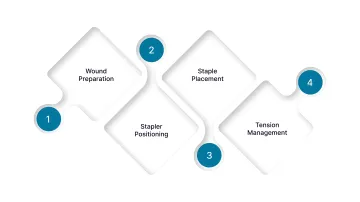
Clinical outcomes with skin staplers are closely tied to technique. Follow these steps to ensure consistent closure and optimal healing:
Wound Preparation
- Evert wound edges slightly using forceps
- Ensure proper alignment before firing
Stapler Positioning
- Hold perpendicular to the skin surface
- Position evenly across wound edges
- Maintain edge eversion during deployment
Staple Placement
- Space staples approximately 0.5–1 cm apart
- Allow a slight elevation of the staple crossbar to accommodate swelling
Tension Management
- Use deep dermal sutures first in high-tension wounds
- Avoid over-compression, which can increase scarring risk
Sterility Checks: What to Verify Before Every Use
Sterility failures are often preventable. A quick, consistent check before use helps reduce contamination risk and avoid intraoperative delays.
Packaging Integrity Inspection
The first-line sterility check requires visually inspecting outer and inner packaging for:
- Tears or punctures in the sterile barrier
- Moisture damage or wet spots
- Compromised seals or open edges
- Crushing or deformation
According to CDC guidelines, sterility maintenance is event-related, not time-dependent. A compromised barrier invalidates sterility regardless of expiration date. If packaging integrity is questionable, do not use the device.
Sterilization Indicator Verification
Chemical indicator strips or color-change labels on sterile packaging confirm the device has been exposed to the sterilization process. Most disposable staplers undergo ethylene oxide (EtO) sterilization, with indicators changing color when exposed to correct sterilization parameters.
Indicator change confirms the device completed a sterilization cycle, not that it remains sterile. Packaging damage or improper storage can still compromise sterility after the cycle.
Expiration Date and Lot Number
Check the printed expiration date before opening any device. Facilities should implement protocols for:
- Rotating stock to use the oldest inventory first
- Pulling expired devices from circulation immediately
- Documenting lot numbers for adverse event traceability
Lot numbers support compliance and enable rapid manufacturer traceability if a safety issue surfaces. They're your audit trail; document them every time.
Expiration and storage integrity are directly linked: a device stored outside recommended conditions may degrade well before its printed date.
Storage Conditions and Shelf-Life Integrity
Proper storage conditions for sterile surgical devices include:
- Temperature: 20–23°C (68–73°F)
- Humidity: 30–60% relative humidity
- Placement: 8–10 inches off the floor, 18 inches from the ceiling, 2 inches from exterior walls
Excessive humidity, temperature swings, or stacking pressure can compromise packaging before expiration. Inspect storage areas on a defined schedule; don't wait for a near-miss to catch an environmental drift.
Point-of-Care Checklist Culture
Integrate a brief pre-use sterility checklist into your standard instrument count protocol:
- Inspect packaging for tears, moisture, or damage
- Verify the chemical sterilization indicator has changed color
- Confirm the expiration date has not passed
- Check that storage conditions have been appropriate
- Perform a mechanism function test where manufacturer instructions include one (typically a fire test on the backing card)
Consistent checks help identify compromised devices early, reducing infection risk and procedural disruptions.
Disposable Skin Staplers Price vs. True Cost of Use
When selecting a skin stapler, understanding cost drivers helps balance the budget with clinical value. Here’s what you need to evaluate:
Unit Price Range and What It Reflects
Disposable skin staplers are available across a wide pricing spectrum, depending on features and technology.
- Standard metal staplers are typically lower-cost and widely used for routine closures.
- Advanced systems (e.g., absorbable or subcuticular devices) are priced higher due to specialized design and materials.
Price differences often reflect device complexity, manufacturing standards, and regulatory requirements, rather than just staple count.
Key Cost Drivers
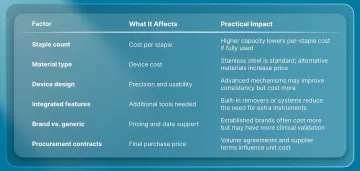
Several variables affect per-unit pricing:
| Factor | What It Affects | Practical Impact |
|---|---|---|
| Staple count | Cost per staple | Higher capacity lowers per-staple cost if fully used |
| Material type | Device cost | Stainless steel is standard; alternative materials increase price |
| Device design | Precision and usability | Advanced mechanisms may improve consistency but cost more |
| Integrated features | Additional tools needed | Built-in removers or systems reduce the need for extra instruments |
| Brand vs. generic | Pricing and data support | Established brands often cost more but may have more clinical validation |
| Procurement contracts | Final purchase price | Volume agreements and supplier terms influence unit cost |
Hidden Costs in Total Cost of Ownership

Unit acquisition price excludes several recurring and downstream costs. The total cost of ownership includes the following:
| Cost Factor | What It Involves | Practical Impact |
|---|---|---|
| Follow-up visits | Removal of non-absorbable staples | Adds clinical time, staffing, and patient follow-up burden |
| Operating room time | Time required for wound closure | Slower closure increases total procedure time and resource use |
| Additional instruments | Separate staple removers or tools | Creates recurring per-case costs if not bundled |
| Complications | Infection, dehiscence, retained staples | Leads to higher downstream treatment costs and extended care |
Procurement Strategy Recommendations
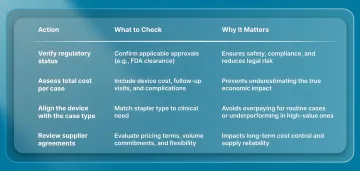
| Action | What to Check | Why It Matters |
|---|---|---|
| Verify regulatory status | Confirm applicable approvals (e.g., FDA clearance) | Ensures safety, compliance, and reduces legal risk |
| Assess total cost per case | Include device cost, follow-up visits, and complications | Prevents underestimating the true economic impact |
| Align the device with the case type | Match stapler type to clinical need | Avoids overpaying for routine cases or underperforming in high-value ones |
| Review supplier agreements | Evaluate pricing terms, volume commitments, and flexibility | Impacts long-term cost control and supply reliability |
These procurement decisions connect directly to clinical considerations, including sterility verification and closure technique covered in the next section.
Why Surgeons Are Switching to SubQ It Staples?
For surgical incisions requiring both efficient closure and optimal cosmetic outcomes, bioabsorbable subcuticular closure systems like SubQ It! offer a clinically distinct approach.
These systems place fasteners beneath the skin surface to approximate internal wounds without external piercing. Key features include:
- FDA‑cleared bioabsorbable closure system: SubQ It! is cleared by the FDA for subcuticular closure in abdominal, thoracic, gynecologic, orthopedic, plastic, and reconstructive surgery.
- Bioabsorbable fasteners: The system uses fasteners that are absorbed by the body over time, eliminating the need for a staple removal visit.
- Subcuticular placement: Fasteners are deployed beneath the epidermis, avoiding external skin penetration and reducing visible scarring.
- Fast deployment: Each bioabsorbable fastener deploys in approximately 7 seconds, enabling closure up to ~7× faster than manual suturing.
- Safety design: The system incorporates retractable needles and safety mechanisms to support secure deployment.
- ISO 13485 quality standards: Manufactured in an ISO 13485 certified facility, ensuring international quality management compliance.
SubQ It 10 vs 25
- SubQ It 10: Contains 10 bioabsorbable fasteners for incisions up to ~10 cm, ideal for small and laparoscopic incisions like trocar sites.
- SubQ It 25: Contains 25 bioabsorbable fasteners for incisions up to ~25 cm, suited for longer incisions in open abdominal or reconstructive procedures.
Explore how SubQ It! integrates seamlessly into your surgical workflow. Contact our team to explore its benefits.
FAQs
1. What is a disposable skin stapler used for?
Disposable skin staplers rapidly close surgical incisions or traumatic lacerations by approximating wound edges with metal staples. They're commonly used in abdominal, orthopedic, and obstetric surgeries where speed is prioritized. Designed for single-patient use, they arrive sterile from the factory and are discarded after use to ensure infection control compliance.
2. How do you check if a disposable skin stapler is sterile?
Inspect packaging for tears, punctures, or moisture damage; verify the chemical sterilization indicator has changed color; confirm the expiration date has not passed. Additionally, ensure storage conditions (temperature 20–23°C, humidity 30–60%) have been maintained. Any compromise in these checks means the device should not be used.
3. What are the disadvantages of skin staplers?
Main drawbacks include train-track scarring if removal is delayed, patient discomfort during removal, contraindication in cosmetically sensitive areas (face, hands), and a required follow-up visit to remove staples. These factors add downstream costs and patient burden beyond the device price. Bioabsorbable subcuticular systems address several of these limitations by eliminating percutaneous staples entirely.
4. Can skin staplers be used on the face?
No, skin staplers are generally contraindicated on the face due to cosmetic concerns, high scarring risk, and proximity to nerves and delicate structures. Sutures or tissue adhesives are the recommended standard of care for facial closures where aesthetic outcomes and precise tissue approximation are critical.
5. Are disposable skin staplers safe for all skin types and wound depths?
Disposable skin staplers approximate superficial skin edges only — deeper tissue layers require prior closure with sutures. Wound contamination, certain skin conditions, or anatomic locations less than 5 mm from underlying structures may make staplers inappropriate and warrant an alternative closure method.