
In surgical wound closure, clear identification of the suture line is essential for accurate placement and safe removal. Nylon sutures are widely used for their strength, smooth handling, and low tissue reactivity, but their natural clear or pale appearance can reduce visibility against soft tissue, particularly in blood-rich operative fields.
To improve intraoperative visibility, nylon sutures are commonly dyed black or blue during manufacturing. The color is added as a practical feature to enhance contrast between the suture and surrounding tissue, making it easier to track during placement and removal. Importantly, this coloration does not alter key material properties such as tensile strength, knot performance, or its non-absorbable nature.
Color in nylon sutures is therefore a functional aid rather than a biological or classification marker. It supports better visualization, reduces handling difficulty, and improves procedural efficiency in routine surgical closure.
In this blog, we explore what nylon suture color represents and why black and blue variants are most commonly used in clinical practice.
TL;DR
- Nylon is a non-absorbable polyamide suture used for skin and soft tissue closure due to its strength and handling reliability.
- Their natural pale color reduces visibility in tissue, especially in blood-rich or low-contrast surgical fields.
- Black and blue dyes are used to enhance contrast for easier identification during placement and removal.
- Color has no impact on mechanical properties such as tensile strength, knot security, or biological response.
- Pharmacopeial standards (USP/EP) regulate size and performance, while color remains a manufacturer-controlled visual feature, not a classification system.
What Is Nylon Suture? Material Science Overview
Nylon sutures are synthetic, non-absorbable sutures made from polyamide polymers, primarily nylon 6 or nylon 6,6, produced through polymerization and processed into fine filaments for surgical use.
They are widely used in soft tissue and skin closure due to their combination of strength, elasticity, and predictable handling behavior in clinical settings.
Nylon sutures are available in different structural forms depending on surgical requirements:
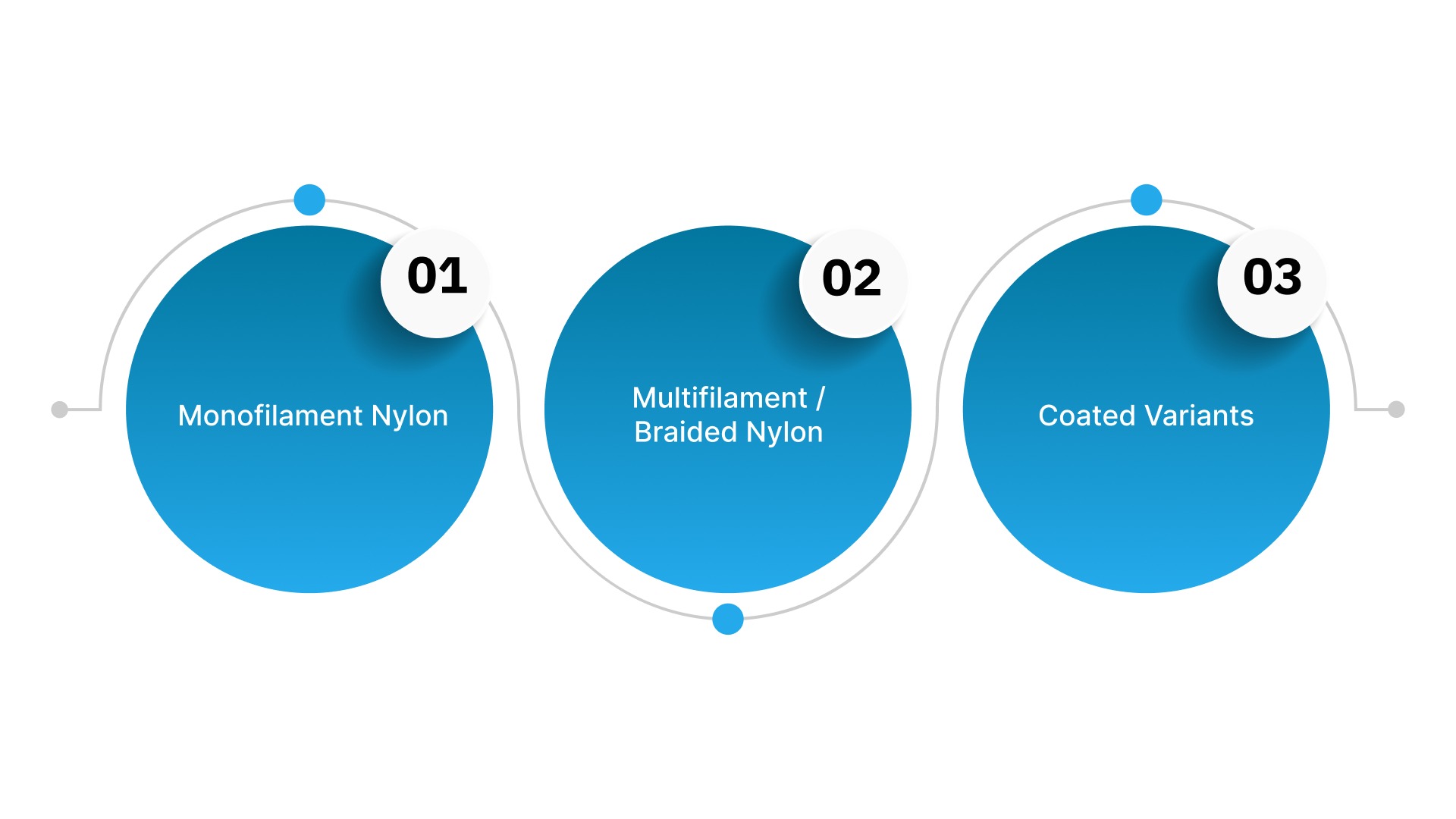
- Monofilament nylon: single-strand structure with smooth surface and low tissue drag
- Multifilament / braided nylon: improved handling and knot security, but slightly higher tissue interaction
- Coated variants: designed to reduce friction and improve passage through tissue
Key material properties relevant to surgical use include:
- High tensile strength for secure wound approximation
- Low tissue reactivity due to the chemically inert polyamide structure
- Gradual long-term strength reduction due to the hydrolytic susceptibility of amide bonds
- Smooth surface profile enabling easier tissue passage, especially in monofilament form
Clinically, nylon sutures are widely selected for skin and soft tissue closure because they combine mechanical reliability with low inflammatory response and consistent performance in superficial surgical applications.
Why Nylon Sutures Are Dyed?
Nylon sutures are manufactured as synthetic polyamide filaments that are naturally white or pale in appearance. In surgical environments, this low intrinsic contrast can make the suture difficult to distinguish from surrounding soft tissue, particularly in the presence of blood or during fine skin closure procedures.
To address this limitation, sutures are commonly dyed during production using approved colorants. The primary function of this dyeing process is to improve visual contrast between the suture and tissue, enabling easier identification during placement, adjustment, and removal.
Importantly, pigmentation is not linked to changes in the fundamental material behavior of nylon. The polymer structure remains unchanged, and key mechanical properties such as tensile strength and handling characteristics are governed by the base polyamide composition rather than color.
Key clinically relevant points include:
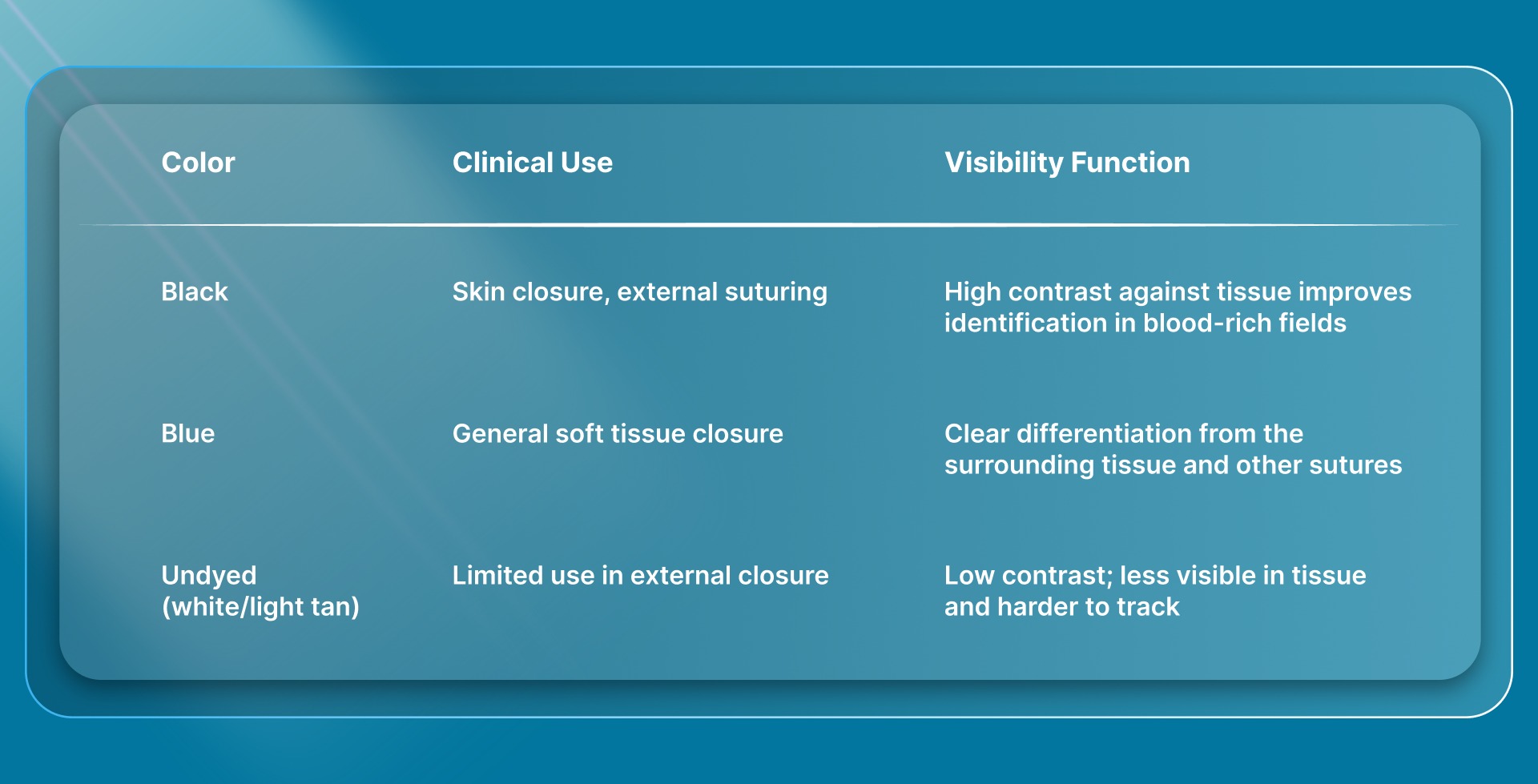
- Natural nylon: low visibility in tissue due to pale coloration
- Dyed nylon (black/blue): improves differentiation from tissue and blood during surgery
- Color function: purely visual, supporting operative precision rather than altering biological performance
Clinically, suture color is best understood as a visibility enhancement feature, used to support accurate surgical handling rather than to indicate material type or functional differences.
Nylon vs Other Suture Materials: Clinical Color Differences
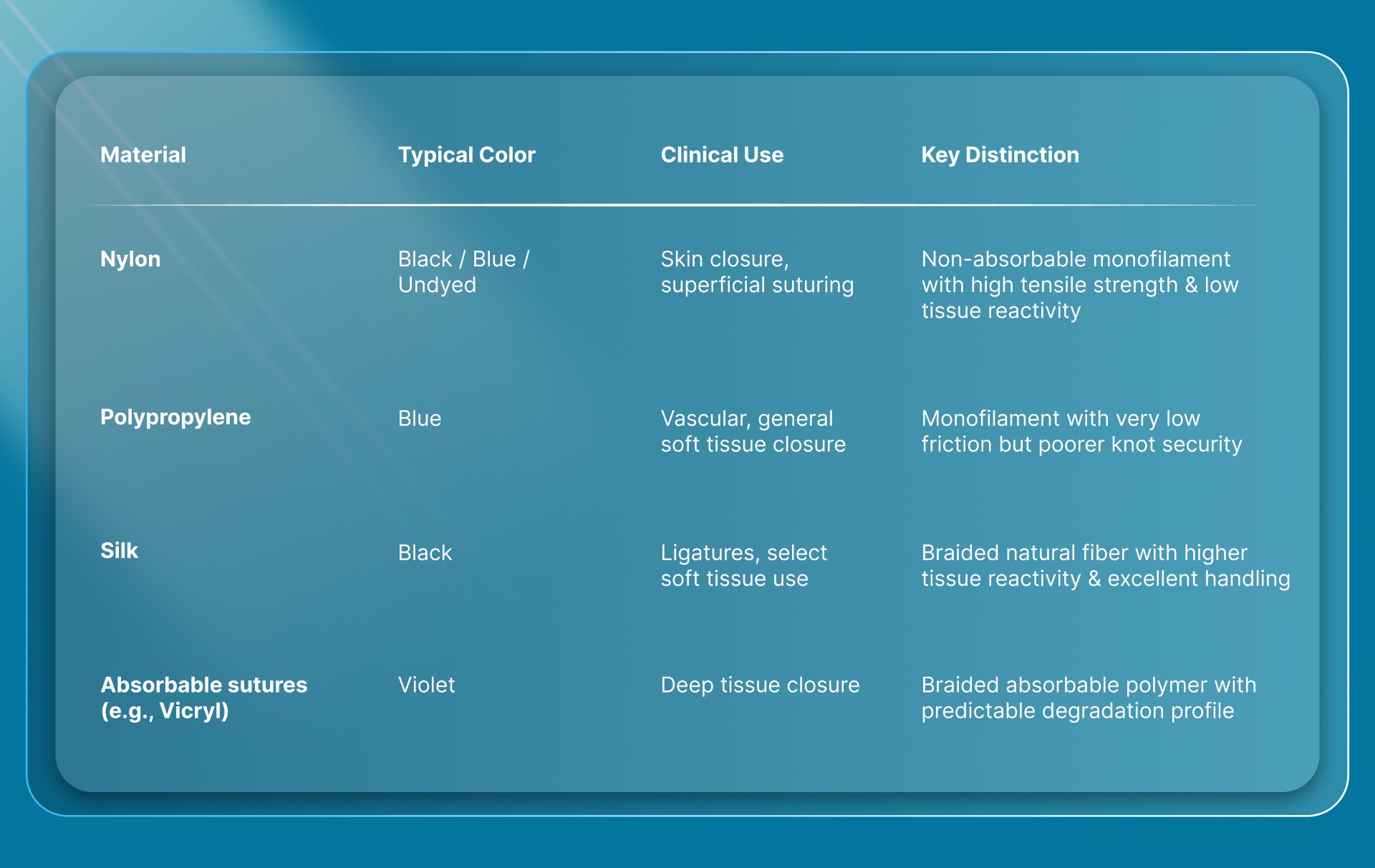
Different suture materials are manufactured in standardized colors primarily to support visual identification in surgical fields, especially where multiple material types are used in the same procedure. Nylon is typically used as a non-absorbable monofilament for skin closure, while other materials differ in structure, handling, and common color conventions.
Clinical comparison of commonly used sutures
Clinical interpretation
- Color differences are primarily used for intraoperative identification, not functional classification of absorbability or strength.
- Nylon’s black and blue variants are optimized for visibility in external closure, while absorbable sutures often use distinct colors (e.g., violet) to differentiate them from non-absorbable materials.
- Material behavior is determined by polymer structure (monofilament vs braided; absorbable vs non-absorbable), not color.
However, modern bioabsorbable closure systems like SubQ It! combine the speed advantages of mechanical closure with the absorption benefits of bioabsorbable materials. It also eliminates the need for suture removal while providing subcuticular wound support.
Standardization of Suture Size and the Role of Color Coding
Surgical sutures are standardized primarily through pharmacopeial systems such as the USP and European Pharmacopeia, which define uniform requirements for diameter ranges and tensile strength, ensuring consistent performance across manufacturers and regions.
However, color is not a pharmacopeial classification system and is not standardized by USP or EP. Instead, coloration is introduced during manufacturing using approved colorants, primarily to improve visual identification in surgical fields where tissue contrast is limited.
While size and mechanical properties are strictly regulated, color remains a manufacturer-controlled feature subject to regulatory approval of dyes rather than a standardized coding system.
Key distinctions:
- USP/EP standardizes: suture diameter ranges and tensile strength requirements
- USP/EP do NOT standardize: suture color coding systems
- Color function: improves visual differentiation during placement and removal
- Dye use: restricted to approved color additives regulated under FDA requirements
In clinical practice, this means sutures of identical size may appear in different colors depending on manufacturer conventions, while maintaining identical performance specifications defined by pharmacopeial standards.
Final Thoughts
Nylon suture color is primarily a practical feature used to improve visibility during placement, handling, and removal, rather than a marker of material performance. In clinical use, black, blue, and undyed variants are selected based on contrast with tissue and procedural needs.
USP and EP standards define structural properties such as diameter and tensile strength, while color remains a manufacturing feature used for visual identification. This distinction reinforces that nylon’s clinical behavior is governed by its material properties, not pigmentation.
In practice, understanding this separation supports more consistent and efficient surgical decision-making in wound closure.
For simplified skin closures workflows, SubQ It! offers subcuticular solutions designed to support controlled application and consistent surgical outcomes.
To learn more about how SubQ It! can support your surgical practice, connect with the SubQ It! team.
FAQs
1. What does the color of nylon sutures indicate?
Nylon suture color is primarily used to improve visual identification during surgical procedures, especially in tissue environments where natural contrast is limited. It does not indicate differences in mechanical performance or absorbability.
2. Are nylon suture colors standardized by USP or EP?
No. USP and EP standards define suture size and tensile strength, but they do not assign standardized color codes. Color is determined by manufacturers using approved medical dyes.
3. Why are nylon sutures commonly black or blue?
Black and blue are widely used because they provide high contrast against most skin tones and surgical fields, making sutures easier to identify during placement and removal.
4. Does suture color affect strength or performance?
No. The mechanical properties of nylon sutures, such as tensile strength and handling characteristics, are determined by the polymer structure, not by pigmentation.
5. Are undyed nylon sutures used in clinical practice?
Yes, but less frequently in external closures. Undyed or clear nylon has lower visibility in tissue, which can make identification more difficult in blood-rich or low-contrast environments.
6. Why do different manufacturers offer different suture colors?
Color variation occurs due to manufacturer-specific conventions and approved dye selection, rather than a universal coding system. Regulatory frameworks control dye safety, but not a fixed color standard.
7. Is nylon suture color important for surgical decision-making?
Yes, but only from a visibility and workflow perspective. Color helps improve handling efficiency and identification, but clinical decisions are based on size, location, and tissue requirements, not color alone.