Suture performance is often evaluated after closure, when mechanical stress, tissue response, and healing conditions begin to act on the material. What appears secure intraoperatively may not maintain the same stability over time.
Polyester is commonly used in high-tension fascial closures, but its behavior varies depending on construction and surface treatment. Braid structure, coating, and handling characteristics can influence knot security, tissue interaction, and bacterial wicking in different surgical settings.
As a result, selection is less about material alone and more about how it performs in a specific clinical context.
This blog explores how these factors affect performance and where polyester sutures are most appropriately used.
Key Takeaways
- Long-Term Strength: Polyester sutures maintain tensile strength indefinitely, ideal for slow-healing or high-tension soft tissues.
- Braided vs Monofilament: Braided sutures enhance handling and knot security; monofilaments reduce tissue drag and infection risk in superficial or contaminated closures.
- Coating Effects: Polybutylate, silicone, and PTFE coatings improve glide and knot run-down but may alter friction, requiring technique adjustments.
- Optimal Applications: Best for tendon, ligament, and deep fascial repair; less suitable for skin closure or highly contaminated areas.
- Context-Driven Choice: Suture performance depends on material, braid, and coating, making selection case-specific.
What Are Polyester Sutures?
Polyester sutures are synthetic, non-absorbable sutures made from polyethylene terephthalate (PET). They are used where sustained tissue support is required, as the material maintains tensile strength over time after implantation.
In clinical practice, polyester sutures are predominantly braided (multifilament) rather than monofilament, which influences how they are handled during suturing.
Braided vs Monofilament Sutures: Clinical Trade-offs
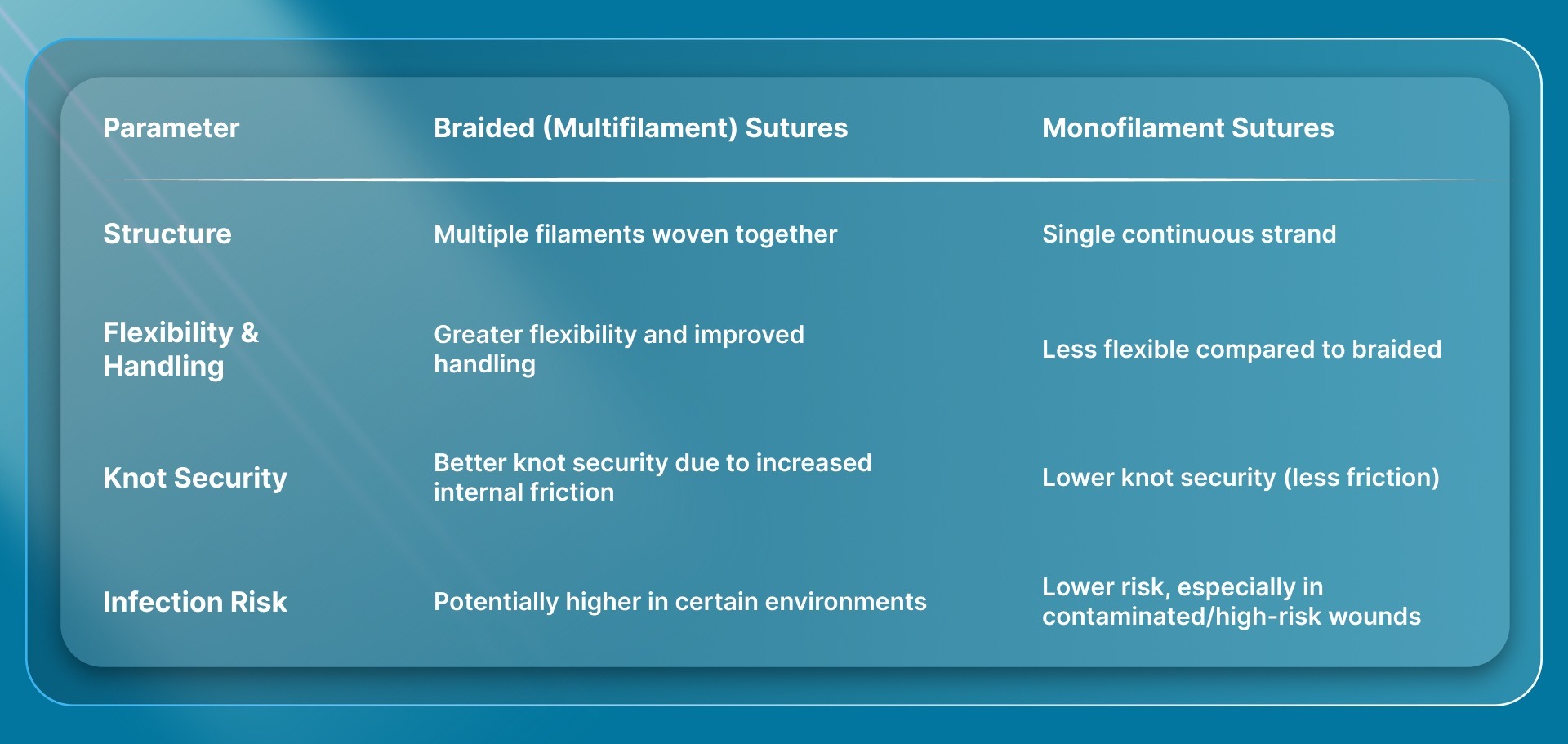
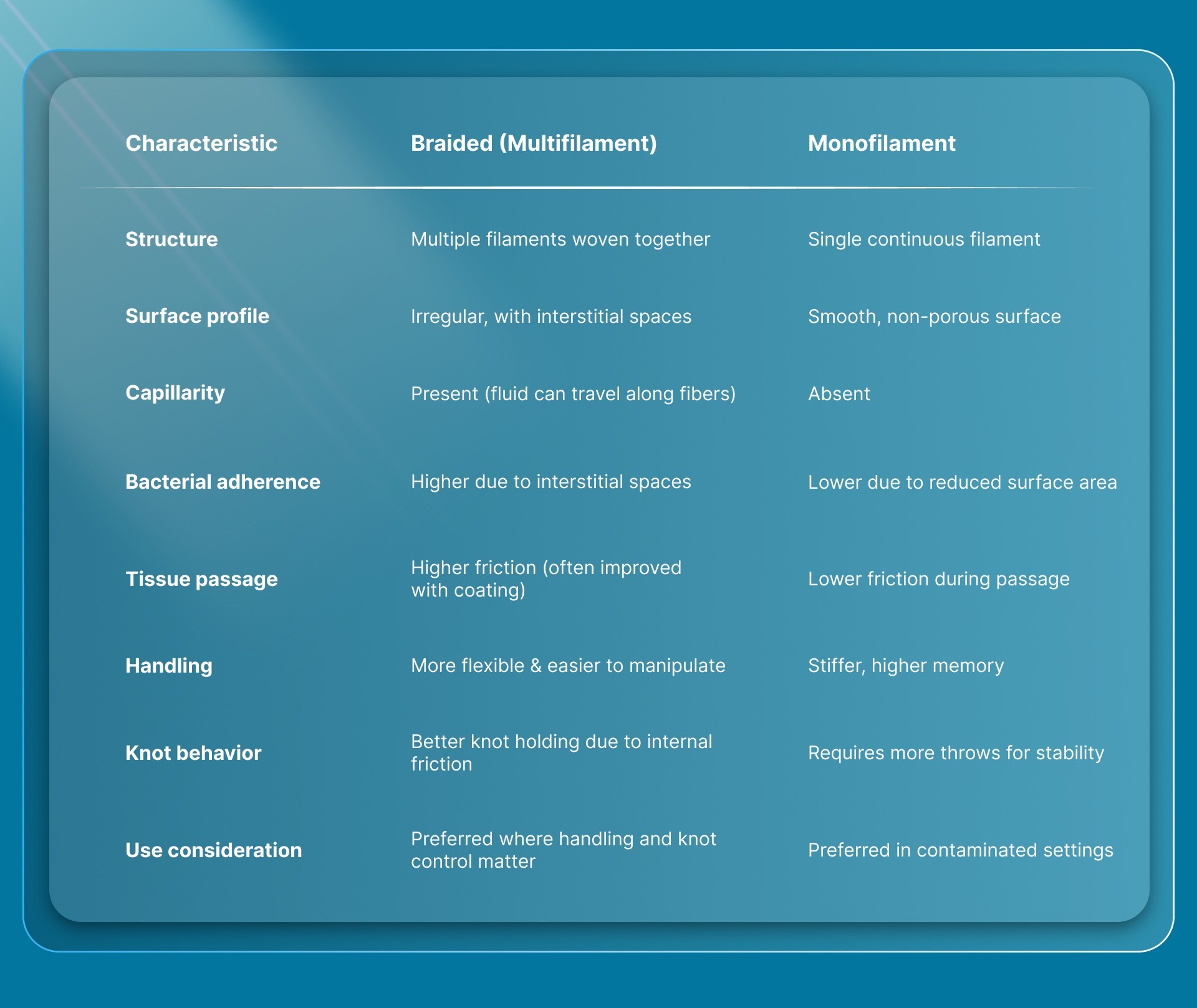
Filament structure shapes how a suture handles, moves through tissue, and performs in different clinical environments. Below is a detailed comparison on braided and monofilament sutures across these parameters.
1. Braided (Multifilament) Sutures
Braided sutures are composed of multiple filaments woven together, resulting in:
- Greater flexibility and improved handling
- Better knot security due to increased internal friction
- Closer conformity to tissue
However, the multifilament structure creates interstitial spaces between fibers, leading to capillarity. This can allow fluid movement along the suture and is associated with higher bacterial adherence in certain environments.
2. Monofilament Sutures
Monofilament sutures consist of a single continuous strand, which provides:
- A smooth surface with lower tissue drag
- No capillarity
- Reduced surface area for bacterial adherence
This structure is often associated with a lower risk of infection, particularly in contaminated or high-risk wounds.
Quick Comparison Table
How Coatings Modify Suture Friction and Performance?
Coatings are applied to braided polyester sutures to address their primary limitation: high coefficient of friction. These biocompatible surface treatments reduce tissue drag, improve passage through tissue planes, and enhance knot run-down properties.
Common Coating Types
Several coating materials are used to improve the handling characteristics of braided polyester sutures:
- Polybutylate coatings: Act as a lubricating polymer layer that reduces surface friction, enabling smoother passage through dense tissue and more controlled knot tightening
- Silicone coatings: Increase surface smoothness and flexibility, improving suture glide while supporting more consistent knot run-down during placement
- PTFE (polytetrafluoroethylene) coatings: Create a low-friction interface that minimizes resistance during tissue penetration, particularly in procedures requiring repeated suture passage
Impact on Knot Security
These coating benefits come with a trade-off. While reduced surface friction improves tissue passage, it can influence the frictional forces that contribute to knot stability.
However, knot security is multifactorial and not determined by coating alone. It depends on:
- Suture material and structure
- Knot configuration (e.g., square, surgeon’s)
- Suture gauge
- Throw count and technique
Evidence shows that throw requirements vary widely across materials and knot types. For commonly used configurations such as square and surgeon’s knots, knot security is typically achieved within a range of 3–5 throws, though some materials may require more depending on their frictional properties and clinical use.
As a result, there is no universally fixed number of throws for coated versus uncoated sutures. Surgeons must adjust their technique based on the specific suture material and procedural context.
Manufacturer-specific guidelines should always be followed to ensure optimal performance.
Note: While manual sutures remain widely used, they can introduce variability due to technique dependence. Bioabsorbable subcuticular closure systems, such as SubQ It!, are designed to standardize closure, improve consistency, and better align with real-world surgical workflows.
Top 4 Non-Absorbable Sutures: Polyester Performance vs Peers
Polyester sutures are valued for their mechanical stability and consistent performance in high-tension surgical environments. They offer distinct advantages across key performance parameters.
The table below compares polyester with other commonly used non-absorbable sutures, including nylon (polyamide), polypropylene, and silk:
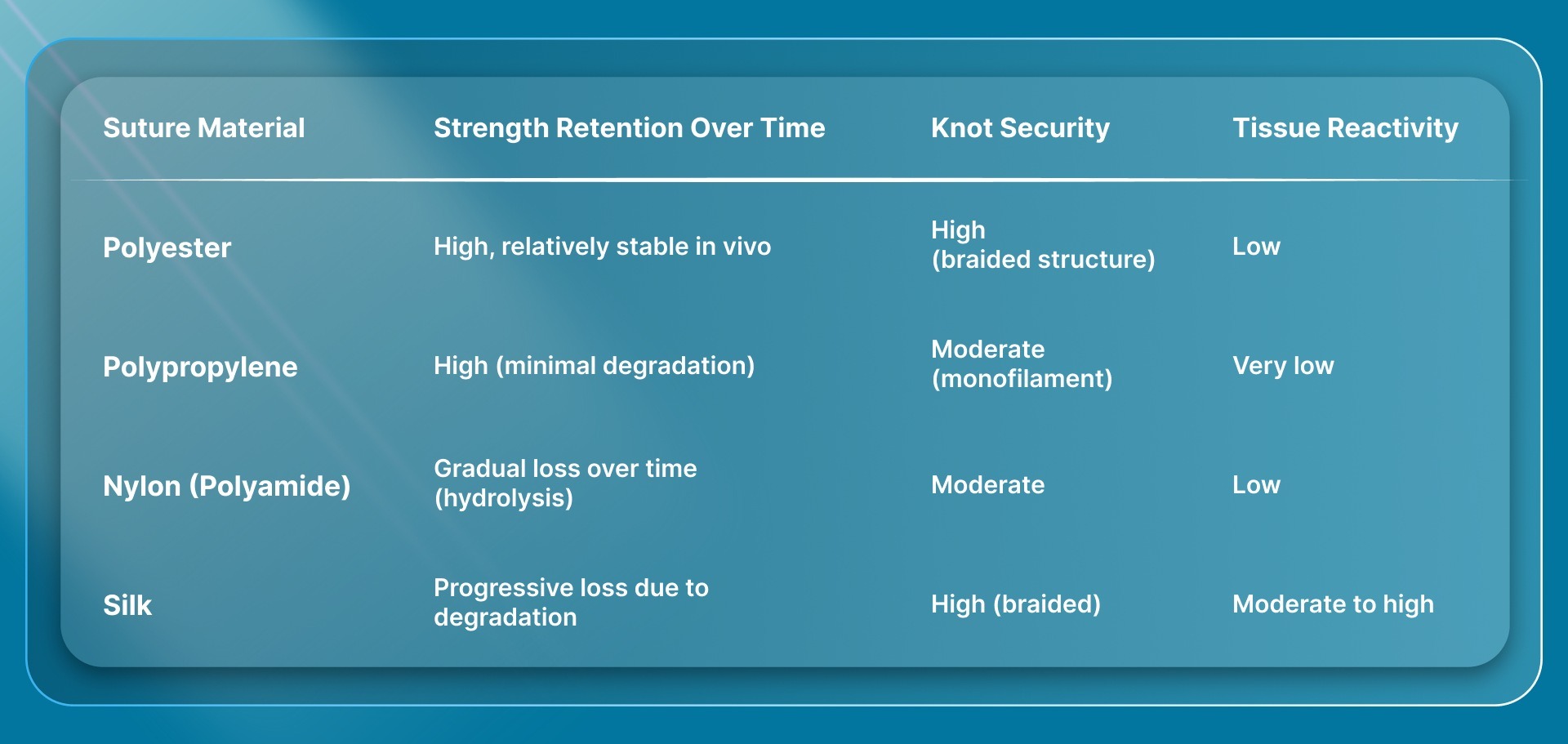
This combination positions polyester as a superior choice for applications requiring long-term mechanical support.
Where to Use Polyester Sutures for Long-Term Support?
Polyester sutures are principally indicated for supporting slow‑healing soft tissues rather than for all types of closure.
Slow‑Healing Soft Tissue Support
Polyester is most often selected where extended mechanical support is needed, particularly in tissues that heal slowly or are subject to prolonged stress. Typical use cases include:
- Tendon and ligament repair: polyester provides durable approximation in slow‑healing soft tissues.
- Deep soft tissue closures: tissues requiring prolonged support during remodeling.
- Support of slow‑healing tissues adjacent to joints, where tensile demands are higher.
Specialty‑Specific Considerations
Vascular Surgery and Anastomoses: In vascular repair and anastomosis, monofilament polypropylene is the preferred nonabsorbable material due to its low thrombogenicity and minimal reactivity. Polyester may be used for soft tissue approximation around vascular structures, but it is not the standard for anastomotic suturing.
General Soft Tissue and Fascia: Polyester sutures are used for general soft-tissue approximation when long‑term support is desirable, such as fascial closure or deep ligament reconstruction, because they retain little tensile strength over time.
Orthopedic Applications: Orthopedic soft tissues that benefit from high tensile strength, like tendons or ligament complexes, may use polyester sutures due to their durable mechanical load resistance.
Situations Where Polyester Is Less Appropriate
Polyester sutures are not suitable for the following:
- Not recommended in contaminated wounds: multifilament braided configuration can trap bacteria and delay clearance.
- Skin and superficial closures: monofilament sutures such as nylon or polypropylene are generally preferred for percutaneous and cutaneous use to reduce capillary occlusion and infection risk.
In highly thrombogenic environments (e.g., major vascular anastomoses), polyester is not the first choice due to its greater reactivity compared to polypropylene.
SubQ It!: Faster, Scarless Closure Redefining Surgical Skin Closure
Traditional metal staples require external placement, removal in 7–10 days, and often leave visible “railroad-track” scars. SubQ It! offers a patient- and practice-friendly alternative by combining bioabsorbable materials with subcuticular placement, eliminating the need for staple removal.
Key Features & Benefits:
- Bioabsorbable & Subcutaneous: Dissolves naturally as the incision heals; no follow-up removal required.
- Time-Saving Models:
- SubQ It 10: 10 staples, closes up to 10 cm, ideal for small and laparoscopic incisions.
- SubQ It 25: 25 staples, closes up to 25 cm, covering longer incisions and saving ~25 minutes of OR time per procedure.
- Versatile Closure: Vertical placement works across all incision lengths, including very small laparoscopic incisions.
- Practice Efficiency: Reduces return visits for staple removal, benefiting both patient satisfaction and surgical workflow.
- Cost Consideration: Device cost ~$60–$100 per use; time saved can generate significant revenue opportunities in high-volume practices.
Final Thoughts
Polyester sutures provide dependable strength and long-term support for slow-healing tissues, but their performance can vary depending on braid type, coating, and technique. Handling, knot configuration, and clinical context all influence outcomes, so material choice alone isn’t enough.
For consistent, predictable closure, especially in skin and superficial tissues, bioabsorbable subcuticular systems like SubQ It! offer a reliable alternative. They eliminate staple removal, reduce technique variability, and enhance patient recovery.
Maximize efficiency and surgical outcomes by choosing closure solutions that perform where it counts. Reach out to the SubQ It! team to see how your workflow can benefit.
Frequently Asked Questions
1. What distinguishes polyester sutures from other nonabsorbable suture materials?
Polyester sutures are braided multifilament, nonabsorbable materials made from synthetic polymers, offering tensile strength second only to metallic sutures and stable performance in slow‑healing tissues. They differ from monofilament materials (e.g., polypropylene) in structure, handling, and infection risk.
2. In which surgical applications are polyester sutures most commonly used?
Polyester sutures are typically used to support slow‑healing soft tissues, such as tendon or ligament repair and deep soft tissue approximation, because of their durable tensile strength and handling properties in high‑tension environments.
3. Why are polyester sutures not recommended in contaminated surgical fields?
Due to their braided multifilament structure, polyester sutures can trap bacteria within inter‑filament spaces, increasing the risk of infection and sinus tract formation if used in contaminated or infected wounds.
4. How does the braided structure of polyester sutures affect handling and performance?
The braided configuration enhances handling, flexibility, and knot security compared with monofilament designs, but it also increases tissue drag and bacterial capillarity, influencing site‑specific performance decisions.
5. Are polyester sutures suitable for cardiovascular anastomosis and vascular repairs?
Polyester can be used for soft tissue approximation near vascular structures, but monofilament polypropylene is often preferred for vascular anastomoses due to lower thrombogenicity and tissue reactivity.
6. What are the key physical properties of polyester sutures that clinicians should understand?
Polyester sutures exhibit high tensile strength with minimal loss over time, good knot security due to their braided construction, and moderate tissue reactivity, making them suitable for applications requiring long-term support.
7. How do multifilament polyester sutures compare to monofilament nonabsorbable sutures for skin closure?
Monofilament nonabsorbable sutures (like nylon or polypropylene) are often preferred for cutaneous and percutaneous closures because they have lower capillarity and reduced bacterial adherence compared to braided polyester, which is better reserved for deeper structural support.