
Suturing is routine in most procedures, yet small differences in spacing, depth, and tension can influence closure consistency and overall outcomes.
In the operating room, these variables are difficult to isolate because tissue characteristics and procedural conditions vary from case to case.
This limitation has increased reliance on structured practice tools, reflected in the suture simulation market projected to grow at a CAGR of 8.8% through 2034. In response, suture pads provide a controlled environment for repeated assessment under consistent conditions.
By reducing variability, they allow technique refinement before clinical application. In this blog, you’ll explore what suture pads are, which features matter, and how they fit into surgical practice.
Key Takeaways:
- Suture pads create a controlled environment to practice spacing, bite size, and tension without the variability of live tissue.
- Multi-layer, reinforced designs offer better depth control and durability for repeated, consistent evaluation of technique.
- Material behavior, including resistance and elasticity, determines how accurately closure performance can be assessed.
- Incorrect use, such as over-tightening or reusing the same area, distorts feedback and reduces training value.
- Suture pads support technique refinement but do not replicate biological response, healing, or real procedural conditions.
What Are Suture Pads & How Are They Used in Surgical Practice?
Suture pads are synthetic simulation tools that approximate layered soft tissue to practice and evaluate wound closure techniques outside the operating room. They allow consistent assessment of suture placement, spacing, and tension without relying on live cases.
The following sections outline how suture pads are constructed and how their design influences practical use.
Typical Construction of Suture Pads
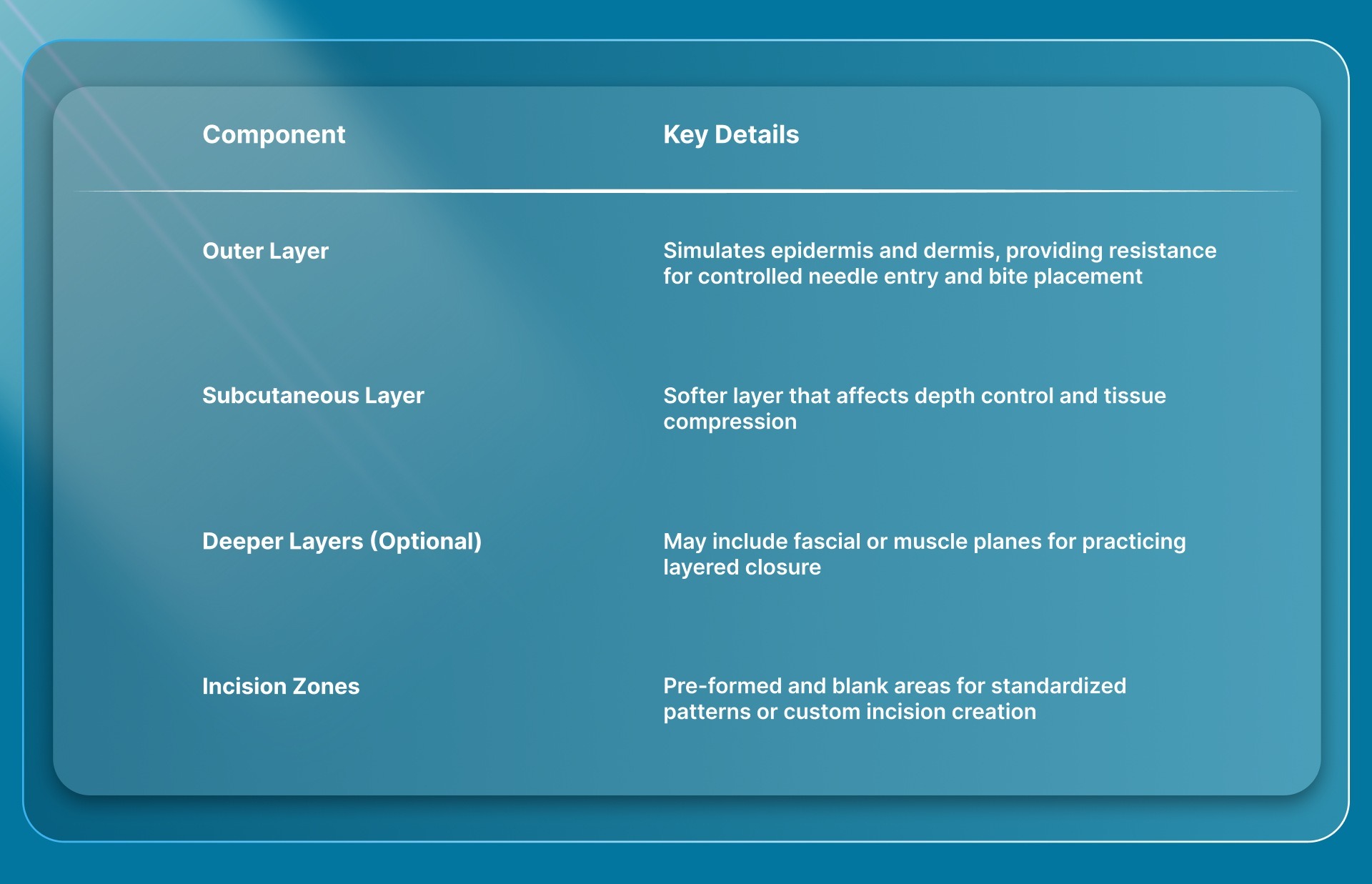
Most high-quality suture pads use a multi-layer structure to approximate the mechanical behavior of human tissue during needle passage and suture placement:
How Material Design Influences Practical Use?
Suture pads are made from synthetic materials such as silicone, foam, or composite polymers, selected to approximate tissue handling characteristics without biological variability.
Their primary value is the repeatable mechanical feedback they provide, enabling consistent evaluation of suture placement, spacing, and tension across multiple attempts under identical conditions.
However, translating that consistency into the operating room still depends on how closure is performed in live tissue.
Device-assisted systems such as SubQ It! SU-25 extends this consistency into practice by standardizing closure with bioabsorbable fasteners placed beneath the skin.
Once their role in surgical training is clear, it becomes easier to identify the features that matter most.
5 Key Features to Look For in Quality Suture Pads
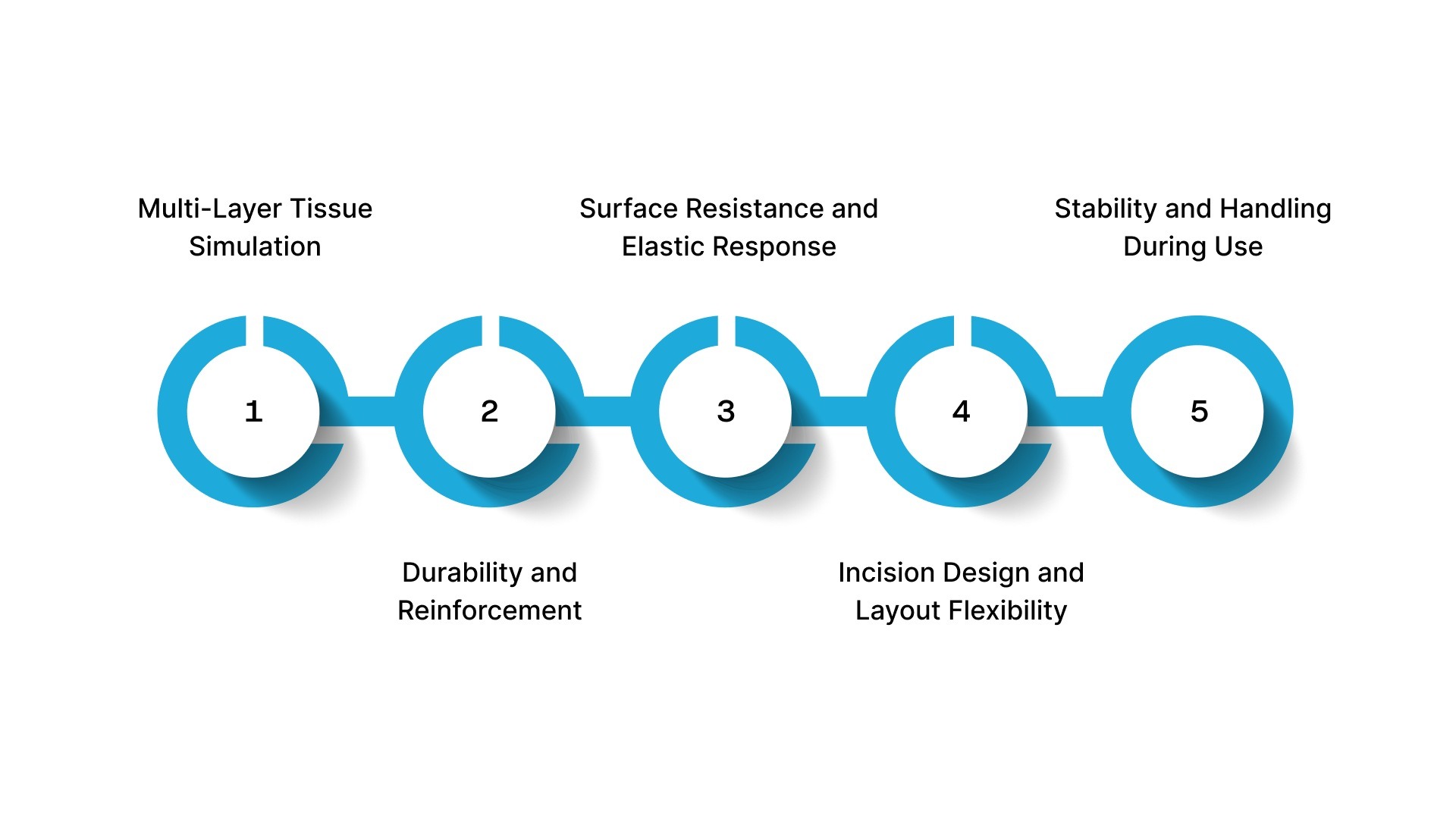
Not all suture pads offer the same level of mechanical response or durability, which directly affects their usefulness for evaluating closure technique.
The right selection depends on how well the pad approximates tissue behavior and how consistently it performs under repeated use.
Below are the features that determine whether a suture pad can support reliable technique assessment and meaningful practice.
1. Multi-Layer Tissue Simulation
High-quality suture pads use a multi-layer construction to approximate the behavior of different tissue planes during needle passage and suture placement.
Compared to single-layer designs, layered pads provide resistance variation and improve depth control.
Why layering matters:
- Depth control: Layered construction helps assess how deep sutures are placed across different closure types
- Tissue differentiation: Firmer outer layers and softer subcutaneous layers create variation in needle resistance across planes
- Consistent mechanical response: Enables repeatable evaluation of how the material responds to needle entry and suture tension
Single-layer pads provide limited variation in resistance and depth simulation, reducing their usefulness for practicing layered closures or techniques that require precise depth and tension.
2. Durability and Reinforcement
Durability determines how well suture pads maintain structural integrity under repeated needle passes and suture tension. Reinforced designs reduce tearing and allow multiple closures within the same area without rapid degradation.
Key durability factors:
- Internal reinforcement: Mesh or fiber reinforcement improves tear resistance and reduces material breakdown under tension
- Resistance to “cheese-wiring”: Non-reinforced pads may tear as sutures cut through the material, limiting usable lifespan
- Surface integrity over repeated use: Higher-quality pads maintain structure across multiple attempts, enabling consistent comparison
Typical durability trends (vary by design and use):
- Basic single-layer pads: limited reuse before noticeable degradation
- Reinforced multi-layer pads: support repeated use with proper spacing and handling
Reinforcement helps maintain consistent performance, especially when evaluating suture placement, spacing, and tension across multiple attempts.
3. Surface Resistance and Elastic Response
The surface layer of suture pads should provide consistent resistance during needle entry and recover its shape after manipulation.
This influences how accurately suture bites can be placed and how reliably tissue approximation can be assessed.
Why this matters:
- Needle entry control: Consistent resistance improves precision during initial penetration
- Elastic recovery: The material should return close to its original form after suturing to allow repeated use
- Tension behavior: Helps evaluate how closure responds under different levels of suture tension
Pads with poor elastic response may deform permanently, reducing consistency across repeated attempts.
4. Incision Design and Layout Flexibility
The design and distribution of incision zones affect how many closure scenarios can be practiced on a single pad. Pads with varied configurations allow broader evaluation without requiring multiple units.
Why this matters:
- Technique variation: Supports practice across different incision lengths and orientations
- Efficient surface use: Allows multiple closures without overlapping previously used areas
- Controlled comparison: Enables consistent evaluation of different techniques on similar incision patterns
Pads limited to a single incision type restrict the ability to test variation in closure approaches.
5. Stability and Handling During Use
The base structure of suture pads should remain stable during needle passage and suture tightening. Movement or instability affects precision and reduces the reliability of technique evaluation.
Why this matters:
- Consistent positioning: A stable pad prevents shifting during needle entry and knot tying
- Improved control: Supports accurate placement without compensating for movement
- Reproducibility: Ensures differences in outcomes are due to technique rather than pad movement
Pads that move or compress excessively during use introduce variability that can interfere with consistent evaluation.
Once you understand these key features, it also helps determine when to incorporate suture pads into practice.
When Should Suture Pads Be Used in Practice?
Suture pads are most useful when the closure technique needs to be evaluated or standardized without the variability of live tissue.
They provide a controlled setting to review consistency, refine placement, and compare techniques before use in live tissue.
Below are the scenarios that outline where suture pads add practical value without replacing real procedural experience.
1. Technique Refinement and Consistency
Suture pads allow repeated execution of the same closure technique under consistent conditions. This makes it easier to assess spacing, bite size, and tension without variability from different tissue types.
They are particularly useful when refining:
- Interrupted sutures
- Running closures
- Subcuticular techniques
2. Onboarding and Skill Alignment Within Teams
Suture pads can be used to align technique across teams, especially when integrating new staff or standardizing closure methods. They provide a consistent reference point for evaluating how different individuals approach the same closure.
This is useful for:
- Training new hires or junior team members
- Aligning closure preferences across multiple practitioners
- Reviewing the technique before introducing new closure approaches
3. Pre-Procedure Review of Closure Approach
In some cases, suture pads may be used to review or compare closure strategies in a controlled setting. This allows evaluation of different techniques or adjustments without impacting patient care.
Typical use cases include:
- Assessing suture spacing and tension strategies
- Comparing approaches for different incision lengths
- Testing handling with different suture materials
4. Controlled Evaluation Without Clinical Variability
Suture pads remove variables such as tissue quality, bleeding, and patient-specific factors, allowing isolated assessment of technique. This makes it easier to identify inconsistencies in placement, spacing, and tension.
As a result, they are useful for:
- Reviewing technique performance objectively
- Identifying patterns in suture placement errors
- Comparing outcomes across repeated attempts
Knowing when to use suture pads provides context for identifying the pitfalls that can affect training outcomes.
Common Mistakes When Using Suture Pads
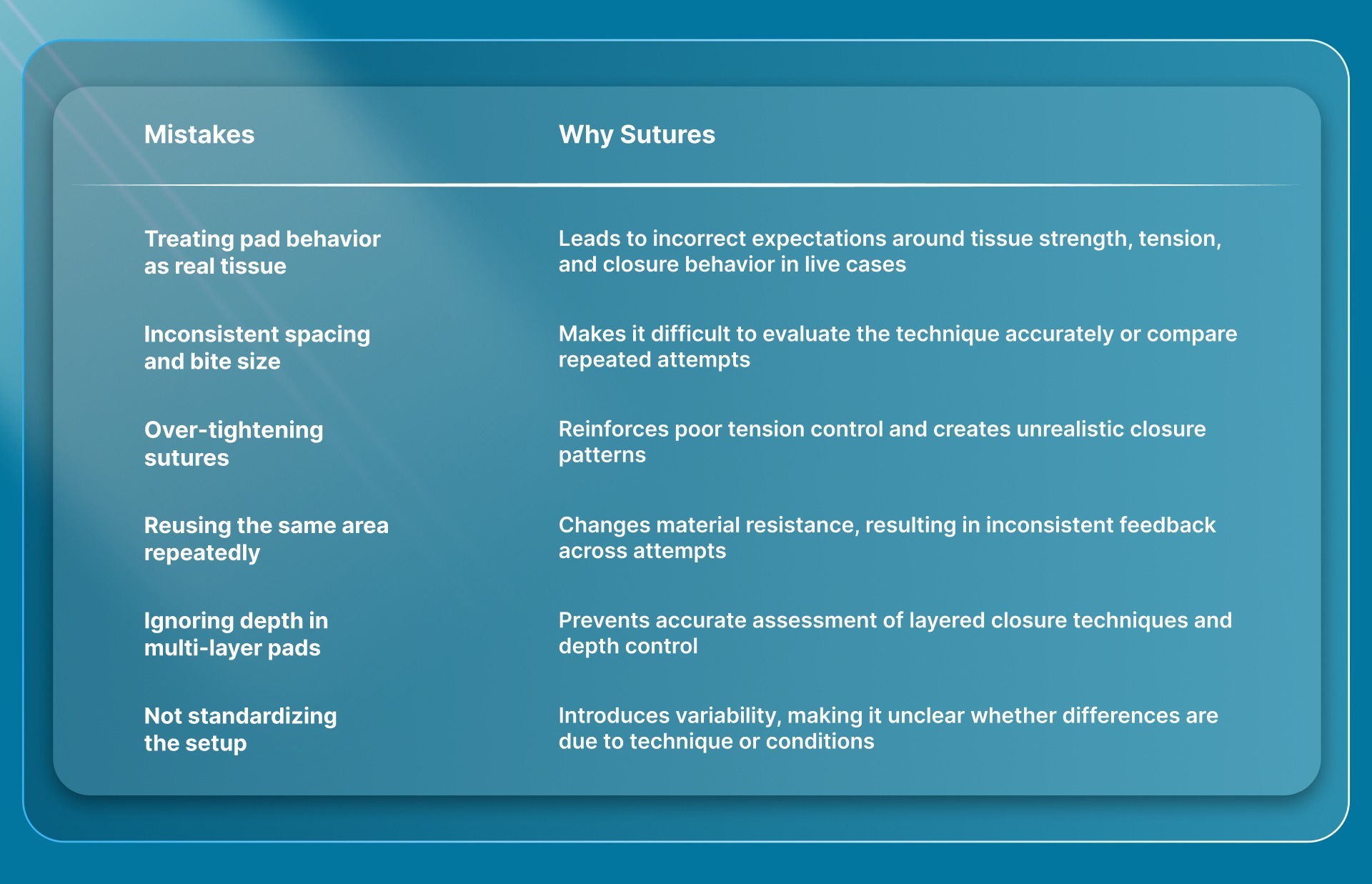
Suture pads provide a controlled environment for evaluating closure technique, but incorrect use can limit their effectiveness and lead to misleading conclusions.
Below are the mistakes commonly observed that can reduce the value of practice if not addressed.
While avoiding errors improves training quality, understanding the limitations of suture pads provides a more balanced perspective.
5 Key Limitations of Suture Pads
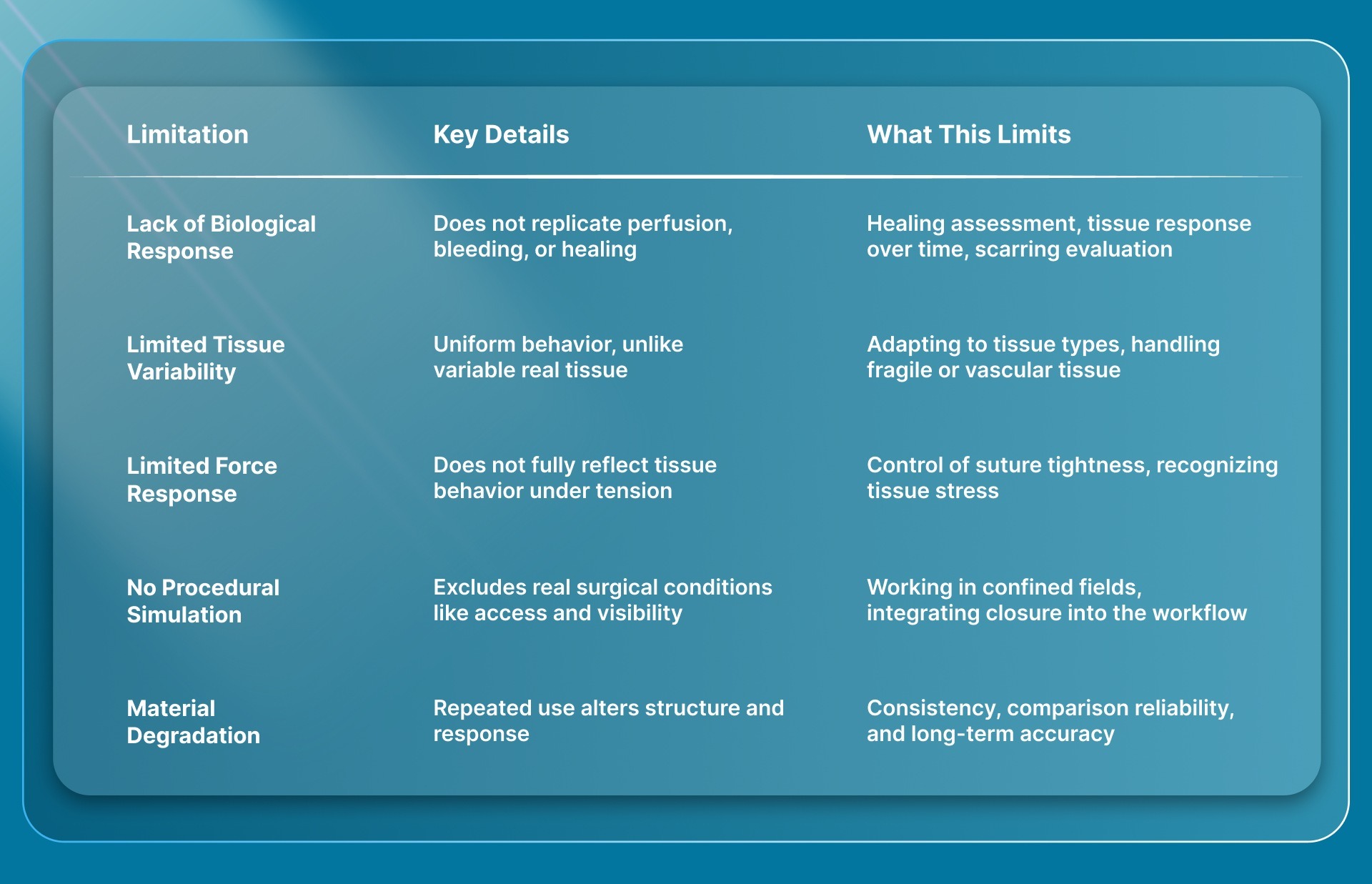
While suture pads are useful for controlled technique evaluation, they do not reproduce the full complexity of living tissue. Relying on them alone can leave gaps in how closure techniques perform under real clinical conditions.
Here are the key limitations of suture pads:
Final Thoughts
Consistency in suturing does not stop at practice. It carries into the operating room, where variations in technique can influence closure quality, workflow efficiency, and overall outcomes.
As the focus shifts from controlled evaluation to real-world execution, approaches that reduce variability during closure become increasingly relevant.
In this context, SubQ It! SU-25, with 25 bioabsorbable fasteners designed for incisions up to 25 cm, provides a device-assisted approach for longer surgical closures.
Using a handheld delivery system, it places fasteners beneath the skin surface, supporting consistent approximation without external staples.
Contact us today to learn how SubQ It! SU-25 can help achieve more consistent, efficient wound closure in your surgical workflow.
FAQs
1. How do suture pads help evaluate closure technique beyond basic practice?
Suture pads allow repeated execution of the same closure under consistent conditions, making it easier to assess spacing, bite size, and tension with reduced variability. This helps isolate technique-related issues that may not be obvious during live procedures.
2. Are suture pads useful once suturing techniques are already established?
Suture pads remain useful for maintaining consistency, reviewing technique, and identifying small variations that can affect the quality of closure. They also provide a controlled way to revisit less frequently used techniques without depending on case availability.
3. Can suture pads be used to compare different suturing techniques?
Suture pads provide a standardized setup where different approaches can be tested under identical conditions for clearer comparison. This makes it easier to evaluate differences in spacing, tension, and overall closure pattern without external variables.
4. Do suture pads accurately reflect how tissue behaves during closure?
Suture pads approximate mechanical resistance during needle passage and suture placement but do not replicate biological responses, such as perfusion, elasticity changes, or healing. As a result, they are best used for technique evaluation rather than predicting clinical outcomes.
5. How does repeated use affect the reliability of suture pads?
Repeated needle passes and tension can alter the material structure, changing how the pad responds over time. This can reduce consistency in feedback, making it important to manage spacing and avoid overusing the same area.
6. When do suture pads add the most value in practice?
Suture pads are most effective when used to evaluate technique in a controlled environment where variables can be minimized. This makes them useful for refining closure methods, maintaining consistency, and objectively comparing different approaches.