Skin closure may happen in the final minutes of a procedure, but it can influence what the patient sees long after the case is over. The suture or closure method a surgeon chooses affects wound-edge alignment, surface marking, removal needs, and closure time.
While the surgical sutures market is projected to reach USD 6.65 billion by 2030, surgeons now have more material options and closure technologies to evaluate.
For plastic, cosmetic, laparoscopic, and general surgeons, the best suture for skin closure depends on incision length, tissue tension, location, cosmetic goals, and follow-up workflow.
In this blog, you’ll explore the best sutures for skin closure surgeons should know in 2026, including absorbable, non-absorbable, and bioabsorbable subcutaneous closure options.
Key Takeaways:
- The best suture for skin closure depends on incision length, tissue tension, location, cosmetic goals, and follow-up needs.
- Absorbable sutures are commonly used for deeper support and subcuticular closure, while non-absorbable sutures are often used externally when longer support is needed.
- Monofilament sutures may be preferred for smoother tissue handling and reduced tissue reaction, while braided sutures can offer stronger handling and more secure knots.
- Closure technique matters as much as material choice, especially when scar appearance, wound-edge alignment, and surface marking are priorities.
- Surgeons should evaluate closure options based on procedural efficiency, removal workflow, patient comfort, and the demands of each incision type.
A Quick Overview of Sutures in Surgical Skin Closure
In surgical skin closure, the best suture choice depends on incision length, tissue tension, location, cosmetic goals, and follow-up needs.
For surgeons, closure affects more than wound approximation. It can also influence scar appearance, OR (Operating Room) efficiency, and patient experience.
Common closure considerations include:
- Tissue tension and wound depth
- Incision location and visibility
- Need for absorbable or non-absorbable support
- Risk of visible puncture marks or railroad-track scarring from external closure methods
- Time required for manual closure
- Need for a removal visit with non-absorbable external sutures or metal staples
In longer surgical closures, surgeons may also consider subcutaneous bioabsorbable systems such as SubQ It! SU-25 is used when procedural efficiency and reduced surface marking are priorities.
A brief overview of sutures also provides the necessary context to understand the differences between absorbable and non-absorbable options for skin closure.
Absorbable vs Non-Absorbable Sutures for Skin Closure: What’s the Difference?
Choosing between absorbable and non-absorbable sutures depends on incision tension, closure depth, cosmetic goals, and follow-up workflow.
Below are the key differences between absorbable sutures and nonabsorbable sutures for skin closure.
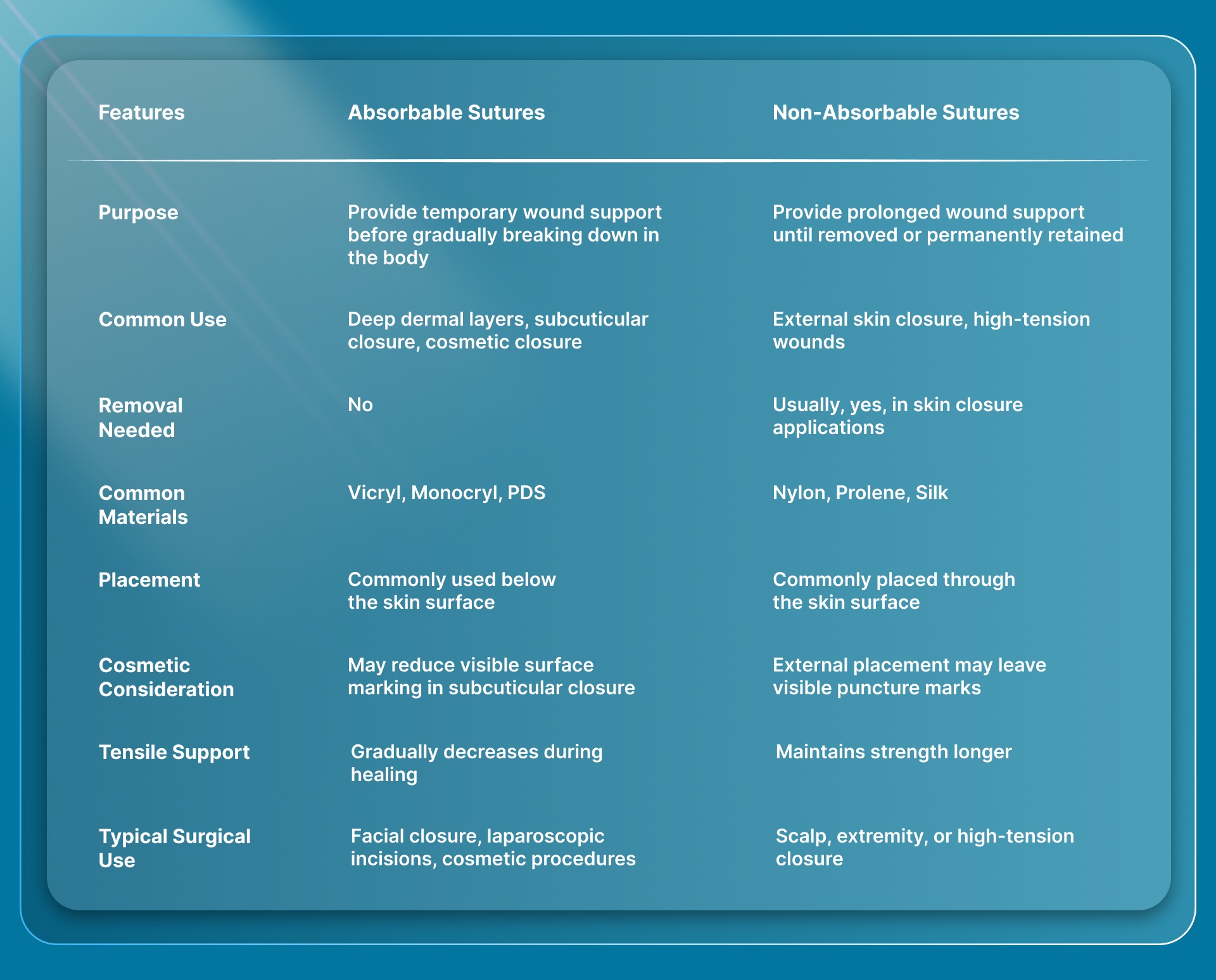
Understanding how absorbable and non-absorbable sutures differ also provides a practical basis for identifying the most suitable material types for skin closure.
5 Best Sutures for Skin Closure by Material Type
Different suture materials are used based on incision tension, healing timeline, cosmetic goals, and closure technique. For surgeons, material selection also affects handling, knot security, tissue response, and OR workflow.
1. Polyglactin 910 (Vicryl)
Vicryl is a braided absorbable suture commonly used for deep dermal support and soft tissue approximation. Surgeons often use it below the skin when layered closure helps reduce surface tension.
- Material type: Synthetic braided absorbable suture commonly used when surgeons need reliable soft-tissue support beneath the skin.
- Common use: Deep dermal closure and subcutaneous support, especially when layered closure helps reduce surface tension.
- Advantages: Good handling, secure knot tying, and predictable absorption during the early healing period.
- Common surgical use: General surgery, plastic surgery, and layered closure where deeper support is needed before surface approximation.
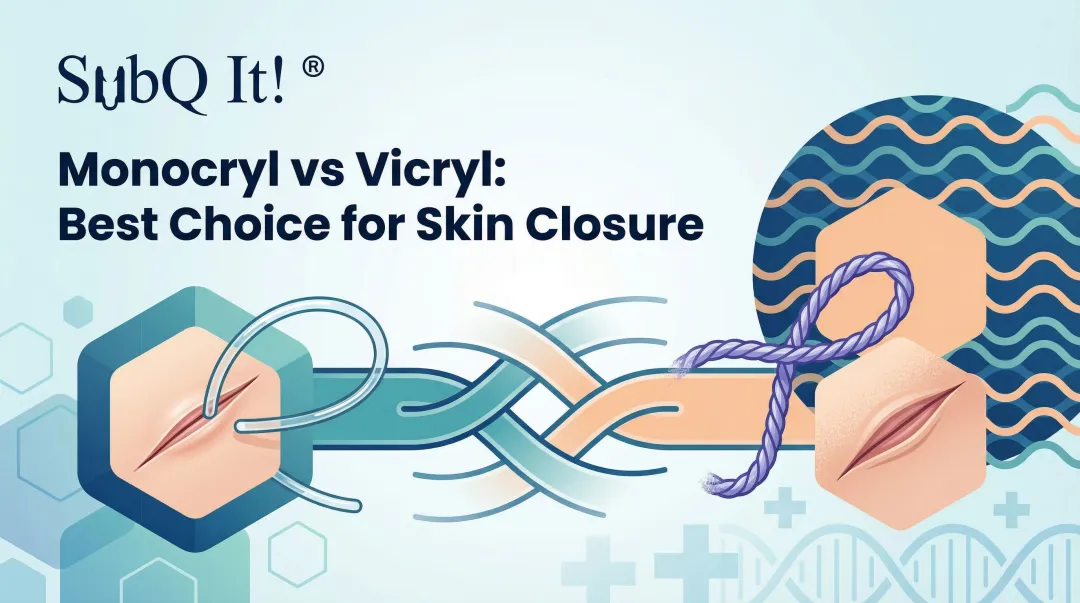
2. Poliglecaprone 25 (Monocryl)
Monocryl is a monofilament absorbable suture often used for subcuticular skin closure. It is commonly selected in cosmetic and facial procedures because it passes smoothly through tissue and produces a low tissue reaction.
- Material type: Synthetic monofilament absorbable suture used when surgeons want a smooth passage through tissue.
- Common use: Subcuticular skin closure, especially in areas where surface marking and patient comfort matter.
- Advantages: Smooth tissue passage, low tissue drag, and no routine removal visit when used in absorbable closure.
- Common surgical use: Plastic surgery, cosmetic procedures, facial closure, and selected low-tension surgical incisions.
3. Nylon
Nylon is a non-absorbable monofilament suture widely used for external skin closure. It provides dependable tensile support and is commonly used when surgeons plan suture removal after the initial healing phase.
- Material type: Synthetic monofilament non-absorbable suture used for external skin approximation.
- Common use: Surface skin closure when surgeons want controlled wound-edge alignment and removable support.
- Advantages: Strong tensile support, low tissue reaction, and broad use across multiple anatomic sites.
- Consideration: Usually requires removal, so timing matters to reduce visible puncture marks or track marks.
- Common surgical use: General surgery, facial repair, scalp closure, and extremity closure where external support is appropriate.
4. Polypropylene (Prolene)
Polypropylene is a non-absorbable monofilament suture known for low tissue reactivity and smooth tissue passage. Plastic and cosmetic surgeons may use it for running subcuticular closure or fine external repairs.
- Material type: Synthetic monofilament non-absorbable suture used when low tissue reaction is a priority.
- Common use: Running subcuticular closure, fine skin closure, and procedures where a smooth pull-through matters.
- Advantages: Smooth gliding through tissue, low tissue reactivity, and blue color improve visibility during placement and removal.
- Consideration: It usually requires removal when used for skin closure, unless placed for a specific retained-support purpose.
- Common surgical uses: Plastic surgery, cosmetic closure, vascular procedures, and fine skin repairs.
5. Bioabsorbable Subcutaneous Closure Systems
Some surgeons may also consider bioabsorbable subcutaneous closure systems when they want internal closure support without external metal staples or removal visits.
These systems place bioabsorbable fasteners beneath the skin instead of using visible external staples.
- Material type: Bioabsorbable subcutaneous fastener system designed to support closure from beneath the skin.
- Common use: Surgical incisions where surgeons want internal support, reduced surface marking, and efficient closure.
- Advantages: No external metal staple removal, reduced visible surface marking compared with external staples, and potential procedural efficiency benefits.
- Common surgical use: Laparoscopic incisions, plastic surgery procedures, cosmetic closures, and longer surgical incisions, depending on device size.
Reviewing the most commonly used suture materials also provides useful context for understanding how surgeons determine the best option for skin closure in specific cases.
How Surgeons Choose the Best Suture for Skin Closure?
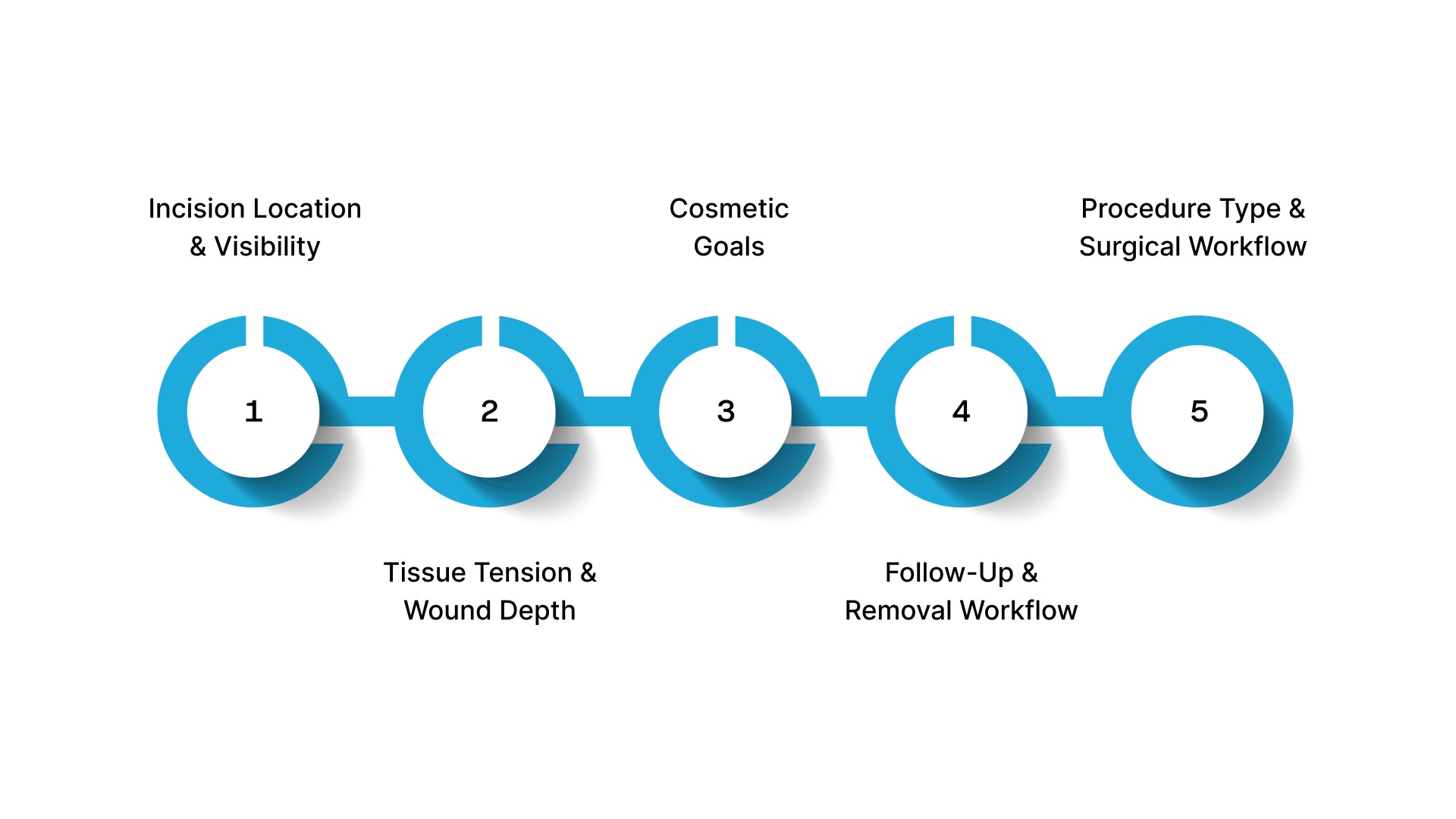
Surgeons evaluate incision characteristics, tissue tension, cosmetic goals, healing timeline, and procedural workflow before selecting a closure method.
For plastic, cosmetic, laparoscopic, and general surgeons, closure decisions can directly affect scar appearance, patient experience, and OR efficiency.
Below are factors commonly influencing the selection of materials and techniques.
1. Incision Location and Visibility
Highly visible areas often require finer closure techniques and lower-profile materials to reduce visible marking after healing.
Common considerations include:
- Facial and cosmetic procedures often use finer monofilament or subcuticular closure techniques.
- Scalp and extremity closures may require stronger external support.
- Larger surgical incisions may need layered closure to reduce surface tension.
2. Tissue Tension and Wound Depth
High-tension wounds usually require stronger support and deeper approximation before surface closure.
Surgeons may consider:
- Deep dermal absorbable sutures for tension reduction
- Layered closure for larger surgical incisions
- Non-absorbable external sutures are used when prolonged support is needed
- Subcuticular closure techniques for lower-tension cosmetic repairs
3. Cosmetic Goals
Cosmetic outcome is often a major consideration in plastic surgery, facial closure, and minimally invasive procedures.
Surgeons commonly evaluate:
- Risk of visible puncture marks
- Potential for railroad-track scarring from external staples
- Surface tension across the incision
- Whether closure materials remain beneath the skin surface
For cosmetically sensitive procedures, absorbable subcuticular closure may help reduce visible surface marking compared with external closure methods.
4. Follow-Up and Removal Workflow
Closure choice can also affect post-operative workflow for both the patient and the practice.
Important considerations include:
- Whether the patient will require a return visit for removal
- Time required for manual skin closure
- Patient comfort during recovery
- Procedural efficiency in high-volume surgical settings
In some procedures, surgeons may also consider bioabsorbable subcutaneous closure systems when they want internal support without external metal staples or the need for removal visits.
5. Procedure Type and Surgical Workflow
Different procedures may require different priorities for closure depending on incision size, tension, and OR workflow demands.
For example:
- Laparoscopic incisions may prioritize efficient closure with minimal surface marking.
- Plastic surgery procedures may prioritize cosmetic appearance and fine wound-edge alignment.
- Longer surgical incisions may require layered support and tension distribution across the closure line.
Because no single material fits every scenario, surgeons often combine closure techniques and materials based on procedural needs rather than relying on one standard approach.
Final Thoughts
Skin closure decisions extend beyond material choice. They affect closure consistency, follow-up workload, visible surface marking, and the efficiency with which each case moves toward completion.
As surgeons compare sutures, external staples, and newer closure options, the goal is often to balance control, cosmetic priorities, and OR efficiency.
In this context, SubQ It! SU-25 offers 25 bioabsorbable staples for incisions up to 25 cm, supporting longer closures in open surgery and plastic surgery procedures while saving approximately 25 minutes per case.
Reach out to us to learn how SubQ It! SU-25 can fit into your current closure workflow.
FAQs
1. What is the best suture for skin closure?
The best suture depends on incision location, tissue tension, cosmetic goals, and closure technique. Monofilament sutures such as Monocryl or nylon are commonly used in cosmetic and facial closure, while Vicryl is often used for deep dermal support in layered surgical closure.
2. Is Monocryl better than Vicryl for skin closure?
Monocryl and Vicryl serve different purposes in surgical skin closure. Monocryl is commonly used for subcuticular closure because of its smooth tissue passage and low tissue reactivity, while Vicryl is often selected for deep dermal closure where layered support and knot security are needed.
3. How long does it take for absorbable sutures to absorb?
Absorption time varies by material. Fast-absorbing gut may dissolve within approximately 5–7 days, while Vicryl typically absorbs in about 56–70 days and Monocryl in about 91–119 days. PDS provides longer support and may take up to 180 days or longer to fully absorb.
4. Which suture is thicker, 3-0 or 4-0?
3-0 suture is thicker and stronger than 4-0. In the USP sizing system, smaller numbers indicate larger diameter sutures, so 3-0 is larger than 4-0 and 5-0.
5. What are the main types of sutures used for skin closure?
The main categories include absorbable synthetic sutures, absorbable natural sutures, non-absorbable synthetic sutures, and non-absorbable natural sutures. Surgeons may also consider bioabsorbable subcutaneous closure systems as an alternative to conventional external closure methods in selected procedures.
6. What closure technique helps reduce visible scarring?
Subcuticular closure places sutures beneath the skin surface rather than across the external skin. This technique may help reduce visible puncture marks compared with external closure methods, especially in cosmetic and facial procedures. However, all surgical incisions heal with some degree of scarring.