
Closing an incision with sutures can take longer than staples. In a busy OR, that adds up fast across a full day of cases.
Speed is the main reason surgeons still reach for metal staples. In port-site closures, staples are nearly 3 times faster than sutures. The trade-off is scarring, patient discomfort, and a required removal visit.
This post breaks down surgical metal clips in detail, including their uses, their limits, and the closure methods that now offer similar speed without the same downsides.
Key Takeaways
- Surgical metal clips include skin closure staples, ligating clips for blood vessels, and hemostatic clips for bleeding control during surgery.
- Staple-related adverse events occur at roughly 7.3% across surgical specialties, nearly double the 3.5% rate seen with sutures.
- Every set of metal skin staples requires a removal visit 7 to 10 days after surgery, adding scheduling and staffing costs to the practice.
- Bioabsorbable subcutaneous closure systems deliver faster speed without the need for removal, external puncture marks, or railroad-track scarring.
- For private practices, switching from metal staples to faster bioabsorbable systems can recover OR time that directly translates into additional patient capacity and revenue.
What Are Surgical Metal Clips?
Surgical metal clips are small metal fasteners used during surgery to close skin incisions, clamp blood vessels, or control bleeding. They're made from stainless steel or titanium and come in single-use, pre-loaded devices that fire one clip at a time.
The most familiar type is the skin closure staple. A surgeon positions the skin stapler over the wound edges, squeezes the handle, and a metal staple bends into a rectangular shape to hold the skin together. The process takes seconds per staple, which is why surgeons rely on them when speed matters.
Metal clips also serve internal purposes. During a laparoscopic cholecystectomy (gallbladder removal), for example, a surgeon places ligating clips on the cystic duct and artery before cutting. These clips stay inside the body permanently. On the skin side, the same case may be closed with metal staples that need to come out 7 to 10 days later.
What Are the Common Types of Surgical Metal Clips?
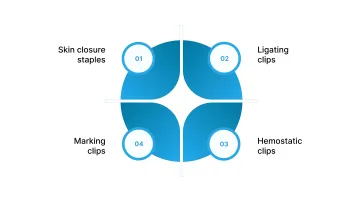
The type of surgical metal clip to choose depends on whether the goal is to close skin, seal a blood vessel, or control bleeding inside the body.
- Skin closure staples: U-shaped metal fasteners placed on the outer skin surface to hold wound edges together. They're the fastest way to close a skin incision. They require removal in a follow-up visit.
- Ligating clips: Small clips are applied to blood vessels or ducts during surgery to stop blood flow before cutting. They stay inside the body permanently. Titanium versions are the most common.
- Hemostatic clips: Similar to ligating clips but used specifically to control active bleeding during a procedure. They're placed on small vessels or tissue that can't be cauterized safely.
- Marking clips: Tiny clips are placed at a biopsy or tumor site to help locate the area on future imaging. Radiologists and surgeons use them as reference points for follow-up scans or additional procedures.
The category that affects patients the most after surgery is skin closure staples. Those are the ones responsible for scarring, removal visits, and cosmetic complaints.
What Are the Main Drawbacks of Surgical Metal Clips for Skin Closure?
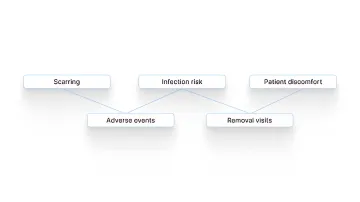
Metal skin staples are fast, but they come with trade-offs that affect both the patient and the practice. The evidence on scarring, adverse events, and follow-up costs has grown considerably in recent years.
- Scarring: A randomized controlled trial (RCT) found that metallic staples produced significantly thicker scars and wider scars compared with subcuticular sutures. At one year, staple patients were more likely to have raised, palpable scars.
- Adverse events: A systematic review of 42 RCTs covering 11,067 patients found staple-related adverse events at 7.3% versus 3.5% for sutures. That's roughly double the rate.
- Infection risk: In a multi-institutional analysis of 18,268 lower extremity bypass procedures, staples were linked to 57% increased chance of surgical site infection (SSI).
- Removal visits: Every patient closed with metal staples needs to return 7 to 10 days later for removal. That visit takes staff time, scheduling capacity, and room availability.
- Patient discomfort: Staple removal is uncomfortable. Patients describe it as painful, and many feel anxious about the process. That anxiety can affect satisfaction scores and referral likelihood.
The financial side matters too. SSIs after orthopedic procedures are associated with significantly longer hospital stays, ranging from 1.73 to 6.27 additional days, depending on the surgery type, plus higher readmission rates and 12-month costs.
Any reduction in SSI risk, even a small one, can translate into real savings for a practice or hospital system. That's why closure method selection is worth a closer look.
How Do Surgical Metal Clips Compare to Other Closure Methods?
Metal staples are fast. Sutures give better cosmetic results. Adhesive strips are gentle but weak. Each method has a clear strength and an equally clear limitation.
| Feature | Metal Staples | Sutures (Subcuticular) | Adhesive Strips | Bioabsorbable Fasteners |
|---|---|---|---|---|
| Speed | Fastest (faster than sutures) | Slowest | Fast | Fast (7x faster than sutures) |
| Scarring Risk | High (railroad-track marks) | Low | Low | Low (no external puncture) |
| Removal Needed | Yes (7-10 days post-op) | Depends on suture type | No | No (absorbed by the body) |
| Patient Comfort | Low (removal is uncomfortable) | Moderate | High | High |
| Incision Size Range | Short to long | Short to long | Short only | Short to long (up to 25 cm) |
| Infection Considerations | Higher adverse event rate in studies | Lower adverse event rate in studies | Limited data | Comparable to sutures in available data |
Each method fits certain clinical scenarios better than others. The real decision depends on incision length, patient expectations, and how much follow-up time the practice can absorb.
Speed vs. Cosmetic Outcome
This is one of the main trade-offs in wound closure. In a study of laparoscopic cholecystectomy port-site wounds, staples closed the skin significantly faster than sutures.
The time savings are real. In a midline laparotomy comparison, staples were significantly faster with comparable wound outcomes, making them a reasonable choice when total surgery time is a concern, especially in high-risk patients.
The cosmetic cost is also real. Stapled wounds produce thicker, wider, and more palpable scars at one year. For suture-based closures, patients more often reported that their scar matched their surrounding skin color.
The Removal Factor
Metal staples always need to come out. That means every stapled patient requires a follow-up visit within 7 to 10 days. For a high-volume practice, those visits add up in terms of scheduling, room availability, and staff time.
Compare that to absorbable sutures or bioabsorbable fasteners, where the closure material dissolves on its own.
The study on subcuticular sutures in non-obstetric surgery, covering 66 RCTs and 7,487 participants, found that subcuticular sutures probably reduce wound complications compared to staples and likely improve patient satisfaction.
Where Bioabsorbable Fasteners Fit
Bioabsorbable fasteners sit in a category that didn't exist for most surgeons until recently. They're placed subcutaneously (under the skin), never piercing the outer surface. They dissolve naturally after the incision has healed.

SubQ It! is a bioabsorbable skin closure system that delivers the speed of a metal stapler, 7 times faster than sutures, without any of the drawbacks tied to metal on the skin. The fasteners go under the skin, hold the wound edges together, and are absorbed by the body once healing is complete. They don’t require a removal visit and don’t leave any external puncture marks.
For surgeons who want speed without the scarring and removal trade-offs, this is the category worth evaluating.
When Should You Use Surgical Metal Clips?
For certain applications inside the body, they remain the right tool. Alternative options are worth it primarily for skin closure, not internal ligation. Here’s when surgical metal clips make sense:
- Vessel ligation: Titanium ligating clips are the standard for clamping blood vessels and ducts during laparoscopic and open procedures. There's no practical skin-closure alternative for this function because it's a completely separate application.
- Tissue marking: Small metal clips placed at biopsy or resection sites serve as permanent imaging markers. Radiologists depend on them to locate areas of concern on follow-up scans.
- Emergency settings: When speed is the only priority and cosmetic outcome is secondary, metal skin staples remain a practical choice. Trauma closures often fall into this category.
However, one consideration that applies to all permanent metal clips is migration. A 2024 literature review identified 68 cases of cholecystectomy clip migration into the bile duct, with symptoms appearing anywhere from 2 months to 30 years after the original surgery.
What Should Surgeons Consider When Choosing a Closure Method?

The right closure method depends on the procedure, the patient, and the practice. There's no single answer, but there are clear factors that should shape the decision.
- Incision length: For small laparoscopic incisions, metal staples are often more closure than the wound needs. Bioabsorbable fasteners and adhesive strips both work well for short incisions without requiring removal.
- Patient expectations: Cosmetic-sensitive cases, including plastic surgery, pediatric surgery, and any visible incision site, benefit from a method that avoids external puncture marks. Patients in these groups are more likely to notice and complain about staple scars.
- Practice setting: Private clinic owners feel the financial impact of OR time directly. The SubQ It! SU-25 saves approximately 25 minutes per case compared to manual suturing. In a private practice, that can mean fitting one more patient per day at roughly $6,000 in additional revenue, while the device costs approximately $60 to $100 per use.
High-volume practices see the biggest cumulative effect. Saving even 5 to 10 minutes per case across 8 to 10 cases a day can make a significant difference. For practices that are still defaulting to metal skin staples for every case, it's worth asking whether that default still makes sense.
Final Thoughts
Surgical metal clips have earned their place in the OR for internal ligation, tissue marking, and emergency skin closure. For routine skin closure, though, the evidence shows that metal staples carry higher scarring rates, higher adverse event rates, and the ongoing cost of removal visits. Those are trade-offs, not inevitabilities.
The practical next step is to evaluate which cases in your current caseload could benefit from a closure method that's fast, leaves no external marks, and requires no follow-up removal. Laparoscopic incisions, cosmetic cases, and any patient population that cares about scarring are a good starting point.
SubQ It! gives surgeons the speed of a metal stapler with bioabsorbable fasteners that go under the skin and dissolve on their own. No railroad-track scars. No removal visit. No compromise on closure time. Every week a practice continues defaulting to metal skin staples is a week of avoidable scarring complaints, unnecessary follow-up visits, and recoverable OR time. Contact us today to request a custom quote.
FAQs
1. Do Surgical Metal Clips Set Off Metal Detectors?
No, most surgical metal clips don't trigger standard metal detectors. Titanium clips produce very little magnetic signal, and the small size of surgical staples typically falls below detection thresholds at airports and security checkpoints.
2. How Long Do Surgical Metal Clips Stay in the Body?
Yes, internal surgical clips like ligating clips are designed to stay in the body permanently. Skin closure staples, on the other hand, are temporary and must be removed by a clinician within 7 to 10 days after surgery.
3. Can Surgical Metal Clips Cause Pain After Surgery?
Yes, skin closure staples can cause discomfort at the incision site, especially when clothing or bandages press against them. Internal clips are usually painless, though in rare cases, clip migration can cause abdominal pain or other symptoms years after the original surgery.
4. What Materials Are Surgical Metal Clips Made From?
Surgical clips are typically made from titanium or stainless steel. Titanium is preferred for internal clips because it's lighter, causes fewer MRI artifacts, and produces minimal tissue reaction over time.
5. How Are Surgical Metal Clips Removed From Skin?
A clinician uses a specialized staple remover tool that bends the middle of each staple upward, releasing the prongs from the skin. The process is done one staple at a time during a follow-up visit, usually a few days after surgery.
6. Are There Non-Metal Alternatives to Surgical Clips for Skin Closure?
Yes, several non-metal options exist for skin closure. These include absorbable sutures, adhesive skin closure strips, tissue adhesives (surgical glue), and bioabsorbable subcutaneous fastener systems. Each option avoids the need for metal on the skin and the follow-up removal visit that metal staples require.